
Author: Dr. Dawit Tesfay
Post-War Military, Security & Transitional Justice Affairs Researcher
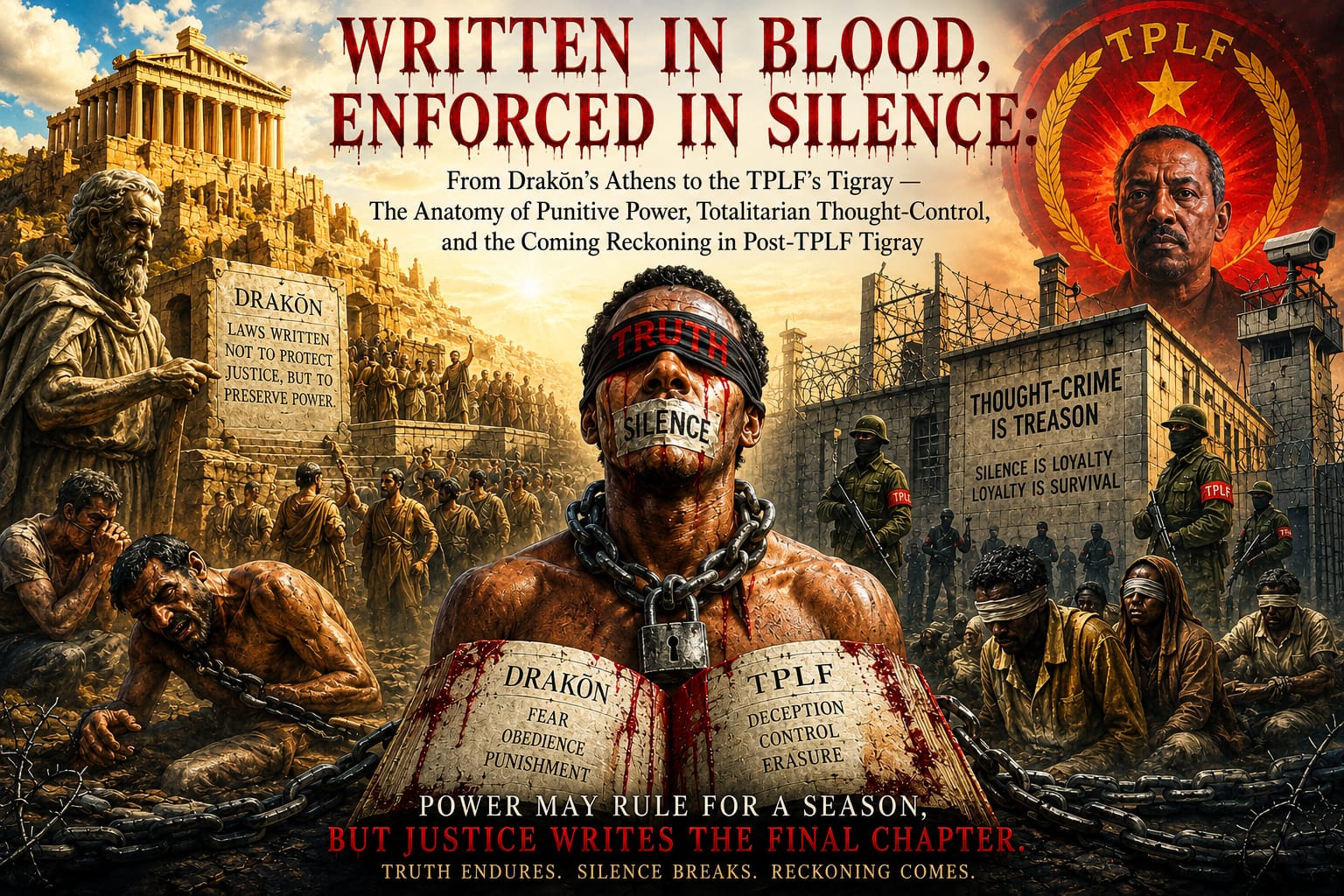
WRITTEN IN BLOOD, ENFORCED IN SILENCE:
The Anatomy of Punitive Power, Totalitarian Thought-Control,
and the Coming Reckoning in Post-TPLF Tigray
“The creatures outside looked from pig to man, and from man to pig, and from pig to man again; but already it was impossible to say which was which.”
George Orwell, Animal Farm A warning that never expires
EXECUTIVE SUMMARY
This analysis proceeds from a deceptively simple etymological fact: the word we use to describe the most extreme political repression in the modern world draconian was born not in a totalitarian capital of the twentieth century, nor in the halls of a military junta, but in the open agora of ancient Athens in 621 B.C., inscribed in stone by a legislator named Drakōn, whose ambition was order and whose method was annihilation. That the same conceptual vocabulary now applies, with full analytical force, to the Tigray People’s Liberation Front (TPLF) in twenty-first-century Tigray is not a rhetorical flourish. It is a precise and damning indictment.
The TPLF once the architect of Ethiopia’s ethnic-federal constitutional order, once the commanding force that held Addis Ababa for nearly three decades has devolved into something that would be tragicomic if its consequences were not so catastrophic: a politico-military apparatus waging comprehensive war against the very population it claims to represent. Against intellectuals. Against independent media. Against civil society. Against the idea itself that Tigrayans might think for themselves. This analysis names that reality without euphemism, traces its historical genealogy without sentimentality, and confronts its political logic with the ruthlessness it deserves.
PART I: DRAKŌN AND THE ORIGINAL SIN OF PUNITIVE LAW
I. Athens Before Order: The World That Made Drakōn Necessary
To understand Drakōn, one must first understand the Athens that produced him. The city-state of Athens in the late seventh century B.C. was not the cradle of democracy that subsequent centuries would mythologize. It was a fractured, blood-soaked aristocratic polity governed not by written statute but by oral custom — a system transparently designed to benefit those wealthy and powerful enough to manipulate its ambiguities. Justice was personal, vendetta was hereditary, and the poor had no recourse against the arbitrary interpretation of unwritten rules by aristocratic magistrates who were simultaneously law-makers, law-interpreters, and law-enforcers.
Blood feuds consumed families for generations. Without written law, there was no appeal, no standard, no accountability. The Athenian poor the demos demanded codification not because they trusted Drakōn, but because anything was preferable to the aristocratic monopoly on interpretive violence. Drakōn was thus a product of crisis, commissioned by a class of men who feared that without some formal legal architecture, the city would tear itself apart.
II. Drakōn’s Code: Order Through Extermination
Drakōn delivered. In 621 B.C., Athens received its first written legal code publicly displayed on wooden tablets so that, for the first time in Athenian history, no citizen could claim ignorance of the law. This was, in principle, a democratic act: equality before a known and fixed standard. In practice, it was something else entirely.
The code prescribed death for virtually every conceivable offense. Stealing a cabbage: death. Minor theft: death. Idleness the failure to work productively: death. Defaulting on a debt: slavery, and for the desperate debtor’s children, slavery too. When the Athenian orator Demades would later remark, with scalding irony, that Drakōn had not written his laws in ink but in blood, he was not speaking metaphorically. He was conducting forensic accounting.
The ancient sources preserve a telling exchange. When asked why he prescribed death for almost all offenses, Drakōn is said to have replied that minor transgressions deserved it, and he could think of nothing worse to assign for the greater ones. It is a reply that belongs simultaneously to the history of jurisprudence and to the history of pathology. The logic is totalizing: all deviation from order is capital. The state becomes the absolute sovereign over life and death not because it is omniscient but because it is omnipotent.
Drakōn wrote his laws not in ink but in blood. The TPLF enforces its authority not through consent but through the barrel of a gun and calls this governance.
III. What ‘Draconian’ Really Means A Precise Political Vocabulary
The word draconian has been flattened by common usage into a synonym for ‘severe’ or ‘harsh.’ This analytical flattening is itself a form of political evasion. The full force of the term denotes something more specific and more damning: the systematic application of disproportionate, irreversible punishment by a power that has granted itself absolute interpretive authority over permissible conduct — and that uses punishment not primarily to rehabilitate, not primarily to deter, but to demonstrate the absolute cost of non-compliance.
Draconian law is not merely strict law. It is law designed as theater of domination. Its purpose is not justice but submission. When we deploy this term in the twenty-first century — when we apply it not to Athens in 621 B.C. but to Tigray in 2024 — we are not indulging in rhetorical excess. We are being analytically precise.
PART II: THE TPLF’S DRACONIAN ARCHITECTURE
IV. From Liberation Front to Occupying Force: The TPLF’s Internal Transformation
The TPLF was born in 1975 in the mountains of Tigray as an armed insurgency against the Derg military dictatorship of Mengistu Haile Mariam. Its founding mythology is one of liberation: a disciplined vanguard fighting for the rights of a historically marginalized people against a brutal centralized state. For nearly two decades of brutal guerrilla warfare, it sustained that mythology with at least partial credibility.
Then it won. And winning revealed what victory always reveals about armed political movements: that the organizational structures, the command hierarchies, the surveillance mechanisms, and the cadre culture built to wage war do not dissolve when the enemy is defeated. They survive. They adapt. They find new enemies. For the TPLF, the new enemy the enemy that ultimately replaced the Derg in the movement’s operational imagination was the Tigrayan population itself.
By the time the TPLF had governed Ethiopia for nearly three decades, the transformation was complete. The liberation front had become a neopatrimonial machine: a system in which formal institutional authority was systematically hollowed out and replaced by personal loyalty networks, cadre patronage, and the weaponization of ethnicity as both shield and sword. The EFFORT conglomerate the TPLF’s vast business empire, built on the spoils of state capture made the movement economically self-sufficient and therefore accountable to no constituency except itself.
V. Politico-Military Martial Law: Governance as Command and Control
Following the catastrophic 2020–2022 Tigray War a conflict the TPLF itself precipitated by attacking Ethiopian National Defense Force bases in November 2020 the organization did not dissolve, did not reconstitute itself as a purely political party, did not subordinate itself to civilian oversight, and did not make a credible attempt to honor the spirit of the November 2022 Pretoria Agreement. It did what armed political movements with cadre cultures always do when faced with existential threat: it militarized further.
The TPLF today operates what can be described only as a politico-military martial law regime over Tigray. The Interim Regional Administration of Tigray (TIRA) the federal-backed civilian governance body established under Pretoria has been systematically bypassed, marginalized, and in multiple documented instances physically confronted and expelled from areas under TPLF-aligned military control. The Tigray Defense Forces (TDF), nominally integrated into Ethiopian national command structures under the peace agreement, remain operationally loyal to TPLF hardline commanders rather than to any legitimate federal authority.
The TPLF’s criminal code enacted under wartime emergency conditions but never formally rescinded extends the death penalty to: refusal to perform military service, defined broadly enough to criminalize conscientious objection; collaboration with the enemy, defined with sufficient vagueness to encompass any contact with the federal government or its representatives; and acts defined as undermining national unity, a category capacious enough to absorb any form of political dissent. This is Drakōn’s architecture transposed twenty-six centuries forward in time. The specific offenses differ. The punitive logic submission or death is structurally identical.
In Tigray today, the TPLF has accomplished what even Drakōn could not: it has not merely criminalized behavior. It has attempted to criminalize thought itself.
VI. The War Against the Tigrayan Intellectual Elite and Civil Society
No aspect of the TPLF’s current posture is more revealing or more damning than its comprehensive assault on the Tigrayan intellectual class, independent media, and civil society. This is not incidental repression, the kind of collateral damage produced by institutional dysfunction. It is a deliberate, methodical campaign whose strategic logic is clear: an intellectually active, informationally sovereign, organizationally independent Tigrayan public is the single greatest existential threat to TPLF hegemony.
Tigrayan academics, lawyers, policy analysts, journalists, and civil society leaders who have attempted to engage publicly with questions of post-war governance, transitional justice, accountability, or political alternatives to TPLF leadership have been subjected to intimidation, threats, arbitrary detention, enforced silence, and in documented cases, physical violence. Independent media operating in Tigray faces a choice that is not a choice: carry the TPLF’s narrative, or cease to operate. There is no third option.
The TPLF’s hostility to independent thought extends, with remarkable ideological consistency, to diaspora-based analytical platforms, academic publications, and advocacy organizations that have subjected the movement to critical scrutiny. The movement’s response to criticism has been uniform across contexts: delegitimization, personal targeting of critics, and the mobilization of loyal cadres to flood information spaces with counter-narratives and personal attacks. HAGR and its affiliated analytical community are not unfamiliar with this dynamic.
PART III: THE TOTALITARIAN ENDPOINT WHEN CONTROL REACHES THE MIND
VII. Animal Farm’s Final Page: The Moment Revolution Becomes Tyranny
George Orwell completed Animal Farm in 1944 and watched it struggle to find a publisher precisely because its political diagnosis was too accurate, too uncomfortable, too perfectly calibrated to expose the mechanisms by which revolutionary movements movements born in genuine grievance, animated by genuine moral energy are captured and corrupted by the very logic of power they initially opposed. The novel’s final image the assembled animals watching through the farmhouse window as the pigs negotiate with the human farmers, moving from pig to man and from man to pig, finding it impossible to say which was which is not a literary device. It is a theorem.
The TPLF began as an organization of men and women who had suffered genuine historical injustice and who fought with extraordinary courage and sacrifice to change the political conditions of their people. That history is real. Its betrayal is also real. The movement that once fought against the Derg’s arbitrary detention of Tigrayans now arbitrarily detains Tigrayans. The movement that once denounced centralized authoritarian control now enforces centralized authoritarian control. The movement that once promised democratic governance now suppresses every institutional mechanism through which democratic governance might take root. Looking from pig to man, from man to pig it has become impossible to say which is which.
VIII. The Criminalization of Thought: Orwell’s Thoughtcrime Made Real
In 1984, Orwell conceptualized thoughtcrime as the logical endpoint of totalitarianism the ultimate ambition of a system that has already captured bodies, speech, and association and now reaches inward to colonize consciousness itself. The concept was understood, when the novel was published, as dystopian extrapolation: a warning about where authoritarian logic, followed to its conclusion, must inevitably arrive.
The TPLF has not arrived at literal thoughtcrime the capacity to surveil and punish the unspoken contents of the human mind remains beyond any political movement’s technological reach, Orwell’s fictional telescreen notwithstanding. But it has arrived at the functional equivalent. When no one in Tigray can speak critically without risk of imprisonment. When no journalist can report independently without risk of closure or worse. When no academic can publish analysis that contradicts the TPLF’s self-narrative without professional and personal consequences. When no civil society leader can organize without TPLF cadre infiltration and disruption then the space between the prohibition on expression and the prohibition on thought has narrowed to the point of analytical meaninglessness.
You cannot think what you cannot say to anyone. You cannot develop ideas in isolation from all intellectual community. You cannot sustain dissent in permanent, enforced silence. The TPLF understands this. The suppression of speech in Tigray is not a side effect of its governance approach. It is the governance approach. Thought suppression is the objective; speech suppression is the instrument.
The TPLF does not merely want Tigrayans silent. It wants them unable to imagine alternatives. That is not repression. That is totalitarianism and totalitarianism is always, ultimately, a losing proposition.
PART IV: THE DEAD DUCK, THE WAG THE DOG, AND THE WAR NO ONE CAN WIN
IX. ‘Dead Duck Walking’: The Strategic Exhaustion of the TPLF
Political movements, like biological organisms, can sustain dysfunction for considerable periods through accumulated reserves of credibility, of institutional momentum, of fear-induced compliance, of external patron support long after the underlying conditions for their survival have been fatally compromised. The TPLF is in precisely this condition: a Dead Duck Walking, continuing to govern through inertia and intimidation while the structural foundations of its authority erode with every passing month.
The Tigray War cost the TPLF the one resource no political movement can replace through military force: legitimacy. Its decision to launch the November 2020 attack on federal military installations a decision taken by hardline factions over moderate objections, a textbook demonstration of how patrimonial movements are captured by their most extreme internal factions handed the Ethiopian federal government and its allies an internationally defensible justification for military operations that, whatever their subsequent atrocities, began with TPLF aggression. The resulting conflict consumed tens of thousands of Tigrayan lives, produced famine conditions across the region, destroyed the economic infrastructure that had taken decades to build, and demonstrated to the Tigrayan population with terrible clarity that the TPLF’s commanders were willing to sacrifice an entire generation of Tigrayan men to perpetuate their political control.
That is not a relationship a political movement recovers from. The TPLF’s current posture continued military mobilization, continued suppression of civilian political activity, continued obstruction of the Pretoria process is not a strategy for political survival. It is a strategy for postponing political death while deepening the wound that will make recovery impossible.
X. ‘Wag the Dog’: The Manufactured Threat as Political Oxygen
A movement that cannot justify its continued dominance through positive programmatic achievement economic development, institutional governance, political representation, social provision must justify it through threat. The TPLF has, with considerable skill but decreasing returns, sustained its authority through the cultivation and amplification of external threats: Eritrea, Amhara expansionism, federal encirclement, international conspiracy against Tigrayan survival.
This is the political equivalent of Wag the Dog the systematic manufacture and maintenance of existential external threat to distract from internal failure and justify the suppression of internal dissent. Every Tigrayan who questions TPLF governance can be reframed as a collaborator with external enemies. Every independent institution that operates outside TPLF control can be characterized as a security vulnerability. Every demand for accountability can be dismissed as enemy propaganda. The threat justifies the control; the control generates the conditions that produce genuine grievances; the genuine grievances are then attributed to external threats rather than internal governance failure; the cycle perpetuates itself.
The TPLF’s deepening internal factionalism the armed clashes between hardline commanders and moderate officials, the forced expulsion of interim administrators from multiple Tigrayan cities indicates that this mechanism is breaking down. When the manufactured external threat can no longer contain the eruption of authentic internal conflict, the political architecture collapses from within.
A movement that governs through fear and manufactured emergency is a movement confessing its own illegitimacy. The TPLF’s escalating repression is not a sign of strength. It is a precise measure of its political bankruptcy.
PART V: AFTER THE TPLF — NAVIGATING THE POST-COLLAPSE LANDSCAPE
XI. Hog-Tied: The Structural Constraints on Post-TPLF Transition
Tigray’s path toward genuine post-conflict reconstruction is not simply obstructed by the TPLF’s continued political dominance. It is structurally constrained by the accumulated institutional damage that TPLF governance has inflicted over decades damage that will persist and complicate governance long after the movement itself has been removed from political authority. The region is, in the most precise political sense, hog-tied: every limb of potential institutional capacity has been systematically bound by TPLF cadre penetration, patron-client dependency, and the deliberate suppression of independent institutional capacity.
Civil society organizations that might provide the social infrastructure for democratic transition have been infiltrated, co-opted, or suppressed. Academic and research institutions that might provide the intellectual infrastructure for evidence-based governance have been subordinated to TPLF political direction or driven into external exile. Legal institutions that might provide the structural infrastructure for transitional justice have been packed with movement loyalists and stripped of operational independence. Media institutions that might provide the informational infrastructure for democratic public discourse have been captured or silenced.
This is not accidental. It is the structural consequence of neopatrimonial governance: a system that survives by ensuring that no institution outside its direct control accumulates sufficient capacity to constitute an alternative center of authority. The TPLF has been extraordinarily effective at this project of institutional destruction. The reconstruction challenge for post-TPLF Tigray is therefore not merely political the replacement of one leadership by another but civilizational: the rebuilding of an entire institutional ecosystem from conditions of near-total institutional collapse.
XII. Preparing for Tomorrow: The Strategic Imperatives of Post-TPLF Tigray
Against this landscape of systematic institutional destruction, the strategic imperatives for those who are thinking seriously about Tigray’s post-TPLF future are both urgent and daunting. They can be stated with analytical precision even if their implementation will require political courage of the highest order.
First: the Pretoria Agreement must be treated as a floor, not a ceiling. The agreement’s provisions for disarmament, demobilization, and the restoration of federal institutional authority over Tigray are minimum conditions for political normalization, not maximum ambitions. A durable peace requires going substantially further toward genuine transitional justice mechanisms, toward accountability for atrocities committed by all parties, toward the dismantling of the EFFORT economic empire and the redistribution of its assets to public institutional purposes.
Second: the intellectual and civic diaspora must be understood as a strategic resource, not merely a sympathetic external audience. The Tigrayan scholars, analysts, lawyers, journalists, and civil society leaders currently in exile represent the accumulated human capital that post-TPLF Tigray will desperately need for institutional reconstruction. Creating pathways political, legal, logistical for their safe and meaningful return must be a strategic priority for any transitional governance architecture.
Third: the regional dimensions of Tigrayan reconstruction cannot be addressed in isolation from the broader Horn of Africa political landscape. Eritrea’s continued destabilizing posture under Isaias Afwerki, the ongoing fragility of the Jigjiga-centered Somali regional political dynamics, the contested relationship between Tigray and its neighboring Amhara and Afar regions all of these must be addressed through a coherent regional strategy, not managed as separate bilateral problems.
CONCLUSION
XIII. The Reckoning That Cannot Be Postponed
The parallel between Drakōn’s Athens and the TPLF’s Tigray is not a clever rhetorical device. It is a structural diagnosis. Both represent the same fundamental political pathology: a governing authority that has substituted punishment for legitimacy, fear for consent, and the systematic suppression of alternative political possibility for the hard work of actually governing in the public interest. Drakōn’s Athens eventually produced Solon — a lawgiver who understood that laws written in blood cannot survive, that the social contract requires revision rather than enforcement by increasingly extreme coercion, that the alternative to political reform is not stability but explosion.
The TPLF has not produced its Solon. Its internal moderates have been systematically defeated, expelled, or silenced by the hardline factions that have captured the movement’s operational direction. The consequence is not stability but accelerating institutional decay the progressive alienation of a Tigrayan population that survived a catastrophic war, that bears the scars of conflict on every family and every community, and that is being asked by the movement responsible for much of that suffering to accept continued dominance, continued silence, continued suppression of any political alternative.
It will not accept this. History does not record successful cases of populations that, having survived what the Tigrayan people have survived, subsequently consented to indefinite subjugation by the same political force that produced their suffering. The TPLF’s reckoning is not a question of if. It is a question of when, and of whether the transition occurs through a managed political process that preserves institutional continuity and minimizes additional human suffering, or through a collapse so complete and so violent that it sets back Tigrayan institutional development by another generation.
That choice belongs, in the first instance, to the TPLF itself to whether any fraction of its leadership retains sufficient realism to understand that postponing transition through escalating repression is not a strategy for survival but a guarantee of catastrophic failure. It belongs, in the second instance, to the regional and international actors the African Union, IGAD, the United States, the European Union who must decide whether they will apply the leverage necessary to make managed transition more attractive than prolonged resistance.
And it belongs, ultimately, to the Tigrayan people themselves to the intellectuals who continue to think despite the criminalization of thought, to the journalists who continue to report despite the suppression of information, to the civil society leaders who continue to organize despite the systematic destruction of organizational capacity, to the ordinary citizens who continue to demand a future worthy of what they have endured.
They cannot silence what they cannot reach. And what they cannot reach is the determination of a people who have already survived everything this movement has thrown at them and who will outlast it.