
By HORN OF AFRICA GEOPOLITICAL REVIEW (HAGR)
How was the TPLF built as a political party with Africa’s most sophisticated architecture of oppression in the name of struggle for freedom and self-determination? And why must the TPLF’s camouflage ideology be understood to defeat it?
“If you know the enemy and know yourself, you need not fear the result of a hundred battles. If you know yourself but not the enemy, for every victory gained, you will also suffer a defeat.” — Sun Tzu, The Art of War
Editor’s Forward: Why this Analysis Matters Now
This document is not written for academic comfort. It is not designed to be polite. It is written because the people of Tigray are suffering under a system whose true nature has been obscured by euphemism, diplomatic caution, and deliberate institutional confusion for over three decades.
The Coalition for Peace in Central Tigray (CPCT) and the Tigray Peace Force (TPF) — along with every serious opposition movement committed to genuine liberation — cannot defeat what they do not fully understand. Strategy built on incomplete analysis produces incomplete results. And in a conflict as complex and as brutal as the one Tigray faces today, incomplete results cost lives.
What follows is a clear-eyed, unsparing, and analytically rigorous examination of the TPLF’s political system what it actually is, how it actually functions, and why it has proven so extraordinarily difficult to dislodge. Understanding this system is not an academic exercise. It is the first and most essential act of strategic preparation.
Setting The Stage: The Most Misunderstood Political Organisation in the Horn of Africa For decades, the TPLF successfully presented itself to the international community wearing different masks for different audiences. To Western donors, it was a developmental state authoritarian perhaps, but committed to poverty reduction and economic growth. To regional neighbours, it was a stabilising force in a volatile region. To its own people, it claimed the mantle of liberation the organization that freed Tigray and Ethiopia from the Derg’s murderous dictatorship.
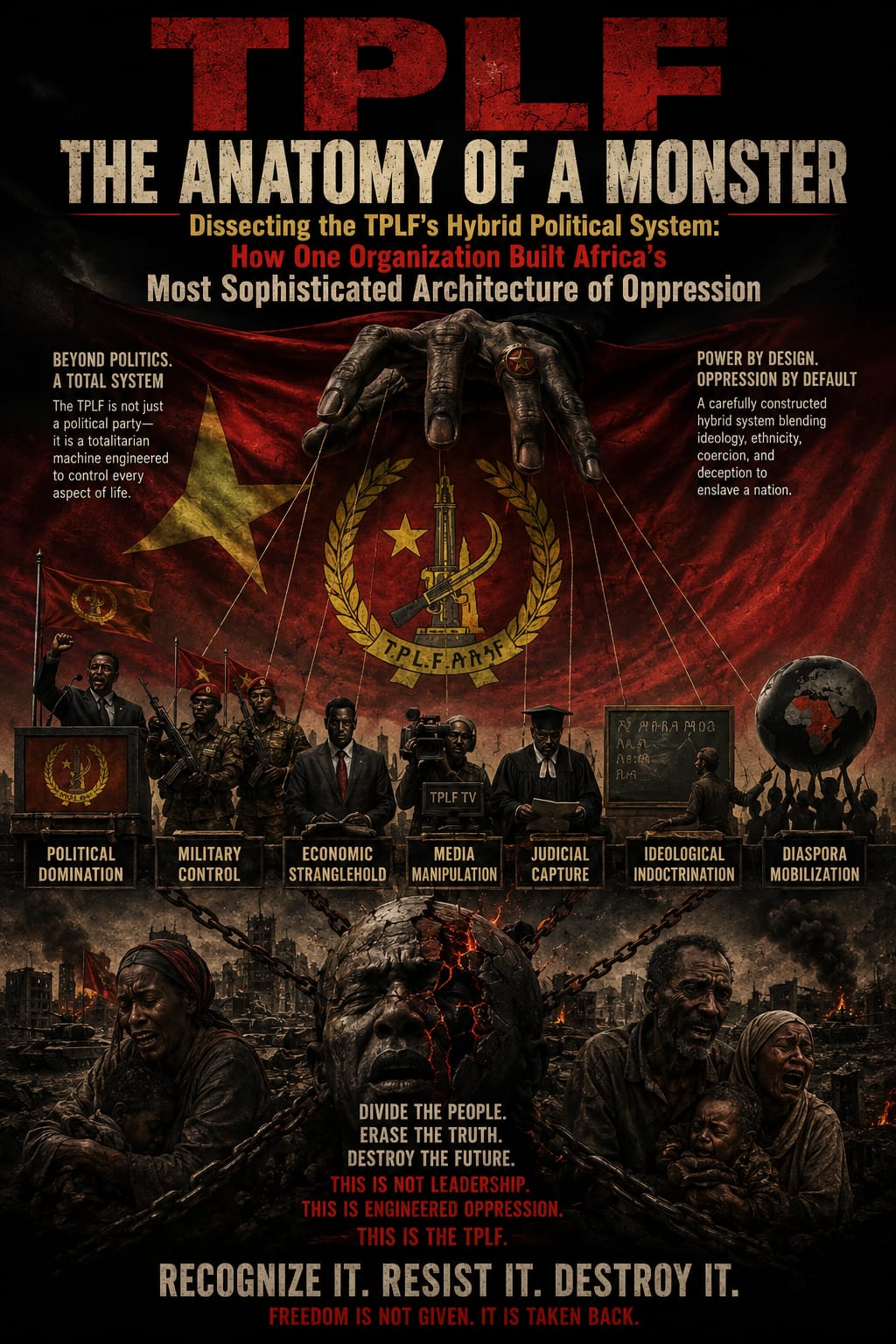
Each of these presentations contained enough truth to be credible and enough deception to be dangerous. The reality of what the TPLF built and what it continues to operate today is something far darker, far more complex, and far more deliberately constructed than any single label can capture. What the TPLF created is not simply a dictatorship, not simply a one-party state, not simply an ethnic supremacy project. It is all of these things simultaneously, fused together into a hybrid system of control so comprehensive that it penetrates every institution, every economic relationship, every community structure, and every individual calculation of survival.
To understand the TPLF, you must understand hybridity. And to understand hybridity, you must first abandon the comfortable assumption that political systems exist in clean and separable categories.
The TPLF Hybrid Political System Explained: When Every Form of Evil Combines into One
A hybrid political ideology is one that deliberately combines elements of multiple governance systems mixing formal democratic structures with authoritarian control mechanisms to create a system that is simultaneously harder to challenge domestically and harder to condemn internationally.
The TPLF did not stumble into hybridity. It engineered it. With extraordinary deliberateness, over decades, the TPLF constructed a layered system of control that drew from the worst features of multiple political traditions while clothing itself in the language of the best, i.e., the TPLF is the people of Tigray’s party, our party (ውድብና), making a distinction between the TPLF and the people as the same and disguising it for people to feel that the party belongs to them. What emerged is arguably the most sophisticated and most cynically constructed hybrid regime in African political history.
Let us examine each layer.
Layer One: Neopatrimonialism
“Power is personal. Loyalty is everything. Merit is nothing.”
At the deepest foundation of the TPLF’s political architecture lies neopatrimonialism—a system in which the formal machinery of the state is systematically hollowed out and replaced by personal loyalty networks that answer not to the law, not to the constitution, not to the people, but to the inner circle of the ruling organisation.
Under neopatrimonialism, the state exists on paper. Ministries have names and budgets and organisational charts. Courts exist. Parliaments convene. Elections are held. But none of these institutions functions according to its stated purpose. They function according to one principle only: does this serve the leadership’s personal loyalty network, or does it threaten it?
The TPLF applied this system with devastating efficiency. Government positions from federal minister to local administrator were distributed not based on qualifications, experience, or public mandate but based on personal loyalty to the party and its leadership. Agricultural assistance, development funds, business licenses, land allocations all of these became instruments of political reward and political punishment.
The result was the systematic destruction of institutional capacity. When positions are filled by loyalists rather than competent professionals, institutions decay, resulting in maladministration, injustice, corruption, fraud, and lack of accountability. When resources flow through personal patronage and loyalty networks rather than transparent and accountability processes, public services collapse. When accountability runs upward to the party rather than outward to the public, governance becomes extraction rather than service.
This is precisely what happened across the regions under TPLF administration. The formal state became a shell. The state the one that actually made decisions, allocated resources, and exercised power was the party network. And that network answered to no one but itself.
Layer Two: Kleptocracy
“The State as a Personal ATM for the TPLF Ruling Elite”
Neopatrimonialism creates the conditions for kleptocracy governance by theft. When political loyalty replaces institutional accountability, the barrier between public resources and private enrichment dissolves completely.
The TPLF’s kleptocratic dimension was institutionalised through an extraordinary vehicle: the party-owned endowment fund system. Through organisations like the Endowment Fund for the Rehabilitation of Tigray (EFFORT), the TPLF constructed a business empire that was nominally charitable but functionally a mechanism for transforming political dominance into economic ownership.
EFFORT and its affiliated conglomerates controlled manufacturing, construction, transport, banking, and import-export industries. These enterprises were not competing in a free market they were operating in a market that the TPLF itself controlled, regulated, and policed. Competitors faced bureaucratic obstruction, denial of licenses, tax harassment, and in some cases outright intimidation. The TPLF is simultaneously the player and the referee as well as the judge and jury in the economic game in absolute control and it has no intention of losing it.
The wealth generated did not flow to the people of Tigray. It financed party operations, rewarded loyalists, funded military capacity, and enriched the inner circle of the top leadership. Tigray remained one of Ethiopia’s most impoverished and underdeveloped regions even as the TPLF’s economic empire expanded. The people’s poverty was not incidental to the system it was functional to it. Economic dependence reinforces political dependence that imposes total control on the population. A population that relies on party patronage for survival is one that cannot afford to rebel against the TPLF monster ideology, which it employs and executes ruthlessly and savagely for those who rebel or raise questions against it.
This is kleptocracy, not as corruption but as system design.
Layer Three: Oligarchy
“Power for the few, justified by the name of the many.”
Beneath the surface of TPLF rhetoric about collective struggle for liberation, self-determination, and Tigrayan unity lay a rigid oligarchic reality. Effective power the power to make strategic decisions, control military assets, direct economic resources, and determine political succession was concentrated in an extraordinarily small group of individuals.
This oligarchy reproduced itself through deliberate exclusion. Access to the inner circle required not just loyalty but the right personal connections, the right family networks, and in many cases the right geographic origins within Tigray itself. Those outside the trusted network however talented, however committed, however educated, however competent, visionary, strategically capable and genuinely dedicated to Tigray’s welfare found ceilings on their advancement that no amount of merit could break through.
The result was a leadership class that became increasingly detached from the population it claimed to represent, increasingly inward-looking in its decision-making, and increasingly willing to sacrifice the welfare of ordinary Tigrayans to preserve its own position and privilege. The catastrophic decisions that led Tigray into the 2020 war and its devastating consequences were not made by the people of Tigray. They were made by an oligarchic inner circle that had long since stopped being accountable to the people, the constitution and the rule of law outside itself.
Layer Four: Ethnocracy
“We claim to speak for the people. What we mean is we speak for ourselves.”
The TPLF built its entire legitimacy on ethnic identity — the claim that it was the authentic representative and protector of the Tigrayan people. This claim served multiple strategic purposes simultaneously.
Internally, it created a powerful psychological barrier against dissent. To criticise the TPLF was framed as criticising Tigray itself as betraying your people, your culture, and your own survival. This conflation of the party with the ethnic group is one of the most effective and the most cynical techniques of authoritarian political control. It transforms political opposition into cultural treason. The language often used to slander political opponents and opposition parties is ‘betrayer’, ‘traitor’, and ‘bandit’ (ጠላም: ከዳዕ: ባንዳ).
Externally, it provided justification for the ethnic federalism system that the TPLF engineered at the national level, which guaranteed that ethnolinguistic boundaries would determine political power a system that conveniently aligned with the TPLF’s own organisational structure and strategic interests.
But the deepest betrayal of the ethnocratic claim is this: the TPLF did not serve the Tigrayan people. It used the Tigrayan people their identity, their legitimate historical grievances, their cultural pride, and their survival instincts as instruments of its own political perpetuation. When TPLF interests and Tigrayan interests diverged, the TPLF consistently chose its own survival. The war of 2020 demonstrated this with lethal clarity.
Layer Five: The Party-Military Complex
“When the gun and the party become the same thing”
Perhaps the most dangerous structural feature of the TPLF system is the complete fusion of political and military authority. The TPLF was born as an armed insurgency. It took power through military victory. And it never in any meaningful institutional sense separated its military capacity from its political authority.
This fusion creates a system that is extraordinarily resistant to peaceful political change. In a genuine democracy, the military serves the state and the state serves the people. In a party-military complex, the military serves the party, the state is an instrument of the party, and the people serve both. Political opposition is not merely an electoral challenge to be overcome it is a military threat to be suppressed.
This is why Giffa (ግፋ) forced military conscription is not simply a military recruitment policy. It is a political tool mechanism. It transforms the population’s youth into instruments of the party’s military power, while simultaneously depriving civil society of the young people most likely to lead organised opposition.
Layer Six: Necrocracy
“Governing through death, fear, poverty, famine, and the memory of martyrs and sacrifice”
Necrocracy governance that derives its authority from death and martyrdom is perhaps the least discussed but most psychologically potent element of the TPLF’s hybrid system.
The TPLF has consistently governed in the name of the dead the martyrs of the liberation struggle, the victims of the Derg, the fallen soldiers of successive conflicts. This is not mere political rhetoric. It is a systematic governance strategy that places current leadership beyond criticism by wrapping its authority in the sacred memory of those who gave their lives.
To question the TPLF’s decisions is framed as dishonouring the martyrs. To oppose the party’s political choices is presented as betraying the sacrifices of those who died for Tigray’s freedom. This is deeply cynical manipulation of genuine grief and heroism in service of political impunity.
The living are being asked at gunpoint, through forced conscription (Giffa ግፋ) to sacrifice themselves for THE TPLF leadership whose primary interest is its own survival. The dead cannot consent to being used this way. The living deserve better than to be next.
The Federal Era and Its Legacy: How the TPLF Scaled Its System to a Nation of 100 Million
From 1991 to 2018, the TPLF did not merely govern Tigray through its hybrid system. It scaled that system to govern Ethiopia a nation of over 100 million people through the EPRDF coalition it totally dominated and directed.
The ethnic federalism architecture it engineered at the national level was a masterpiece of strategic institutional design. By dividing Ethiopia into ethnolinguistic regions and guaranteeing those regions formal autonomy, the TPLF created a system that appeared democratic and decentralising that genuinely addressed some of Ethiopia’s real historical tensions around ethnic representation while ensuring that the upward accountability of regional elites to the federal centre, which the TPLF controlled, prevented any genuine challenge to its national supremacy.
The national defence forces, security agencies, federal courts, and foreign aid distribution networks were all shaped to serve TPLF strategic interests during this period. The system was not simply authoritarian it was comprehensively and deliberately designed so that challenging it through legitimate institutional channels was functionally impossible.
When Prime Minister Abiy Ahmed dismantled the TPLF’s federal dominance in 2018, what he removed was the national layer of this hybrid system. What he could not and did not remove and what remains fully operational today is the regional layer, now concentrated in Tigray itself.
The Strategic Implications: For the Coalition for Peace in Central Tigray (CPCT), the Tigray Peace Force (TPF), and All Forces of Genuine Liberation
This analysis was not written for its own sake. It was written because understanding the enemy is the precondition for defeating the enemy, i.e., the TPLF. What follows are the strategic implications that flow directly from the hybrid system analysis above.
Implication One: Political Strategy Must Match System Complexity
A movement that understands the TPLF as simply a military adversary will design purely military responses. A movement that understands the TPLF as a political party will design electoral and institutional responses. Neither is sufficient, because the TPLF is neither simply one nor the other it is a hybrid system requiring a hybrid counter-strategy that operates simultaneously across military, political, economic, social, and psychological dimensions.
Implication Two: The Patronage Network Is Both the System’s Strength and Its Vulnerability
The TPLF’s neopatrimonial networks are its primary instrument of control but they are also its primary vulnerability. Patronage networks are expensive to maintain. They require constant resource flow to sustain loyalty. They create internal competition and resentment among those who feel inadequately rewarded. Any strategy that disrupts the economic foundations of the patronage system that cuts off resource flows, exposes the network’s internal contradictions, or creates credible alternative pathways for those currently dependent on it attacks the system at its structural core.
Implication Three: The Narrative Warfare is Decisive
The TPLF’s greatest weapon is not its military capacity. It is its control of the story the narrative that equates the party with the people, that wraps its authority in martyrdom, and that frames opposition as betrayal. Defeating this narrative clearly, consistently, and with the moral authority of genuine commitment to Tigrayan welfare is as strategically important as any military operation.
The opposition must relentlessly and publicly distinguish between the TPLF leadership and the people of Tigray. It must make undeniably clear that its struggle is for Tigray’s genuine liberation not from Ethiopia, not from neighboring peoples but from the hybrid system of extraction and control that the TPLF has imposed on Tigray’s own sons and daughters.
Implication Four: International Accountability is a Strategic Weapon
The TPLF’s hybrid system is vulnerable to sustained, serious international legal and diplomatic pressure precisely because it has spent decades presenting itself as a legitimate governance structure. Every documented human rights violation, every confirmed instance of forced conscription, every piece of evidence of kleptocratic extraction weakens the legitimacy claim that is central to its system’s survival.
The CPCT), the TPF, and allied advocacy organisations must invest heavily in documentation, international legal engagement, and diplomatic advocacy not as peripheral activities but as core strategic priorities.
Implication Five: Know The TPLF Ideological Red Lines
The TPLF’s Marxist-Leninist roots, its ethnocratic identity claims, and its military culture create specific ideological commitments and specific vulnerabilities. They will not negotiate in good faith from a position of military weakness their democratic centralism ideology interprets compromise as betrayal and retreat as an existential threat. Any strategy for negotiation that does not account for these ideological red lines will produce agreements that are not honoured and processes that are not genuine.
Conclusion: The Case for Clarity“The most dangerous enemy is not the one whose strength you underestimate. It is the one whose nature you misunderstand.”The TPLF is not a liberation movement that lost its way. It is not a political party that became corrupt. It is not a government that made bad decisions. It is a comprehensively hybrid system of political, military, and economic control that was deliberately designed from its ideological foundations to its institutional architecture to perpetuate the power of a small elite at the expense of the people it claims to represent.https://hornnewshub.com/the-anatomy-of-a-monster-dissecting-the-tplfs-hybrid-political-systemarticles/Understanding this is not pessimism. It is the beginning of genuine strategic clarity. And genuine strategic clarity is the beginning of genuine liberation.Tigray deserves leaders who serve it. It deserves institutions that protect it. It deserves a future free from the hybrid system that has consumed so many of its best years and so many of its best people.That future is possible. But it will only be built by those who understand with unflinching clarity exactly what stands in the way.
Editor’s Disclaimer:
The views and opinions expressed in articles published by Horn News Hub are those of the authors and do not necessarily reflect the official position or editorial stance of Horn News Hub. Publication does not imply endorsement.