
By Dr. Dawit Tesfay, Post-War Military, Security & Transitional Justice Affairs Researcher, HORN OF AFRICA GEOPOLITICAL REVIEW (HAGR)
ARCHIVAL FLASHBACK SERIES
A PHOTOGRAPH FROM MOSCOW,
DECEMBER 3, 2001:
What They Thought Would Last Forever,
Who Is Laughing Now and the Two Quiet Men Who Were Always Thinking Further Ahead.
An In-Depth Archival Diplomatic Flashback Analysis
“History is the cruelest photographer. It does not flatter. It simply waits and then it shows you exactly what you were.”
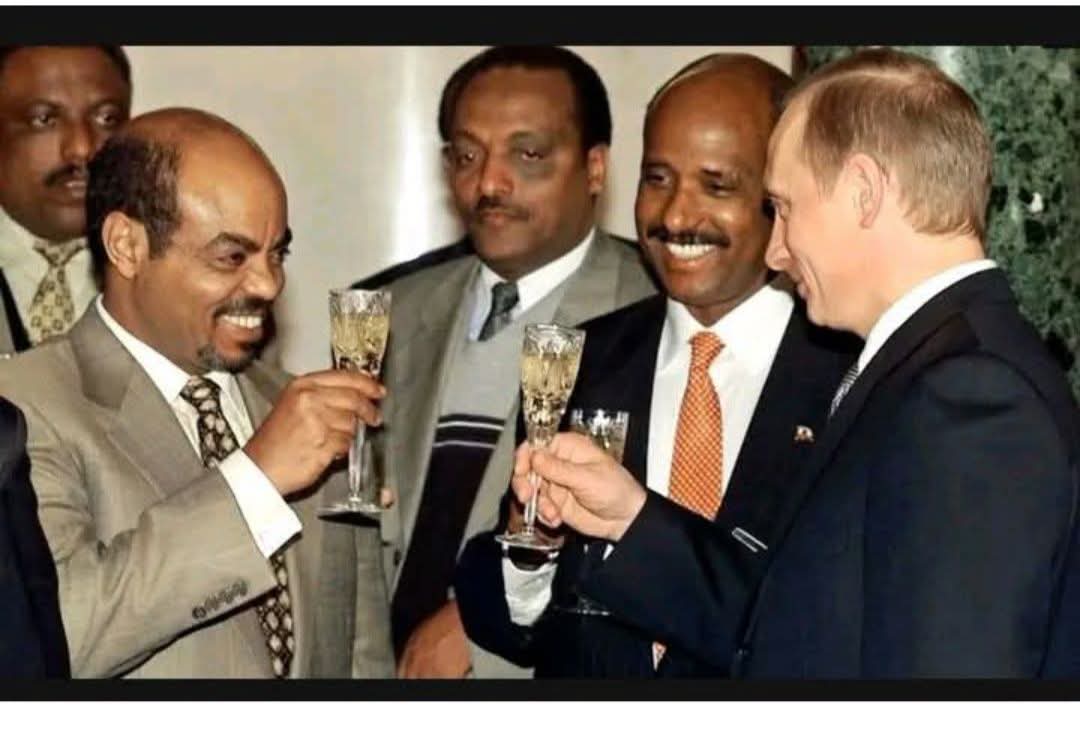
Ethiopian Prime Minister Meles Zenawi visits Russian President Vladimir Putin at the Kremlin. The Ethiopian delegation includes: Seyoum Mesfin, Minister of Foreign Affairs; Abadula Gemeda, Minister of Defence; Girma Birru, Minister of Trade and Industry. The three-day working visit focuses on modernizing Ethiopia’s air defences, arms supply negotiations, and bilateral debt settlement. A Declaration on Principles is signed. Meles is at the height of his post-purge political authority, having just consolidated absolute control over the TPLF and EPRDF following the internal party purges of 2001.
PART ONE: THE PHOTOGRAPH READING POWER IN A SINGLE FRAME
I. What an Archive Image Actually Contains
Archival photographs are not decorative. They are primary source documents among the most reliable, because they record what was present in a room at a specific moment without the editorial mediation of official transcripts, diplomatic cables, or the retrospective distortions of memoir. The photograph of Meles Zenawi and Vladimir Putin’s Moscow meeting, December 3, 2001, is precisely this kind of document. It is a visual time capsule. And reading it carefully reading not merely the staged principals at the centre of the frame but the full composition of the delegation, the posture of the officials, the visible gradations of protocol and deference tells a more complex and more revealing story than the official records of the visit are designed to communicate.
At the centre of the frame, Meles Zenawi forty-six years old, at the peak of his political authority having just completed the brutal internal TPLF purges of 2001 that eliminated every significant rival meets with Vladimir Putin, himself barely eighteen months into the presidency he would hold, in various configurations, for the next quarter-century. It is a meeting of two men who are, in December 2001, at similar points in their political trajectories: consolidated authority, confident projection, the kind of settled institutional power that photographs like this one are designed to communicate to the world.
But it is not the principals who most reward extended examination. It is the delegation: Seyoum Mesfin, the veteran TPLF foreign minister who had managed Ethiopia’s external relations since 1991; Abadula Gemeda, the Minister of Defence, an Oromo military commander whose presence in a TPLF-dominated cabinet is itself a political statement carefully calibrated for external audiences; and Girma Birru, the Minister of Trade and Industry, whose economic portfolio reflects the developmental state ambitions that Meles is projecting to the post-Cold War international community. Three men standing behind their principal, visible in the official frame, but not yet fully visible in the official history.
The photograph shows who held the room on December 3, 2001. History shows who held the future. They are not the same people.
The Champagne Toast Protocol, Exclusion, and What Is Left Unsaid
One detail in the record of this Moscow visit repays close analytical attention: the question of the ceremonial toast, and who participated in it at the level of principal rather than delegation. In high-level state visits, the architecture of ceremony is not incidental. It is a precise communication system. The champagne toast or its equivalent in formal diplomatic hospitality determines, through the physical arrangement of who stands where and who raises a glass with whom, the visible hierarchy of the encounter.
The exclusion of delegation members from the principal’s ceremonial moments is standard protocol. But in the specific context of a TPLF-dominated delegation where the precise ethnic and institutional composition of the accompanying officials was itself a political calculation a performance of multiethnic governance for external audiences that did not reflect internal power realities the ceremonial exclusion carries additional resonance. Abadula Gemeda and Girma Birru were present in Moscow as Ministers of the Ethiopian state. They were not present as equals in the TPLF’s internal hierarchy. The photograph shows proximity. It does not show parity.
This is not a minor distinction for the purposes of historical analysis. It is the foundational reality of the EPRDF’s ethnic architecture: Oromo and other non-Tigrayan officials occupied formal positions of institutional authority within a system in which substantive political power remained concentrated in the TPLF’s Tigrayan core. The Moscow photograph is a precise visual representation of this architecture and it is worth examining with that analytical frame explicitly in mind.
PART TWO: WHAT THEY THOUGHT-THE ANATOMY OF MISPLACED CONFIDENCE
II. Till the Cows Come Home The TPLF’s Fatal Assumption
December 2001 was, for Meles Zenawi and the TPLF, a moment of extraordinary, apparently settled confidence. The Ethio-Eritrean war of 1998–2000 had ended with the Algiers Agreement and the Boundary Commission process, removing what had seemed the most immediate existential threat to the regime’s security. The internal TPLF purges of 2001 had eliminated the dissident faction the group of senior party figures who had challenged Meles’s military strategy and governance approach with surgical brutality and complete institutional success. The EPRDF’s economic development narrative was beginning to attract international attention and, more importantly, international development finance. The arms modernization agenda being pursued in Moscow was part of a broader military consolidation effort.
The delegation that flew into Moscow that December carried with it, in its very composition, the unspoken assumption that would ultimately prove the TPLF’s most catastrophic strategic error: the assumption that the current configuration of power was self-sustaining. That ethnic federalism as designed and administered by the TPLF was a permanent rather than provisional settlement. That the combination of economic growth, security apparatus capacity, and international legitimacy could maintain political dominance indefinitely till the cows came home, as the idiom puts it, meaning forever, meaning the question of succession and political transformation need not arise.
This assumption was embedded in the TPLF’s every institutional design choice. It was embedded in the party’s cadre system, which recruited for loyalty to the movement rather than competence in governance. It was embedded in the EFFORT economic empire, which was structured to make the TPLF’s economic survival independent of electoral accountability. It was embedded in the federal architecture itself, which distributed formal authority across ethnic regional states while reserving substantive control over security, finance, and political direction to the TPLF’s federal core. It was the assumption of a movement that had won a war and confused military victory with historical permanence.
They thought history had given them the final word. History is not in the habit of granting final words to anyone. It simply keeps writing and it eventually writes everyone out.
The Purges of 2001: Strength That Was Actually Fragility
The internal TPLF purges that immediately preceded the Moscow visit deserve particular attention in any retrospective analysis, because they illustrate with precision the mechanism by which authoritarian movements consume their own institutional resilience in the act of demonstrating their strength. Meles’s elimination of the dissident faction which included some of the movement’s most experienced military and political figures was, in the short term, a demonstration of complete political control. In the medium and long term, it was the removal of the internal corrective capacity that might have enabled the TPLF to adapt, to reform, and to manage a political transition rather than suffering a political collapse.
Organizations that suppress internal dissent do not eliminate the sources of that dissent. They eliminate the voices that make dissent visible and thereby eliminate the feedback mechanisms through which leadership might receive accurate information about institutional dysfunction. The TPLF after 2001 was a more obedient organization than it had been before the purges. It was also a less intelligent one. The willingness to challenge leadership thinking, to bring uncomfortable analyses to internal deliberation, to advocate for strategic revision all of these capacities were structurally suppressed by the demonstration that internal dissent was met with complete political destruction. Meles consolidated power in 2001. He also, through that consolidation, began the process of institutional brittleness that would eventually make the TPLF unable to manage its own succession crisis.
PART THREE: WHERE ARE THEY NOW — THE FULL ACCOUNTING
III. The December 2001 Delegation, Two Decades Later
The most telling exercise in historical analysis is not the examination of a single moment but the comparison of that moment with what came after. The December 3, 2001 Moscow photograph gives us a precise starting point. Two and a half decades of subsequent history give us the full accounting. The distance between what those men in that room expected to become and what they actually became is, in itself, one of the most revealing documents in recent Ethiopian political history.
Meles Zenawi [Deceased] Prime Minister of Ethiopia, died in office August 20, 2012. Held power until his final breath the precise model of the leader who confused personal political survival with institutional stability. His death produced the succession crisis the TPLF’s institutional design had never prepared for.
Seyoum Mesfin [Deceased] Minister of Foreign Affairs 1991–2010, later Ambassador to China. Killed by Eritrean military forces during the Tigray War, January 13, 2021 having aligned himself with the TPLF hardline faction that launched the November 2020 attack on federal military bases. The diplomat who survived three decades of international statecraft did not survive his own movement’s final strategic miscalculation.
Abadula Gemeda [Active] Former Minister of Defence, Oromia Regional President, Speaker of the House of Peoples’ Representatives. Invested his accumulated political capital in the 2018 transition to a new generation of Oromo leadership. Celebrated in June 2026 with the publication of his biography and his 68th birthday. In politics. Relevant. Honoured.
Girma Birru [Active] Former Minister of Trade and Industry, later Ambassador to the United States and Canada. Among the quiet but consequential Oromo political figures whose long-game institutional positioning contributed to the conditions that made the 2018 transition possible. Still significant. Still present. Still operating with the strategic patience that distinguishes the genuinely effective from the merely powerful.
The contrast is not subtle. Two of the four men in that Moscow room are dead. One died in office having never relinquished power; the other was killed in a war his movement launched from a position of catastrophic strategic overconfidence. The other two both Oromo, both formally subordinate within the TPLF’s ethnic hierarchy, both excluded from the inner circle of the movement’s substantive decision-making are alive, politically relevant, and increasingly recognized as among the most consequential figures of their political generation. This is not coincidence. It is the harvest of entirely different strategic philosophies, pursued across the same decades, from radically different starting positions.
The photograph from Moscow shows who thought they had won. The present shows who actually did. The two groups are not the same people and the distance between them is the full measure of what strategic patience, political intelligence, and the refusal to confuse power with permanence can produce.
PART FOUR: THE QUIET MEN — KINGMAKERS WITHOUT PORTFOLIO
IV. Abadula Gemeda and Girma Birru -The Art of the Long Game
In the political science literature, a kingmaker is defined as an individual or entity that wields decisive influence over the selection of leadership without being a viable candidate for the position themselves. The definition, taken literally, applies comfortably to both Abadula Gemeda and Girma Birru in the context of Ethiopia’s 2018 political transformation. But the definition, taken literally, is too narrow. It suggests a primarily instrumental role the deployment of influence at a specific moment of succession. What Abadula Gemeda and Girma Birru represent is something considerably more complex and more strategically sophisticated: the long-term cultivation of institutional relationships, political credibility, and generational investment that creates the conditions for transformative change, rather than merely tipping the balance at a single decisive moment.
Both men operated, across the TPLF era, in the specific condition that defines the most consequential political actors in neopatrimonial systems: they accumulated genuine credibility among the Oromo political community and the broader Ethiopian political landscape while navigating the structural constraints of TPLF dominance without being consumed by either complete compliance or futile resistance. This is an extremely difficult position to sustain across decades. It requires the capacity to be simultaneously strategic and principled to choose battles with deliberate care, to absorb institutional discrimination without being defined by it, to maintain relationships across factional and ethnic lines that the TPLF’s political culture was designed to make impossible.
The Oromo Political Revolution — What Their Investment Actually Produced
The emergence of the Qeerroo youth movement from approximately 2014 onward, the sustained civil disobedience that made the old political settlement impossible to maintain, and the ultimately successful demand for fundamental political change that produced Abiy Ahmed’s prime ministership in April 2018 this entire sequence is sometimes narrated as a spontaneous popular uprising that swept away the EPRDF’s ethnic power hierarchy. That narrative is accurate at the level of mobilization. It is incomplete at the level of institutional enablement.
Popular mobilization creates the political opening. It does not, by itself, determine what fills it. For the 2018 Oromo political breakthrough to produce genuine institutional change rather than a managed reshuffling within the TPLF’s existing framework, it required that the new generation of Oromo political leaders Abiy Ahmed, Lemma Megersa, Shimelis Abdisa, and others have access to experienced mentors, institutional relationships, and the accumulated credibility of senior political figures who could signal to the broader Ethiopian establishment that the transition was legitimate and that the new leadership was serious.
This is precisely what Abadula Gemeda and, in a different register, Girma Birru provided. Their investment in this younger generation visible, deliberate, and consequential was not a small act of generosity by establishment figures who had nothing to lose. It was a strategic choice made by men who understood that the model of leadership they had observed the TPLF’s death-grip approach to institutional power was not merely morally wrong but strategically catastrophic, and that the alternative required active construction rather than passive hope.
The Contrast With the Old Guard A Lesson Written in Outcomes
Against the long-game strategic intelligence of Abadula Gemeda and Girma Birru, the posture of the TPLF’s die-hard old guard faction stands in the starkest possible relief. The hardliners the founding ideologues, former military generals, and senior party veterans who rejected the Pretoria Agreement, who launched the November 2020 attack on federal military bases, who have continued to pursue armed confrontation in conditions that make armed confrontation catastrophic for the Tigrayan population they nominally represent are pursuing a strategic philosophy that can be summarized simply: grip power until death, whatever the cost to everyone else.
The outcomes of the two philosophies need not be argued. They are visible. Meles Zenawi held power until he died in office and left the TPLF without an institutional succession mechanism. Seyoum Mesfin died in a war his movement’s hardline faction started from a position of strategic delusion. The TPLF’s current leadership Debretsion Gebremichael and the hardline faction that continues to obstruct every viable pathway toward Tigrayan political normalization are pursuing the same logic toward what will inevitably be the same destination. History does not run this experiment differently the second time.
Abadula Gemeda turned 68 in June 2026 at a book launch in his honour at the Sheraton Addis Ababa, celebrated by his daughter’s biography and the testimonies of a lifetime of relationships built on genuine mutual respect. Girma Birru remains active in Ethiopian political life, his institutional experience and credibility more relevant than ever in a political landscape that is desperate for exactly the qualities he and Abadula Gemeda embody. The old guard TPLF hardliners are managing armed confrontation, international isolation, and the progressive destruction of the region they claim to protect. History has already rendered its verdict. It simply has not finished announcing it.
Who is laughing now, and who is weeping? The answer is not complicated. It was written in the strategic choices made across decades not in any single month, not in any single decision, but in the accumulated consequence of knowing what power is for and what it is not.
PART FIVE: THE HISTORICAL MIRROR WHAT THIS FLASHBACK TEACHES
V. History as Political Teacher The Moscow Photograph’s Full Lesson
The analytical value of the archival flashback method lies precisely in the distance it creates between the moment of action and the moment of assessment. Standing in the present and looking back at December 3, 2001, we can see what the participants in that Moscow room could not: the full arc of consequence that their respective strategic philosophies would eventually produce. This is not hindsight as smugness. It is hindsight as instruction the specific kind of historical intelligence that prevents the repetition of catastrophic errors.
The core lesson of the Moscow 2001 photograph, read through the lens of everything that followed, is not complicated. It is, in fact, ancient — so ancient that its most memorable formulation appears in texts older than the Aksumite Empire that HAGR’s analytical community has studied so intensively. Power is temporary. Legitimacy is earned over time and lost in proportion to the gap between what a political actor claims to represent and what they actually do. Movements that confuse their own survival with the interests of the people they claim to serve eventually discover that history corrects that confusion at enormous cost to everyone, but most especially to the movement itself.
Ethiopia’s Red Sea and Horn of Africa Stakes — The Living Dimension
The significance of Abadula Gemeda and Girma Birru in the current political landscape extends well beyond their personal political histories. Both men, through their careers, their relationships, and their continued quiet influence, represent a bridge between the political generation that navigated the TPLF era and the generation that now governs Ethiopia in a moment of extraordinary strategic consequence. Ethiopia’s push for Red Sea access, its entanglement in the Sudanese civil war, its contested relationships with Eritrea, Somalia, and Egypt, its role in the Horn of Africa’s shifting security architecture all of these dynamics are being shaped by a political leadership whose foundations were partly laid by the generational investment that figures like Abadula Gemeda and Girma Birru made in the 2018 transition.
The quality of that investment the strategic patience, the institutional intelligence, the willingness to build for the long term rather than optimize for immediate personal advantage is directly visible in the quality of the political leadership it helped produce. This is not a minor observation. It is the central argument of the entire historical analysis: that the most consequential political choices are not the dramatic ones, visible in the official photographs and the treaty signing ceremonies, but the sustained, often invisible choices about what to invest in, whom to trust, and what kind of future is worth working toward across years and decades rather than political cycles.
For the Old Guard: The Lesson Is Available, If They Will Receive It
This analysis is directed, in its analytical conclusions, not only at the historical record but at the present moment. The TPLF’s hardline old guard the commanders who rejected Pretoria, who launched the 2020 war, who continue to obstruct every viable pathway toward Tigrayan political normalization in pursuit of a power retention that history has already shown is unachievable are living, in real time, the trajectory that the Moscow photograph’s analysis predicts. They are the Seyoum Mesfins of this political moment: men who survived the full complexity of TPLF history only to be destroyed by their inability to distinguish between the movement’s interests and their own.
The lesson that Abadula Gemeda and Girma Birru embody and that the contrast between their current circumstances and those of their former TPLF colleagues makes inescapably visible is that the political actor who understands power as temporary custodianship, who invests in successors rather than their own perpetuation, who chooses the long game over the last stand, is not sacrificing political effectiveness. They are achieving it. The two men who were quietly not drinking champagne at the main table in Moscow in December 2001 outlasted, outmaneuvered, and ultimately outserved every figure who was.
The most powerful lesson in the Moscow photograph is not visible in the frame at all. It is written in what came after in who endured, who mattered, and who, in the end, the Tigrayan and Oromo peoples will remember with gratitude rather than grief.
CONCLUSION: WHAT THE ARCHIVE PRESERVED
VI. The Photograph Will Outlast Everyone In It
Archival photographs endure beyond the political moments they capture. The Moscow photograph of December 3, 2001, will continue to be read by historians long after every person visible in it has passed from the political stage. What those future historians will see is a precise record of a political configuration that believed itself permanent and proved to be profoundly temporary and within that configuration, the presence of two men whose subsequent careers demonstrated that the most important political choices are not always the most visible ones.
Abadula Gemeda and Girma Birru were not the principals of the December 2001 Moscow visit. They did not sign the Declaration on Principles. They did not lead the champagne toast. They were present as delegates as representatives of a political system that placed Oromo figures in formal positions of authority while reserving substantive power for the TPLF’s inner circle. And they chose, across the years that followed, to use their formal positions and their accumulated relationships not to perpetuate that system but to help dismantle it from within patiently, strategically, and ultimately effectively.
That is the full lesson of the Moscow flashback. That is what the archive preserved when it preserved that photograph. And that is the standard against which every political actor in the Horn of Africa’s current moment the TPLF hardliners who are still fighting the last war, the federal government officials who are navigating an extraordinarily complex regional security environment, the diaspora intellectuals and civil society leaders who are building the institutional foundations of whatever comes next must ultimately measure their choices.
History does not remember the people who held power the longest. It remembers the people who used it wisely. And on that measure, the balance sheet of December 3, 2001’s Moscow delegation has already been settled.