

By Dr. Dawit Tesfay, Post-War Military, Security & Transitional Justice Affairs Researcher, HORN OF AFRICA GEOPOLITICAL REVIEW (HAGR)
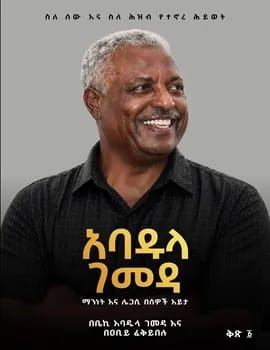
IN HONOUR OF HIS EXCELLENCY ABADULA GEMEDA | STATESMAN · SOLDIER · SERVANT OF THE PEOPLE፡THE IRON MAN WHO CHOSE TO SERVE:
Abadula Gemeda, Soldier, Statesman, and the
Quiet Architect of Ethiopia’s Political Transformation
An Editorial Reflection on a Life in Full
Published in honour of the launch of
Abadula Gemeda: Legacy and Identity Through the Eyes of Others Sheraton Addis Ababa, June 10, 2026
“The measure of a statesman is not the power he accumulated, but the power he chose to walk away from.”
CONGRATULATIONS – TO HIS EXCELLENCY AND HIS FAMILY
On behalf of the Horn of Africa Geopolitical Review and its entire analytical community, and Horn News Hub we extend to His Excellency Abadula Gemeda our deepest, warmest, and most genuine congratulations on the occasion of his 68th birthday, on the remarkable milestone of this biography’s publication, and above all, on a life of public service that has left marks on Ethiopia’s political architecture that will endure long after the political turbulence of this era has subsided. To Beki Abadula, his daughter and co-author, and to the entire Abadula family: you have given Ethiopia a gift in this book a window into the human being behind the statesman, and a record that history deserved to have and that your courage in producing it has now secured.
PART ONE: THE MAN BEHIND THE TITLE
I. A Figure of Rare Political Substance
In the competitive, often brutal landscape of Ethiopian political life a landscape in which institutions have frequently served as instruments of personal power rather than public accountability, and in which survival has too often required the subordination of integrity to expedience Abadula Gemeda represents something that deserves to be named plainly: a figure of rare political substance.
A man who accumulated significant power over the course of a career spanning decades at the highest levels of both military command and civilian governance, and who consistently demonstrated that his relationship to that power was instrumental rather than terminal. He wielded authority in service of objectives larger than himself. He understood, in ways that many of his contemporaries demonstrably did not, that political office is a temporary custodianship rather than a permanent personal possession.
This is not a minor distinction. It is, in the context of the Horn of Africa’s political history, an extraordinary one. And it is the lens through which his full record as military commander, as Oromia Regional President, as Speaker of the House of Peoples’ Representatives, and as the quiet senior statesman who made one of the most consequential acts of political courage in modern Ethiopian history must be read and assessed.
The Iron Man Archetype: What It Actually Means
The description of Abadula Gemeda as an ‘iron man’ of Ethiopian politics has circulated across political commentary for decades, and it has been earned though not in the ways that the phrase might superficially suggest. The iron man archetype in political life does not simply describe someone who is physically or personally indestructible. It describes something more specific and more interesting: a leader who absorbs pressure that would shatter less disciplined personalities, who maintains strategic clarity under conditions of intense institutional hostility, and who emerges from sustained opposition with his core commitments intact. By every measure of this definition, Abadula Gemeda qualifies.
He survived, during the years of TPLF neopatrimonial dominance, a sustained campaign of institutional discrimination and political blackmail that drove many of his Oromo contemporaries either into exile, into silence, or into complete capitulation to the TPLF’s ethnic power hierarchy. That he endured this campaign without abandoning his political footing, without surrendering his standing within the Oromo political community, and without losing the relationships and networks that would eventually matter enormously is a testament to a quality that the best political leaders possess in rare abundance: the capacity to absorb punishment patiently, to keep a level head when the political stakes are existentially high, and to distinguish between battles worth fighting now and battles that must wait for a different moment.
He was pushed beyond the limit not once, not occasionally, but as a matter of sustained institutional policy by leaders who understood exactly what they were doing. He did not break. That alone sets him apart.
PART TWO: SURVIVING THE TPLF ERA- THE TEST THAT DEFINED HIM
II. What It Cost to Remain Standing
To understand the full significance of Abadula Gemeda’s career, it is necessary to understand the political environment that constituted its most demanding test: the three decades of TPLF-dominated governance that defined Ethiopian political life from 1991 to 2018. The TPLF’s system of governance was, in structural terms, a textbook case of what political scientists call neopatrimonialism a system in which formal institutional authority is systematically hollowed out and replaced by personal loyalty networks, ethnic patronage hierarchies, and the calculated distribution of rewards and punishments based on proximity to and compliance with the dominant political clique.
Within this system, Oromo political figures occupied a structurally ambiguous and consistently disadvantaged position. The EPRDF architecture nominally included the Oromo People’s Democratic Organization (OPDO) as a partner party, but the partnership was transparently subordinate a mechanism through which the TPLF managed Oromia’s vast population and resources without relinquishing substantive control over federal political direction. Oromo leaders who played within this system too compliantly lost credibility with the Oromo public. Those who pushed back too aggressively risked direct institutional retaliation. Navigation between these constraints required precisely the kind of political intelligence the capacity to be simultaneously strategic and principled, patient and purposeful that Abadula Gemeda demonstrated over a career-defining period.
Weathering the Storm: The Quality That Cannot Be Manufactured
What the TPLF era demanded of leaders like Abadula Gemeda was not the dramatic courage of a single decisive confrontation. It was the more grinding and in many ways more demanding courage of sustained endurance the capacity to weather the storm for years, to keep a level head when institutional pressure was mounting from every direction, to maintain an ironclad determination without the outlet of visible resistance that might have provided catharsis at the cost of political survival.
He remained. He accumulated credibility within the Oromo political community not through revolutionary gestures but through consistent, visible presence through being the kind of political figure whose word meant something, whose relationships were built on genuine mutual respect rather than strategic calculation, and whose public record demonstrated that his commitments tracked his convictions over time. This is the specific quality that made what he would eventually do in 2018 both possible and consequential: the trust he had built over years of patient political navigation was the resource that made his support for a new generation of leadership transformative rather than merely procedural.
To snatch victory from the jaws of defeat requires more than tactical brilliance. It requires the patience to remain in the game long enough for the moment to arrive. Abadula Gemeda understood this in ways that changed the course of Ethiopian history.
PART THREE: THE ACT THAT CHANGED ETHIOPIA
III. Jumping Ship from Comfort to Conscience-The 2018 Transformation
The most consequential single act of Abadula Gemeda’s political career and one of the most consequential acts of individual political courage in modern Ethiopian history was his decision to throw the full weight of his authority and credibility behind the emergence of a new generation of Oromo political leadership at precisely the moment when the old TPLF-dominated order was most vulnerable to challenge. Understanding what this meant requires understanding what he was, in effect, walking away from.
By 2018, Abadula Gemeda held the Speakership of the House of Peoples’ Representatives one of the most powerful formal positions in Ethiopian constitutional architecture. He was, by any measure, an establishment figure: a man who had navigated the TPLF era successfully enough to reach the apex of institutional authority. For a leader of his standing to support, platform, and effectively legitimize the emergence of younger Oromo figures the cohort that would coalesce around Lemma Megersa, Abiy Ahmed, Shimelis Abdisa, and what became known as Team Lama was not a risk-free calculation. It was, in the deepest sense of the idiom, a willingness to turn the tables on the system he had survived within: to use the institutional credibility he had built across decades to fund a transition whose beneficiaries were not himself.
The Art of Being the Bigger Person in Politics
There is a phrase that captures one dimension of what Abadula Gemeda demonstrated in this period: being the bigger person. In everyday usage, the phrase describes the choice to take the high road when provocation invites retaliation the choice to respond to difficult circumstances with maturity and restraint rather than defensiveness and self-interest. In political usage, it describes something considerably more demanding: the willingness to subordinate personal political interest to institutional and generational necessity, to choose reconciliation over entrenchment, and to recognize that the most important legacy a leader can leave is not the length of his tenure but the quality of the transition he enables.
Abadula Gemeda chose to be the bigger person in a political culture that had been defined for three decades by leaders who were constitutionally incapable of that choice. The TPLF’s failure its most fundamental, most consequential, and ultimately most self-destructive failure was the failure of its leadership generation to recognize when it was time to pass power. Figures like Meles Zenawi held office until death. Others continued to cling to institutional authority long after their political legitimacy had been exhausted, creating the conditions for the explosion that eventually cost the movement everything.
Against this backdrop, Abadula Gemeda’s willingness to invest in successors to pull a rabbit out of the hat by deploying his institutional credibility not for his own perpetuation but for the empowerment of a younger generation reads as exactly the kind of political wisdom that Ethiopian political culture has desperately needed and only rarely received.
The Oromo Political Legacy: Complexity Without Simplification
It would be analytically irresponsible to present the legacy of the 2018 political transformation that Abadula Gemeda helped enable without acknowledging its complexity. The emergence of Abiy Ahmed’s administration has produced outcomes that are contested from multiple political perspectives: optimism about democratization from some quarters, deep concern about centralization and the suppression of genuine Oromo nationalist political movements from others. The Tigray war and its catastrophic human cost have cast long shadows over the optimism of the reform moment. The Oromo political landscape remains fractured and contested.
None of these complexities diminish the significance of what Abadula Gemeda did. They complicate it as all serious historical acts are complicated by their consequences, which no actor can fully control. What he did was invest his political capital in a transition. What came of that transition was shaped by forces, decisions, and actors far beyond his singular influence. His place in history is properly assessed by what he chose to do with power when he held it and what he chose to give away.
PART FOUR: THE BOOK — A DAUGHTER’S GIFT TO HISTORY
IV. Legacy and Identity Through the Eyes of Others: Why This Volume Matters
The publication on June 10, 2026 of Abadula Gemeda: Legacy and Identity Through the Eyes of Others co-authored by his daughter Beki Abadula and Abiy Feqybelu, launched at the Sheraton Addis Ababa in a gathering that doubled as a surprise celebration of his 68th birthday is not simply a family tribute, though it is that too. It is a contribution to the historical record at a moment when Ethiopia desperately needs credible, documented accounts of its recent political history told by people who lived it from the inside.
A Daughter’s Perspective: The Indispensable Angle
Beki Abadula’s authorial choice to write not solely from her own perspective as a daughter, but to structure the biography as a collection of testimonies from the full range of people who encountered her father across the dimensions of his extraordinary life reflects a documentary intelligence that goes beyond filial affection. The title’s phrase ‘through the eyes of others’ is not modesty. It is a methodology. It acknowledges that the full truth of a public life is not contained in any single perspective, that the soldier colleagues see dimensions of the man that the political comrades do not, that the family sees what the institutional record cannot capture, and that the most honest portrait of a complex life is assembled from the full mosaic of testimony.
This approach also places the biography in a lineage of political testimony literature that has proven durable precisely because it refuses to flatten its subject into hagiography. The most enduring portraits of great political figures in the biographical tradition are those that permit the reader to encounter the subject’s full human dimensions the private vulnerabilities alongside the public achievements, the moments of doubt alongside the demonstrated courage. A daughter who is also a serious author is positioned to provide exactly this: the intimacy of family knowledge combined with the discipline to present rather than merely celebrate.
The Multilingual Release: Reaching Every Ethiopian
The simultaneous publication in Afaan Oromoo, Amharic, and English is not a logistical detail. It is a political and cultural statement. In a country where linguistic access to political history has too often been unequally distributed where the historical record has been curated in ways that privileged certain communities’ narratives over others a biography published simultaneously in all three major languages of Ethiopian political life makes an implicit argument about whose history this is. It is Oromo history. It is Ethiopian history. And it is history that the international community deserves access to in its own terms, without the mediation of a single linguistic prism.
For the Tigrayan intellectual community, observing the launch of this biography from our own complicated position in Ethiopia’s political landscape, the multilingual release carries particular resonance. The documentation of political history in all the languages of those who lived it is a standard that the reconstruction of Tigrayan political memory must also aspire to meet. Beki Abadula’s editorial choice is, in this sense, a model as well as a monument.
A daughter who writes her father’s biography honestly does not just honour him. She holds him accountable to history and that is the highest form of love a biographer can offer her subject.
PART FIVE: THE STATESMAN’S LEGACY- A COMPARATIVE ASSESSMENT
V. What Abadula Gemeda Teaches Ethiopian Political Culture
The analysis of Abadula Gemeda’s career yields several lessons that carry relevance well beyond the specific story of one remarkable political life lessons that Ethiopian political culture, in its current condition of fragmentation and crisis, urgently needs to receive and internalize.
The First Lesson: Power Held as Custodianship
The single most important structural lesson of Abadula Gemeda’s career is the demonstration that it is possible not merely theoretically, but practically and consequentially for a political figure who has accumulated substantial power in the Ethiopian system to understand that power as temporary custodianship rather than permanent personal possession. This lesson sounds simple. In the context of Horn of Africa political culture, it is revolutionary.
The TPLF’s most catastrophic failure was the failure to internalize it. Leaders who hold power until death, who equate institutional authority with personal identity, who cannot imagine political life without their own centrality to it such leaders do not merely fail themselves. They fail the institutions they control and the populations those institutions are supposed to serve.
The Second Lesson: Not Power-Hungry, Therefore Powerful
There is a paradox at the heart of Abadula Gemeda’s political effectiveness that deserves direct acknowledgment. A leader who is genuinely not power-hungry who has demonstrated, through action rather than rhetoric, that his objectives are larger than his personal political survival is, precisely because of this quality, more politically effective than the leader who is consumed by power-seeking. Colleagues trust him, because they know his support is not transactional. Successors are willing to be mentored by him, because they know he is investing in them rather than using them. Adversaries underestimate him, because they cannot understand a political actor whose motivation does not reduce to self-interest.
Abadula Gemeda’s support for Team Lama and the new generation of Oromo leadership was credible precisely because his career had established that credibility. You cannot manufacture that kind of political trust in the moment when you need it. It is built across years of consistent conduct. His investment in Abiy Ahmed, Lemma Megersa, Shimelis Abdisa, and the figures around them carried the full weight of a career’s worth of accumulated credibility and that weight made the transition possible in ways that no amount of tactical maneuvering by less trusted figures could have achieved.
The Third Lesson: A Person of the People Who Reached the Summit
Throughout a career that took him from military command to the Oromia Regional Presidency to the Speakership of the national parliament, Abadula Gemeda maintained by the consistent testimony of those who knew him across these different phases of his life the quality that his biography’s diverse voices all seem to recognize: he remained, despite everything, a person of the people. Accessible. Grounded. Capable of genuine human encounter outside the protocols of institutional authority. This quality is not cosmetic in political life. It is strategic. Leaders who lose their connection to the lived experience of the people they nominally represent lose, over time, the capacity to make decisions that actually serve those people. The distance between the institutional summit and the human ground becomes, in such cases, a source of systematic governance failure. Abadula Gemeda, by the available evidence, never entirely lost the connection.
CLOSING TRIBUTE TO HIS EXCELLENCY, HIS DAUGHTER, AND HIS LEGACY
VI. A Life in Full
His Excellency Abadula Gemeda turns 68 at a moment when Ethiopian political life faces challenges that would daunt any serious observer. The Tigray war’s aftermath remains unresolved. The Oromo political landscape is contested and complex. The institutional architecture of Ethiopian federalism is under pressure from multiple directions simultaneously. It would be tempting, in this context, to assess his legacy against the full complexity of the outcomes that followed from the political transformation he helped enable.
We choose, instead, to assess it against the standard most appropriate to a man of his particular qualities: the standard of what he chose to do when he had power, and what he chose to give away. By that standard, the verdict is clear and it is honourable. He served with distinction in the most demanding conditions his country could produce. He survived the worst that a neopatrimonial system could inflict on a figure who refused to be completely captured by it. He chose, at the pivotal moment, to invest his political capital in successors rather than his own perpetuation. He accepted the Speaker’s chair with the same seriousness he had brought to every role before it and he left it, when the time came, without clinging.
These are not small things. In the history of the Horn of Africa, they are not common things. They deserve to be named, recorded, and honoured which is precisely what his daughter Beki Abadula has done in producing the biography now before us.
A man of the world. A person of the people. A soldier who became a statesman. A statesman who chose legacy over longevity. Happy birthday, Your Excellency and congratulations on a life that earned every word written in its honour.