
Strategic Comparative Analysis | Political-Military Assessment Published by the Horn of Africa Geopolitical Review (HAGR) Security • Military • Political • Institutional Analysis & Intelligence Review
Executive Assessment
In every collapsing military campaign, the most critical front often shifts away from the physical theater of operations. It migrates into the widening gap between objective reality and official messaging.
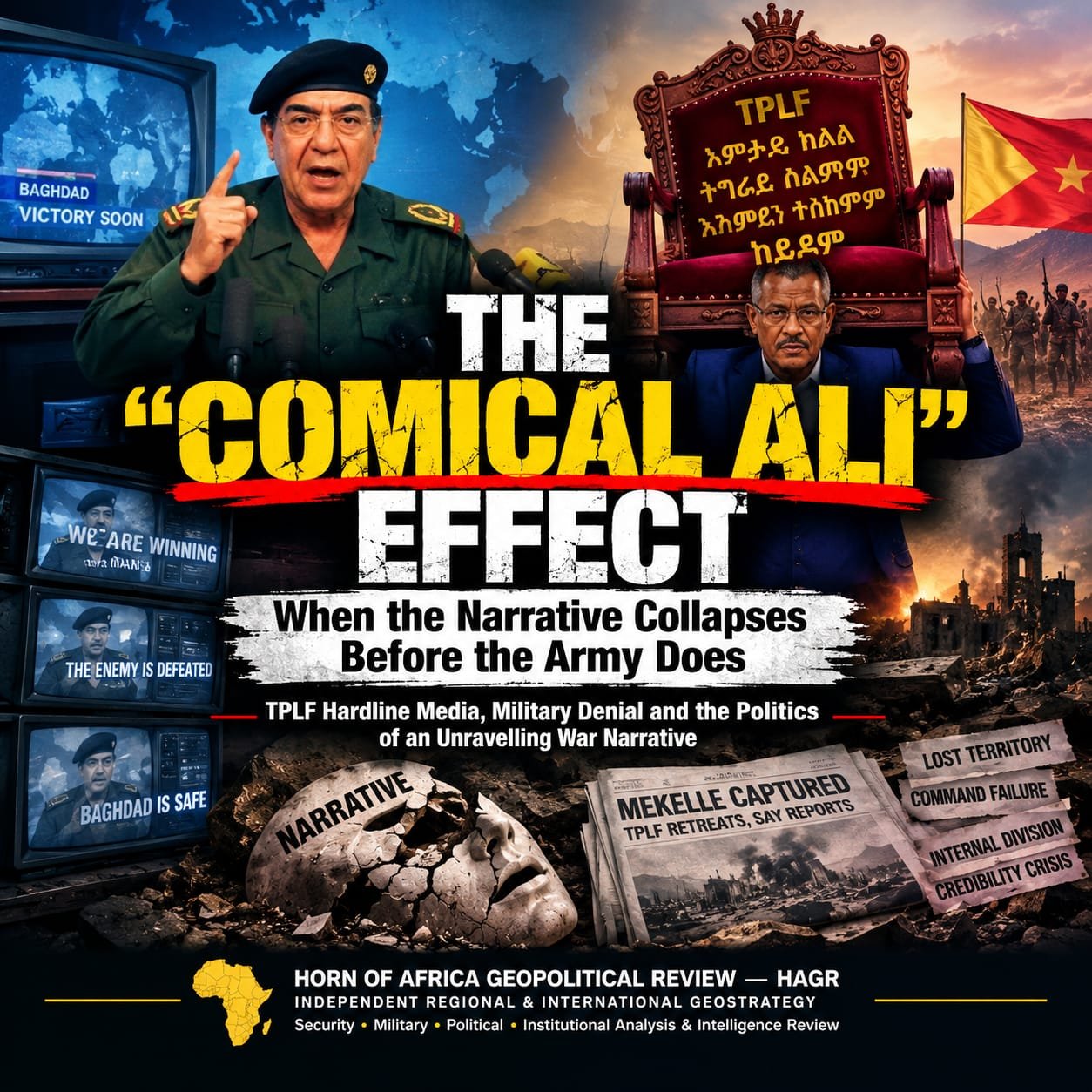
This phenomenon recalls Muhammad Saeed al-Sahhaf—Saddam Hussein’s information minister during the final weeks of the 2003 Iraq War. Internationally dubbed “Comical Ali” or “Baghdad Bob,” al-Sahhaf continued projecting confidence, control, and imminent victory while coalition forces actively converged on the capital.
The historical takeaway, however, is not merely that optimistic military spokesmen are prone to exaggeration. The deeper lesson is structural: an information system becomes dangerous to its own leadership when political narrative completely replaces situational awareness.
This comparative analysis examines elements of the hardline TPLF information environment during recent hostilities. It does not equate Tigray to Ba’athist Iraq, nor does it treat the Tigrayan population, civil society, or media as a monolith. Instead, it isolates a recurring information-war mechanism: the danger that unfolds when a political-military leadership under severe pressure continues presenting battlefield developments through a narrative of uninterrupted success while independent evidence indicates rapid unravelling.
1. Baghdad 2003: The Divergence of Screen and Street
Al-Sahhaf’s public performances became legendary because of a stark paradox. The official information apparatus projected absolute control, while the physical evidence outside the studio windows told a completely different story.
As viewers compared televised assertions with visible events on the ground, the official narrative suffered a catastrophic loss of credibility. The more aggressively the information system denied observable reality, the faster its authority dissolved. Thus, “Comical Ali” transitioned from a nickname into a lasting historical metaphor for the collapse of institutional credibility under conditions of severe military deterioration.
2. The TPLF Information-War Mechanism
Evaluating contemporary information strategies requires analytical discipline. The TPLF emerged from a distinct political and military history, and Tigray’s conflict is deeply embedded in Ethiopia’s complex internal political structure, post-war grievances, and regional rivalries.
The analytical focus here is neither the Tigrayan population nor Tigrayan media as a whole, but rather the hardline political-military information narrative surrounding the conflict. The central question is straightforward: What happens when a military organization suffers acute battlefield reversals, but its political communications continue describing the strategic environment as fundamentally favorable?
While the two conflicts differ vastly in context, the underlying information pathology is strikingly recognizable.
3. The First Crack: When Defeat Must Be Renamed
Military organizations routinely execute legitimate tactical withdrawals—repositioning, consolidating, shortening supply lines, abandoning exposed positions, or preserving combat power.
The analytical fault line opens when every tactical setback is automatically rebranded as a victory within official political vocabulary:
- A retreat becomes a “strategic repositioning.”
- A lost town becomes an “operational adjustment.”
- A failed offensive becomes “successful defensive warfare.”
- A collapsing front becomes a “planned maneuver.”
These characterizations are not automatically false on their face; the decisive test lies in the subsequent evidence. Did the force regain the initiative? Were lost positions recovered? Did the temporary withdrawal yield a superior operational posture?
When the repeated answer is no, terminology can no longer conceal underlying trends. At that juncture, language stops explaining the battlefield and begins attempting to outrun it.
4. The Speed and Scale of Reversal
The sequence of events in late September and early October 2026 underscores these dynamics. Following initial reports of Tigrayan forces seizing several regional airports and expanding operations beyond Tigray, federal and allied forces launched a major counteroffensive, capturing Alamata. By October 4, reporting from Reuters indicated that government forces had captured Mekelle, with the TPLF confirming its retreat from the city.
If independently verified, this rapid turnaround raises a foundational strategic question: How did an offensive capable of yielding rapid territorial gains degenerate into a campaign where the initiative was reversed so abruptly?
Answering this requires looking closely at logistics, command and control, intelligence, force cohesion, local alliances, airpower, communications, and mobilization capacity. Rapid military collapse is rarely isolated; it is almost always the terminal phase of a much longer institutional process.
5. Losing the Battlefield Inside the Headquarters
The most hazardous failure in warfare is rarely a tactical defeat; it is the misreading of that defeat. Commanders can lose towns, rebuild forces, and survive serious military setbacks. What organizations rarely survive is a leadership incapable of accurately assessing why they are losing.
This dynamic triggers a destructive institutional feedback loop:\text{Bad Intelligence} \longrightarrow \text{Flawed Assessment} \longrightarrow \text{Unrealistic Expectations} \longrightarrow \text{Poor Decisions} \longrightarrow \text{Setback} \longrightarrow \text{Denial}
When denial sets in, the information problem mutates into a command problem, which ultimately manifests as a structural military failure.
6. From Confidence to Hubris
A vital dividing line separates strategic confidence from hubris:
- Confidence acknowledges setbacks while retaining a clear-eyed view of recovery capacity, enabling tactical and strategic adaptation.
- Hubris assumes that ideological premises are infallible, forcing reality to bend to the narrative and foreclosing necessary adaptation.
When a military organization penalizes bad news, it systematically blinds itself. The adversary does not need to execute perfect deception; the leadership ultimately deceives itself.
7. The “Baghdad Bob” Problem in the Digital Age
Al-Sahhaf relied on traditional television broadcasting. Modern political movements operate within a fragmented digital ecosystem where claims face instant scrutiny:
- Satellite imagery exposes territorial shifts.
- Geolocation tools verify or debunk photographs.
- Open-source intelligence tracks air activity, destroyed equipment, and troop movements.
This abundance of evidence raises the evidentiary burden for any wartime narrative built on absolute certainty. The information environment no longer belongs solely to governments, oppositions, or spokesmen; it belongs to anyone capable of documenting, verifying, and distributing data.
8. When the Narrative Becomes a Liability
Propaganda eventually stops protecting morale and begins eroding it. The trajectory typically follows a predictable downward spiral:
- Claimed victory
- Observable contradiction
- New, ad-hoc explanation
- Second claimed victory & subsequent contradiction
- Cumulative credibility erosion
- Internal confusion and political fragmentation
This is the true essence of the Comical Ali effect: not mere public ridicule, but systemic credibility failure. Supporters stop asking whether an official statement is true and begin wondering whether anything from the leadership can be trusted.
9. Indicators of Narrative Stress for Analysts
HAGR evaluates narrative failure not through isolated speeches or single video clips, but through cumulative indicators:
- Shifting descriptions of territorial control and unexplained withdrawals.
- Repetitive claims of imminent counteroffensives unaccompanied by operational details.
- Declining specificity in military statements and the disappearance of concrete casualty metrics.
- Escalating rhetorical attacks on independent media combined with heavier reliance on ideological language.
- Discrepancies between official statements and verified open-source imagery.
Indingly, none of these indicators single-handedly proves collapse; collectively, however, they map severe narrative stress.
10. Why Mekelle Matters to the Narrative
The reported capture of Mekelle carries disproportionate weight not merely because it is Tigray’s administrative capital, but because capital-city control imposes profound symbolic, administrative, and psychological consequences across the region.
If sustained by independent verification, this reversal forces an uncomfortable reckoning for any hardline narrative that previously framed the campaign as strategically favorable. When strategic recovery is perpetually deferred into an indefinite future—“soon,” “the next phase,” or “temporary withdrawal”—the burden of proof becomes insurmountable. At some point, the operational reality of the battlefield supersedes rhetoric.
11. Core Recommendations for Strategic Monitoring
To maintain analytical integrity, independent intelligence bodies must adhere to strict methodological guardrails:
- Avoid mirror-imaging propaganda: Do not automatically accept or reject claims from federal, regional, or allied authorities.
- Interrogate open-source material: Treat social media footage with rigorous skepticism and cross-reference independent verification.
- Separate political legitimacy from operational effectiveness: Acknowledging a military reversal does not validate an adversary’s political agenda, nor does political grievance compensate for battlefield collapse.
- Prioritize chronology and verifiable operational indicators: Focus on logistics, force preservation, and command structures over rhetorical flourishes.
Final HAGR Judgment
The ultimate lesson from Baghdad in 2003 and its modern echoes in the Horn of Africa is straightforward: confidence detached from accurate situational awareness is a fatal strategic liability.
While military organizations can survive lost territory, temporary setbacks, or retreating fronts, they rarely survive the simultaneous erosion of military capability, command credibility, political authority, and public trust.
The battlefield ultimately determines what a force can physically control, while the information environment shapes what its supporters believe it can control. When those two realities drift too far apart, a political system begins fighting an imaginary war—and imaginary victories cannot hold real territory.
The Central HAGR Question: Did the hardline TPLF military system collapse because it was suddenly defeated on the battlefield, or did it lose strategic coherence earlier, when its leadership became unable to distinguish operational reality from the narrative required to sustain internal morale?
— HORN OF AFRICA GEOPOLITICAL REVIEW — HAGR Independent Regional & International Geostrategy