

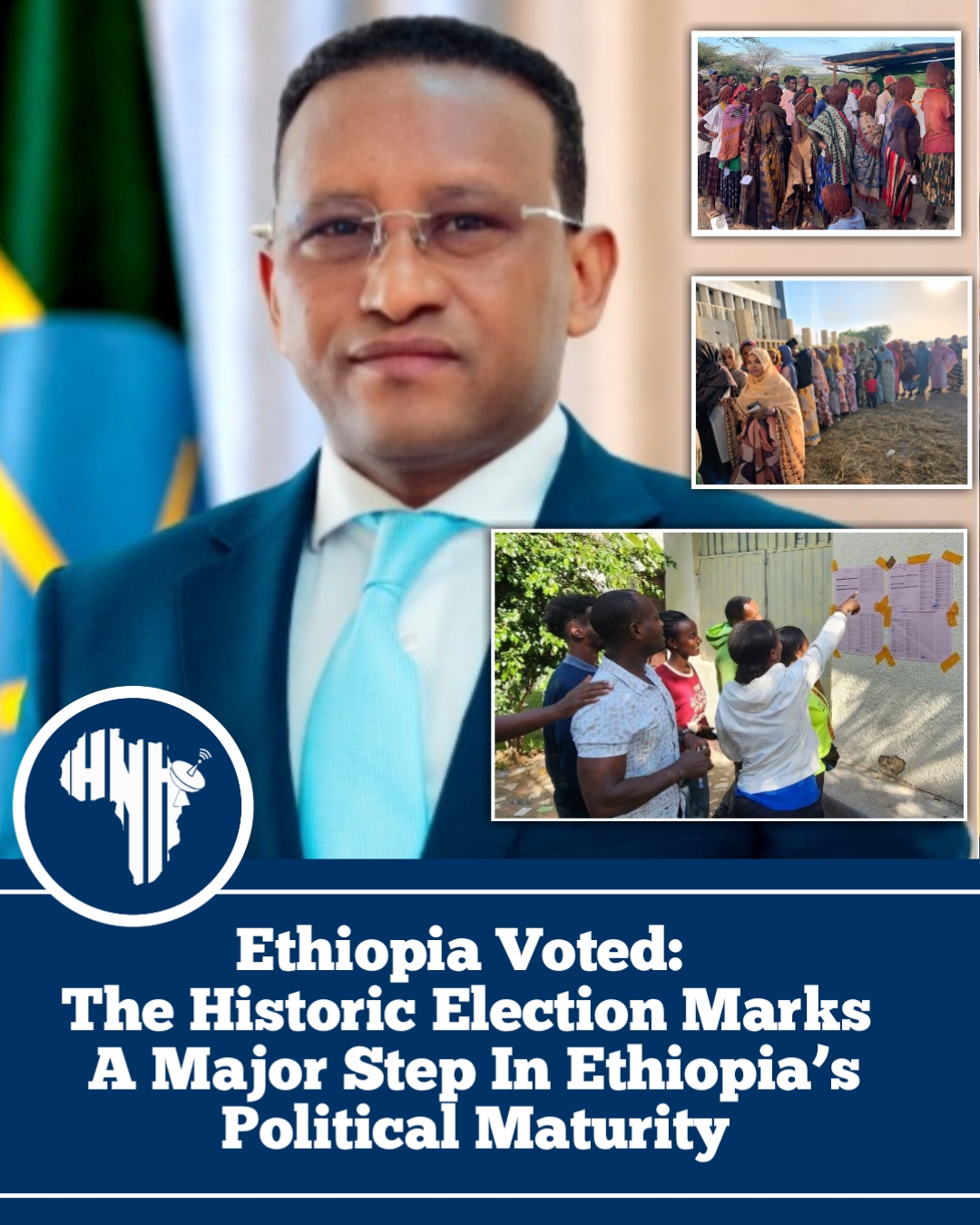
By Ambassador Jemal Beker (PhD)
Ethiopia, as a nation with a remarkable centuries-old history, diverse civilizations, and an unyielding legacy of independence, has achieved a critical milestone in political maturity. While my country’s formal engagement with modern democratic systems is relatively recent, the progress forged over the past four decades demonstrates a steadfast commitment to institutional evolution. By moving past deep-seated historical challenges, we have successfully institutionalized a system that respects the voice of its citizens, proving that its democratic trajectory is both resilient and irreversible.
Historically, one of the primary vulnerabilities identified within our state architecture has been the lack of deeply rooted democratic traditions. Following recent reform under H.E. Prime Minister Abiy Ahmed (PhD), the nation embarked on an ambitious, holistic restructuring project to establish genuinely independent, non-partisan institutions.
This transition has been heavily anchored in a home-grown democratic philosophy Medemer- an approach that synthesizes international best practices with local socioeconomic realities to repair legacy structural fractures. Supported by strategic updates in administrative organization, political thought, and electoral technology, this institutional shift ensures that political transition is dictated solely by law and the ballot box.
The Architecture of the 7th National Election
Building directly upon the foundations and lessons learned from the landmark 6th National Election, the recent 7th National Election represents a highly sophisticated evolution in governance style. It intentionally reflects the principles of consociational democracy, explicitly designed to maintain stability and equitable representation in a multi-faceted nation.
The operational structure of this election was built upon four pillars consisting of Grand Coalitions to foster broad political alliances for widespread consensus, Fair Representation to ensure equitable legislative weight across diverse political views, Segmental Autonomy to allow cultural and regional identities to manage local interests securely, and Minority Rights Protection to safeguard the voices and inclusion of smaller communities.
Consequently, these inclusive structural pillars directly inspired an unprecedented wave of nationwide civic enthusiasm, translating high-level design into historic voter turnout.
Numbers Don’t Lie: High Engagement and Inclusive Participation
To evaluate the democratic integrity of an election, international standards examine three core phases consisting of the Pre-Election, Election Day, and Post-Election periods. Ethiopia’s rigorous management of the pre-election phase laid the groundwork for an inclusive, highly competitive environment, verified by exact institutional data points.
The process achieved a total registered candidate field of over 10,438 candidates across participating 42 political parties, with opposition and party competitors deploying 250,000 observers to guarantee transparency across polling stations. Additionally, the field included 80 independent candidates contesting outside traditional party structures, while registered voter turnout reached exactly 54,057,871 citizens who successfully registered and secured their voting cards. Among the registered voters, 90% of them have cast their votes in the ballot box.
Out of an overall eligible population of 135+ million, this impressive turnout represents an undeniable vote of confidence from the Ethiopian public. Furthermore, during this pre-election phase, the political parties successfully conducted 19 televised debate forums across five distinct languages using strategically allocated public airtime slots to guarantee equity in media access. In tandem with this remarkable civic energy, Election Day unfolded as a peaceful, joyful climax where voters confidently exercised their democratic rights.
Election Day: A Free, Fair, and Sovereign Expression
On Election Day, citizens turned out en masse to cast their ballots freely, peacefully, and without external influence or intimidation. This smooth execution reaffirms a fundamental truth that our public embraces a credible electoral process as the sole legitimate mechanism for establishing a social contract with governance. By mobilizing to build an accountable administration, the electorate has consciously chosen a path of constitutional continuity, stability, and peaceful institutional transition.
The transparency and exclusivity of the entire process were thoroughly observed and verified by international monitoring bodies, including the African Union (AU) and the Intergovernmental Authority on Development (IGAD), complemented extensively by domestic civil society. Specifically, the African Union deployed a 59-member Election Observer Mission led by the former President of the Republic of Kenya, H.E. Uhuru Kenyatta, while IGAD fielded a specialized team of 26 international observers. On the domestic front, 55 legally authorized civil society organizations successfully mobilized and deployed 1,562 certified domestic monitors across the country’s polling infrastructure. Their unified presence validated that the election met rigorous international standards for fairness, openness, and civic participation.
As the seat of the African Union, Ethiopia’s successful election serves as a powerful, stabilizing template for other emerging democracies across the African continent and the global south, proving that complex, diverse nations like us, can execute seamless democratic cycles.
During the preliminary post-election briefing, the African Union and IGAD Election Observation Missions confirmed that Ethiopia’s electoral process took place in a peaceful, orderly, and calm environment, with observer teams reporting smooth voting procedures and orderly polling station operations across observed areas. Head of the AU Election Observation Mission and former Kenyan President Uhuru Kenyatta stated that voting had “progressed smoothly,” noting that citizens were freely and voluntarily exercising their democratic rights and choosing their preferred parties without pressure.
Kenyatta further described the electoral process as a “completely peaceful and credible process.” Observer missions highlighted strong citizen participation, broad voter engagement, and voting processes that largely proceeded without major incidents in observed areas. These preliminary findings reinforced confidence in the overall conduct, credibility, and peaceful nature of the electoral process while demonstrating the commitment of Ethiopian citizens to express their democratic will through the ballot box.
Consequently, this profound milestone stands validated before the international community, perfectly setting the stage for a bright, self-determined future for our nation’s democratic exercise. The successful completion of this historic 7th election is a testament to our growing political maturity and the enduring resilience of our state architecture. Ultimately we, the Ethiopian people, are the true authors of this success, establishing a sacred mandate for our own peace, justice, and equitable development.
By coming together to transcend past fractures, we have proven that our democratic path is irreversible, positioning Ethiopia as a powerful global exemplar of democratic consolidation.
Contributor: Ambassador Jemal Beker (PhD), Ethiopia’s Ambassador to the United Arab Emirate
Editor’s Disclaimer:
The views and opinions expressed in articles published by Horn News Hub are those of the authors and do not necessarily reflect the official position or editorial stance of Horn News Hub. Publication does not imply endorsement.