
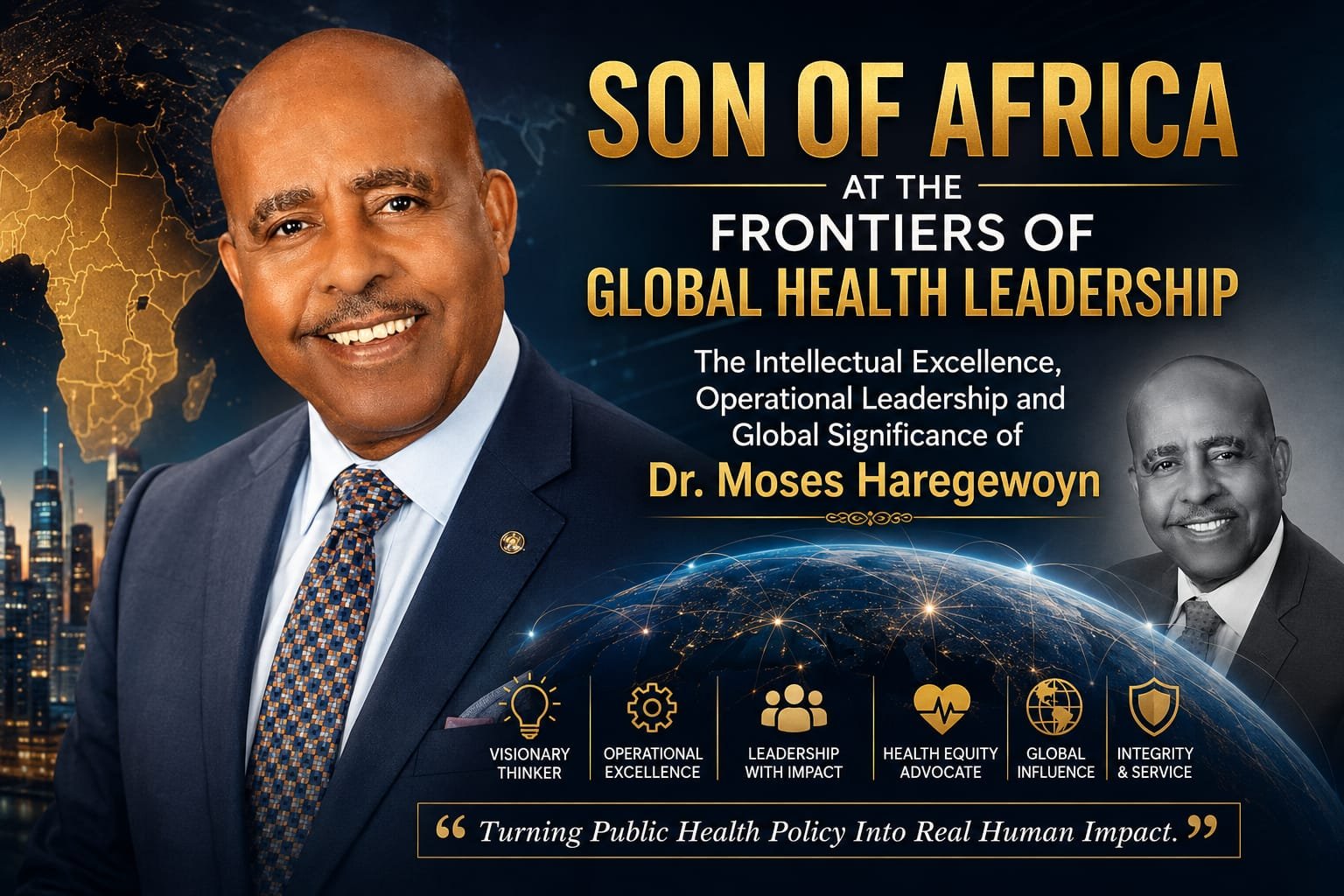
The Intellectual Excellence, Operational Leadership and Global Significance of
Dr. Moses Haregewoyn
A Special Editorial Recognition by the Horn of Africa Geopolitical Review
Some professional achievements deserve congratulations. Others deserve reflection because they tell a larger story about what disciplined leadership, education and service can accomplish over a lifetime.
The career of Dr. Moses Haregewoyn belongs in the latter category.
The Horn of Africa Geopolitical Review offers this recognition not as ceremonial praise, but as an expression of genuine respect for a professional journey that has brought together scholarship, public-health administration, institutional leadership and a strong commitment to serving communities.
Dr. Moses represents a kind of leadership that rarely receives the attention it deserves. Much of the work that sustains a health system happens away from the cameras. It happens in administrative offices, enrollment systems, call centres, technology platforms, policy implementation teams and countless decisions that determine whether a person can actually obtain the assistance to which they are entitled.
That work may not always be visible.
Its consequences are.
A health policy can be ambitious. A government programme can be well funded. A medical system can have outstanding professionals and sophisticated technology. Yet if people cannot understand the system, enrol in it, navigate it or receive the services intended for them, policy remains incomplete.
This is the space in which Dr. Moses Haregewoyn has built much of his professional contribution.
As President of Automated Health Systems (AHS), he has worked at the intersection of public health, organisational leadership, administration, technology and human need. His multidisciplinary academic background—including advanced study in public health, sociology, business administration and organisational behaviour—has given him a distinctive foundation from which to approach complex institutional problems.
His career also reflects sustained professional development. Beginning in healthcare administration in the early 1990s, he progressed through increasingly demanding responsibilities before taking on senior leadership at AHS.
What makes that journey particularly noteworthy is not simply the position he ultimately attained. It is the breadth of experience accumulated along the way and the practical understanding that comes from working inside complicated public systems over many years.
FROM POLICY TO PEOPLE
The effectiveness of a health system cannot be judged solely by legislation, budgets or institutional structures.
The harder question is whether those structures work for the person standing at the other end of them.
Can a vulnerable family access the programme created for its benefit?
Can an elderly person navigate the enrollment process?
Can someone with limited language proficiency understand what assistance is available?
Can a citizen move through an administrative system without becoming lost in bureaucracy?
These questions may sound operational, but they are ultimately questions of fairness.
That is one of the important lessons reflected in Dr. Moses’s professional work: public policy has little value if the institutions responsible for delivering it cannot translate policy into practical access.
This is where administration becomes more than administration.
It becomes part of public health itself.
AHS’s work in areas such as eligibility, enrollment, beneficiary support and customer-service infrastructure illustrates the importance of that often-unseen layer of healthcare delivery.
There is nothing glamorous about making complicated systems function properly.
But there is enormous value in doing so.
INTELLECTUAL LEADERSHIP THAT PRODUCES RESULTS
What particularly distinguishes Dr. Moses is the relationship between his academic background and his practical leadership.
Scholarship can provide insight, but insight alone does not change institutions.
Management can produce activity, but activity alone does not necessarily produce progress.
The real challenge is bringing the two together.
Dr. Moses’s professional path reflects an effort to do precisely that: to understand organisations as human and institutional systems while remaining focused on the practical demands of operating them effectively.
That requires more than technical knowledge.
It requires judgement.
It requires the ability to see the larger system while remaining attentive to the details that determine whether the system actually works.
It requires listening to people, understanding competing interests, anticipating institutional obstacles and making decisions that can survive beyond the immediate moment.
This is a quieter form of leadership, but it is often the leadership that determines whether large institutions succeed or fail.
THE AMERICAN EXPERIENCE AND ITS GLOBAL LESSON
The significance of Dr. Moses’s work extends beyond the United States.
American healthcare administration is extraordinarily complex. Federal programmes intersect with state governments, local authorities, providers, insurers, technology systems and millions of individual beneficiaries.
Working effectively within such an environment demands institutional maturity.
It demands an understanding of scale.
It demands technological competence without losing sight of the human being behind the data.
And it demands the patience to improve systems whose problems cannot be solved by a single policy announcement or a single executive decision.
The broader lesson is therefore relevant far beyond America.
For countries seeking to expand universal health coverage, the question should not simply be how many hospitals are built or how much money is allocated.
The question must also be: Can the system reliably connect people with the services and benefits it promises?
That is an administrative question.
But it is also a question of human dignity.
A BRIDGE BETWEEN AFRICAN HERITAGE AND AMERICAN EXCELLENCE
There is a particular sense of pride in seeing a person of African heritage build a distinguished professional career within one of the world’s most complex public-health environments.
But the significance of Dr. Moses’s journey should not be reduced to identity alone.
Its deeper meaning is about possibility.
It demonstrates what can happen when education, opportunity, discipline, professional integrity and institutional responsibility come together over time.
It is also a reminder to Africa’s younger generation that success should not be measured simply by the title attached to one’s name.
The greater achievement is to acquire knowledge, master difficult systems, build institutions and leave something useful behind.
Africa possesses extraordinary intellectual and professional talent. One of its continuing challenges has been creating institutions capable of developing, retaining and fully benefiting from that talent.
Dr. Moses’s career offers a powerful counterexample: a professional shaped by African heritage who has built substantial institutional experience in the United States and whose work offers lessons that can be considered far beyond the country in which it was developed.
FROM AMERICAN PUBLIC HEALTH TO AFRICAN POLICY THINKING
African policymakers and health administrators have much to consider when examining successful models of public-health administration.
The conversation about healthcare often begins with hospitals, doctors, medicines and financing. Those are indispensable.
But another layer deserves equal attention.
How are people enrolled?
How are vulnerable communities identified?
How is information communicated in languages people understand?
How are administrative barriers reduced?
How does technology improve access rather than create another obstacle?
How are government programmes monitored?
And, ultimately, how does a policy move from a government document to the life of an ordinary citizen?
These are not secondary questions.
They are central to whether health policy succeeds.
A person who is technically entitled to healthcare but cannot navigate the system to receive it remains effectively excluded.
That is why the administrative dimension of public health deserves far greater attention in Africa and elsewhere.
LEADERSHIP MEASURED BY WHAT REMAINS
Perhaps the fairest way to judge leadership is to ask what remains after the leader is no longer in the room.
Is the institution stronger?
Are the systems more capable?
Have people been given opportunities to grow?
Has knowledge been transferred?
Are communities better served?
Has the next generation inherited something more effective than the generation before it?
These questions matter more than titles, publicity or ceremonial recognition.
Dr. Moses’s career invites that kind of assessment.
His years in public-health administration, his academic preparation and his leadership of AHS together represent a substantial body of professional experience. More importantly, they illustrate a philosophy of leadership in which institutional performance and human outcomes are not competing objectives.
They are connected.
RECOGNITION BEYOND TITLES AND AWARDS
Recognition has value when it reflects substance.
Awards, media coverage, professional honours and public acknowledgement can bring attention to achievement, but they should never become substitutes for achievement itself.
The recognition that matters most is the recognition that comes from the quality and durability of a person’s contribution.
For that reason, we do not view Dr. Moses simply as a successful executive or accomplished scholar.
We recognise him as an institution-builder and systems thinker whose career demonstrates how knowledge can be converted into practical organisational capacity and public value.
That distinction is important.
His story is not simply about personal advancement. It is about what can be accomplished when intellectual preparation is matched by years of disciplined professional execution.
THE PRIDE OF AFRICA — THE POWER OF PROFESSIONAL EXCELLENCE
For many Africans, Dr. Moses’s journey is a source of legitimate pride.
But pride should not end with admiration.
It should become inspiration.
Young Africans should see in such a career the value of education, professional discipline, intellectual curiosity and institutional responsibility. They should understand that leadership is not simply about occupying prominent positions. It is about becoming capable of carrying responsibility when the problems are difficult and the answers are not obvious.
The lesson is therefore bigger than success.
The objective is not merely to become prominent. It is to become consequential.
To build something.
To solve something.
To improve something.
And, ultimately, to leave institutions and communities stronger than they were before.
A FORMAL MESSAGE FROM THE EDITORIAL BOARD
On behalf of the Editorial Board of the HORN OF AFRICA GEOPOLITICAL REVIEW, we extend our sincere admiration, respect and appreciation to Dr. Moses Haregewoyn.
We recognise the intellectual discipline behind his career.
We recognise the decades of professional experience that have shaped his leadership.
We recognise the complexity of the public-health systems within which he has worked.
We recognise the value of combining academic knowledge with practical institutional leadership.
And we recognise the wider significance of seeing African professional excellence contributing at a high level within American public-health administration.
The most important forms of leadership are not always loud.
Sometimes leadership is found in the architecture of a system.
Sometimes it is visible in the improvement of a process.
Sometimes it is measured by whether an institution becomes more capable of serving the people who depend upon it.
And sometimes the greatest evidence of leadership is the fact that a complicated system simply works when someone needs it to work.
That is not spectacular leadership.
It is something more enduring.
It is responsible leadership.
And it deserves recognition.
A MESSAGE OF RESPECT AND PRIDE
Dr. Moses Haregewoyn,
Your professional journey represents far more than individual achievement.
It reflects the meeting of scholarship and service, African heritage and American institutional experience, intellectual ambition and practical execution.
Your career offers an important reminder that excellence is not simply about possessing knowledge.
It is about knowing what to do with that knowledge.
It is about transforming ideas into institutions, institutional capacity into reliable systems, and reliable systems into tangible benefits for human beings.
That is the standard of leadership we celebrate.
The Horn of Africa Geopolitical Review is therefore proud to acknowledge your contribution to public-health leadership and to recognise the example your professional journey offers to Africans, Americans and aspiring leaders around the world.
May the work continue.
May the knowledge continue to grow.
And may the institutions you help strengthen continue to serve people long after individual achievements have become part of history.
With profound respect, admiration and appreciation,
The Editorial Board
HORN OF AFRICA GEOPOLITICAL REVIEW
Independent Regional & International Geostrategy
Security • Political • Legal • Institutional Affairs Analysis
Special Editorial Recognition — 2026