
Written by HAGAR
Classification: Open-Source Strategic Analysis | 7 October 2026
Executive Summary
The outbreak of direct hostilities between Eritrean forces and the Ethiopian National Defense Force (ENDF) inside Tigray and Afar represents a strategic inflection point of historic proportions. As of 7 October 2026, Eritrean troops have been confirmed in Adigrat, approximately 40 kilometres south of the Eritrean border, with elements pushing toward Mekelle. Ethiopia and Eritrea have severed all diplomatic ties. A quadrilateral alliance of Egypt, Eritrea, Sudan, and Somalia has agreed to coordinate military and intelligence operations in the event of cross-border escalation.
This assessment evaluates Ethiopia’s strategic position through the lens of a fundamental question: Can Ethiopia transform this crisis into a historic opportunity to permanently reconfigure the geopolitical geography of the Horn of Africa securing sovereign Red Sea access, neutralising the Eritrean threat, and establishing itself as the undisputed regional hegemon?
Our conclusion: Yes but only through decisive, legally justified, and strategically timed military action that fundamentally alters the political geography of the region.
Part I: Ethiopia’s Historical Grievance — The Strategic Case for Redemption
The 1998–2000 War: The Unfinished Victory
The 1998–2000 Ethio-Eritrean War remains the central strategic trauma in Ethiopian national security doctrine. Ethiopian forces, after expelling Eritrean invaders, broke through Eritrean defensive lines and advanced to positions roughly 50 kilometres from Asmara. According to then-President Negasso Gidada, the Ethiopian army had a clear opportunity to seize Assab and potentially advance on the capital.
Senior military officers and the majority of the EPRDF Central Committee supported pressing the advantage. Three operational routes were assessed as feasible: through Keren, through Zalambessa, and by first securing Assab before moving on Massawa and Asmara. The political leadership, however, ordered a retreat under pressure from the United States, which threatened to cut aid if Ethiopia refused a ceasefire.
The result was the Algiers Agreement an instrument that Ethiopia’s own leaders have since described as a catastrophic strategic error. Ethiopia remained landlocked. Assab stayed under Eritrean control. The Isaias regime survived intact. General Tsadkan Gebretensae, then Chief of the General Staff, has repeatedly characterised the decision as a failure to convert military success into lasting strategic gain.
This is the mutuality of regret that now shapes Ethiopian statecraft. Prime Minister Abiy Ahmed has consistently framed Eritrea’s independence and the cession of the Red Sea coast as a catastrophe for the Ethiopian nation—a strategic blunder that must be corrected.
The Demographic and Economic Imperative
Ethiopia’s quest for sea access is not a policy preference—it is an existential necessity:
- Population Pressure: Ethiopia’s population exceeds 130 million, making it the second most populous nation in Africa and one of the largest landlocked populations on Earth.
- Economic Asphyxiation: Since Eritrea’s independence in 1993, Ethiopia has been forced to rely on Djibouti for over 95% of its trade. This dependency imposes massive freight premiums, insurance costs, and strategic vulnerability.
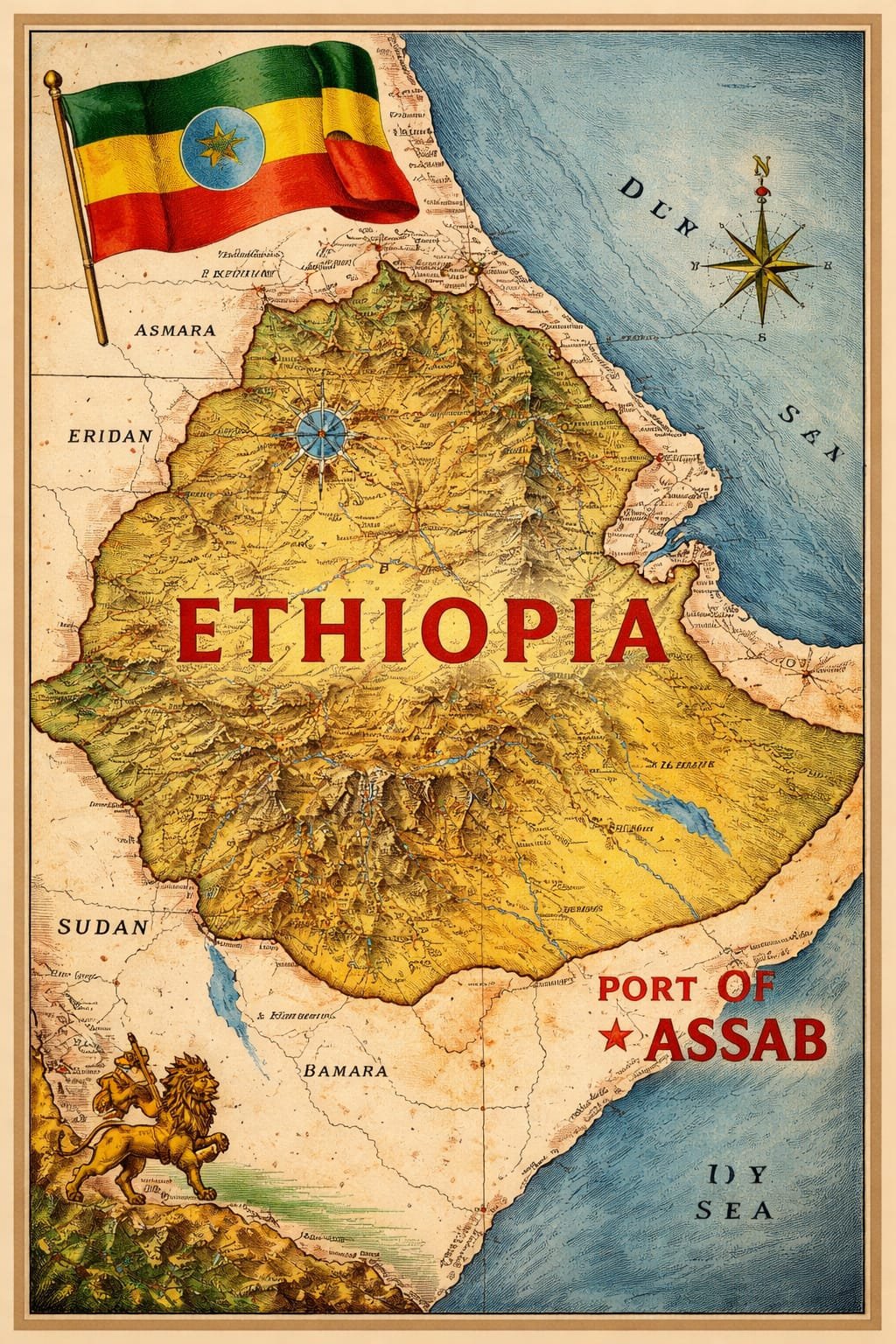
- The Assab Factor: Assab is located just 40 miles from the Ethiopian border. It is the natural, historical, and legal port of Ethiopia. Its loss was not a natural geographic outcome it was a political decision made possible by colonial-era boundary arrangements.
Strategic Conclusion: Ethiopia’s pursuit of Assab is a rational and strategic necessity for regional peace and shared prosperity. A negotiated outcome is preferable—but as the 1998–2000 precedent demonstrates, reliance on international mediation has produced only frozen conflict and renewed Eritrean aggression.
Part II: The Current Military Situation — Eritrea’s Aggression and Ethiopia’s Response
Eritrean Invasion: The Facts on the Ground
Eritrean regular forces have crossed the border and are operating deep inside Ethiopian territory. Confirmed positions include Adigrat, located 40 kilometres south with an established troop presence, Idaga Hamus at 60 kilometres south with elements heading further inland, and multiple points across the Afar Region where Eritrean forces are actively controlling supply routes.
Dr. Abraham Belay, a senior Ethiopian government official and former interim president of Tigray, has confirmed that Eritrean forces “directly participated” alongside Tigrayan forces, warning that Ethiopia’s response would be “doubled”.
Legal Threshold: When a neighbouring state’s regular forces conduct sustained operations deep inside another country, and when that neighbour is credibly accused of arming and directing groups seeking to fragment the Ethiopian state, the conflict has crossed the threshold from internal civil war into an internationalised confrontation. Article 51 of the UN Charter preserves the inherent right of self-defence when an armed attack occurs.
The Eritrean Regime: A Structural Threat to Ethiopian Security
Isaias Afwerki’s regime has survived through:
- Indefinite Conscription: Eritrea imposes unlimited national service, officially until age 40 but often beyond, systematically used as an instrument of social control and repression.
- Externalisation of Violence: Every major confrontation with Ethiopia has been deliberately fought on Ethiopian territory. Tigray functions as a buffer zone. As long as the war stays south of the Mereb River, the Eritrean state apparatus and the ruling clique in Asmara remain insulated.
- Mass Mobilisation: Eritrea maintains an estimated 200,000 active personnel through compulsory national service, creating a highly militarised society.
Strategic Assessment: The Isaias regime is the primary structural driver of recurrent northern conflict. As long as this regime remains intact, every future crisis will be channelled back into Tigray and the surrounding Ethiopian lowlands.
Part III: The Legal Framework — Ethiopia’s Right to Self-Defence and Territorial Reconfiguration
The Eritrea-Ethiopia Boundary Commission (EEBC)
The EEBC was established under the Algiers Agreement to delimit and demarcate the colonial treaty border based on the 1900, 1902, and 1908 treaties and applicable international law. The Commission delivered its delimitation decision on 13 April 2002.
Critical Failure: Ethiopia called into question certain parts of the delimitation decision, and demarcation was never completed. The UN Security Council requested compliance, but the impasse persisted. In November 2007, the Commission determined that the boundary points listed in its annex became binding—yet the border remains un-demarcated and a source of permanent instability.
Strategic Implication: The EEBC framework has effectively collapsed. A direct interstate war would completely dismantle the existing boundary framework, leaving the frontier to be redrawn purely by military force and subsequent political settlement.
The Right to Self-Defence Under International Law
Ethiopia’s legal position is robust:
- Article 51, UN Charter: Preserves the inherent right of self-defence when an armed attack occurs. Eritrean regular forces operating deep inside Ethiopian territory, combined with active support for armed groups seeking to fragment the state, meets the gravity required.
- Sovereignty is Not Suicide: Sovereignty is not the right to manage one’s own destruction it is the right to end the source of the threat.
- Proportionality and Necessity: A response that targets the source of the aggression the Eritrean regime’s capacity to project force is legally justified and strategically necessary.
Part IV: Comparative Analysis — Germany’s Territorial Losses and the Eritrean Scenario
Why Germany Lost Its Territories After World War II
Germany’s territorial losses following its unconditional surrender in 1945 were driven by four strategic imperatives:
- “Never Again” Security Strategy: The Allies aimed to fundamentally weaken Germany so it could never again wage a war of aggression. The northern part of East Prussia the historic cradle of Prussian militarism was dissolved entirely.
- Soviet Geopolitical Compensation: Stalin demanded that the USSR’s western border shift into territory previously belonging to Poland. To compensate Poland, the Allies pushed Germany’s eastern border drastically westward to the Oder-Neisse Line.
- Elimination of Future Pretexts: Major industrial and historical German regions Silesia, Pomerania, and southern East Prussia were transferred to Poland and the Soviet Union. To prevent a future German government from using “ethnic minorities” as a pretext to invade, the Allies oversaw the forced expulsion of 12 to 14 million ethnic Germans.
- Annulment of Wartime Annexations: All land seized by Hitler’s regime was stripped away and restored to its original pre-war status.
Germany went from a territory of approximately 468,787 square kilometres to a loss of 24%—about 111,000 square kilometres. The Oder-Neisse Line became the permanent eastern border.
Comparison: Will Eritrea Lose Its Territories Like Germany Did?
When evaluating the historical precedent of post-WWII Germany against current conditions in Eritrea, several stark contrasts emerge.
Germany initiated a global war of aggression, whereas Eritrea has repeatedly invaded Ethiopian territory in 1998, 2020, and 2026. While Germany faced a unified Allied coalition of the US, UK, and USSR that imposed territorial losses under the Potsdam Agreement, Ethiopia faces fractured regional alliances with Egypt backing Eritrea and a lack of global consensus. Furthermore, the total defeat and complete dissolution of the Nazi state contrast with the Isaias regime, which remains intact though overextended while Ethiopia simultaneously navigates internal insurgencies.
Key Differentiator: Germany’s losses were enforced by a unified global coalition after total defeat. Eritrea’s potential losses would be enforced by Ethiopia acting unilaterally under Article 51—a less legally secure but strategically viable path if executed swiftly and decisively.
Strategic Conclusion: Eritrea is highly unlikely to lose territory in the exact manner Germany did—through multilateral imposition. However, Ethiopia has the right, the capacity, and now the opening to bring about a fundamental change in Eritrea’s political direction, including the potential reconfiguration of the Assab corridor as a sovereign Ethiopian maritime outlet.
Part V: The Strategic Scenarios — Redrawing the Map
Scenario A: Limited Military Operation — Securing the Assab Corridor
- Objective: Seize and hold the Assab port and surrounding coastline, establishing a permanent Ethiopian military and commercial presence.
- Operational Requirements: Rapid armoured and mechanised advance from Tigray/Afar into the Eritrean lowlands, naval and air support to secure port facilities, and the establishment of a defensive perimeter to repel Eritrean counter-attacks.
- Strategic Outcome: Ethiopia regains direct Red Sea access for the first time since 1993. Assab becomes a sovereign Ethiopian port. Eritrea is reduced to a rump state without strategic significance.
Scenario B: Decisive Military Campaign Regime Change in Asmara
- Objective: Eliminate the Isaias regime’s capacity to project force by advancing on Asmara and dismantling the PFDJ security apparatus.
- Operational Requirements: Multi-axis advance through Keren, Zalambessa, and the Assab corridor, coordination with Eritrean opposition forces and defectors, and international diplomatic cover emphasising self-defence and civilian protection.
- Strategic Outcome: A political transition in Eritrea removes the structural motivation to externalise conflict onto Ethiopian soil. A new Eritrean government—aligned with Ethiopian interests—legally reconfigures border agreements, including permanent Ethiopian sovereignty over Assab.
Scenario C: Fragmentation of Eritrea
- Objective: Exploit Eritrea’s internal divisions ethnic, religious, and generational to facilitate the fracturing of the state along federal lines.
- Operational Requirements: Support for Eritrean opposition groups such as RSADO and EDF-Democratic, information operations highlighting regime conscription abuses, and regional diplomacy to secure recognition for emerging federal entities.
- Strategic Outcome: Eritrea fractures into autonomous regions. Ethiopia negotiates directly with a friendly Afar-led entity for Assab access. The Red Sea coastline is reconfigured into multiple sovereign entities, none capable of threatening Ethiopia.
Part VI: Regional and International Dimensions
The Egyptian-Eritrean Alliance: A Paper Tiger?
The quadrilateral summit in New Alamein on 4 October 2026 brought together Egypt, Eritrea, Sudan, and Somalia all hostile to Ethiopia who agreed to coordinate military and intelligence efforts if the conflict escalates.
However, this alliance is structurally fragile:
- Egypt’s Strategic Dilemma: Egypt’s military footprint in Eritrea and Somalia is chiefly designed to isolate and pressure Ethiopia over the Nile dam dispute. But Egypt faces its own internal economic crises and cannot sustain a prolonged proxy war.
- Sudan’s Civil War: Sudan’s army chief al-Burhan is fighting the RSF and cannot spare forces for an Ethiopian front.
- Somalia’s Weakness: Somalia’s federal government barely controls Mogadishu, let alone can project force into the Horn.
- Egyptian Military Sites: Egypt has naval and army sites in Eritrea and an estimated 15,000-strong contingent in Somalia. These are defensive and advisory in nature—not an offensive coalition.
Strategic Assessment: The Egypt-Eritrea-Sudan-Somalia axis is a diplomatic and intelligence alignment, not a war-fighting coalition. Ethiopia can exploit these divisions through bilateral diplomacy and targeted military operations.
The Red Sea Great Game
The Red Sea corridor has been elevated from peripheral theatre to central corridor in global geopolitics. Key dynamics: - Israel’s Recognition of Somaliland: Israel recognised Somaliland on 26 December 2025, anchored in Bab al-Mandeb oversight and a potential military footprint at Berbera port.
- UAE’s Port Investments: DP World holds a 30-year concession at Berbera, consolidating an “Israel-Ethiopia-Emirates” port axis.
- Egypt’s Red Sea Doctrine: Egypt insists that “the security and management of the Red Sea remain the exclusive responsibility of its littoral states”—a doctrine aimed at excluding Ethiopia.
Ethiopia’s Opportunity: By securing Assab, Ethiopia becomes a Red Sea littoral state—transforming its status from a supplicant to a gatekeeper of one of the world’s most strategic maritime chokepoints.
Part VII: Strategic Recommendations
Military-Diplomatic Sequencing - Phase 1: Consolidate Domestic Front (Immediate)
- Secure Mekelle and Tigray’s urban centres
- Neutralise TPLF hardliner leadership
- Establish a loyal interim administration in Tigray
- Phase 2: Cross-Border Operations (Short-Term)
- Execute limited armoured thrust toward Assab
- Establish air superiority over Eritrean lowlands
- Secure the Adigrat-Assab corridor
- Phase 3: Diplomatic Offensive (Parallel)
- Frame operations as Article 51 self-defence
- Engage the African Union and UN Security Council
- Offer Eritrean opposition groups a seat at the table
- Phase 4: Post-Conflict Architecture (Medium-Term)
- Negotiate permanent Ethiopian sovereignty over Assab
- Establish a demilitarised zone along the Mereb River
- Secure international recognition through bilateral treaties
The Strategic Window
The present moment is a rare strategic opening: - The previous Addis–Asmara alliance has collapsed
- Diplomatic ties are severed
- The Isaias regime is overextended
- Egypt, Sudan, and Somalia are distracted by their own crises
- The international community is focused on other theatres
Twenty-five years ago, Ethiopia possessed both the military capacity and the legal justification to finish the job and chose to stop at the border. That choice left the Eritrean regime free to rebuild, to intervene again in 2020, and to threaten Ethiopia once more today. The cost of repetition would be existential.
Conclusion: Ethiopia’s Historic Mission
The war should not remain confined to Tigray because Tigray is not the source of the problem. The source sits in Asmara.
Using the present moment to bring about a fundamental change in Eritrea’s political direction is not escalation for its own sake. It is the necessary correction of a historical mistake that Negasso Gidada and General Tsadkan both recognised at the time, that Abiy Ahmed has openly named a catastrophe, and that Ethiopia has paid for ever since.
True and lasting stability in the Horn of Africa depends on ending the cycle that treats Ethiopian territory as the permanent arena for Eritrea’s security dilemmas.
Ethiopia has the right, the capacity, and now the opening to refuse this arrangement.
The Red Sea is Ethiopia’s destiny. Assab is Ethiopia’s port. The time to reclaim both is now.