

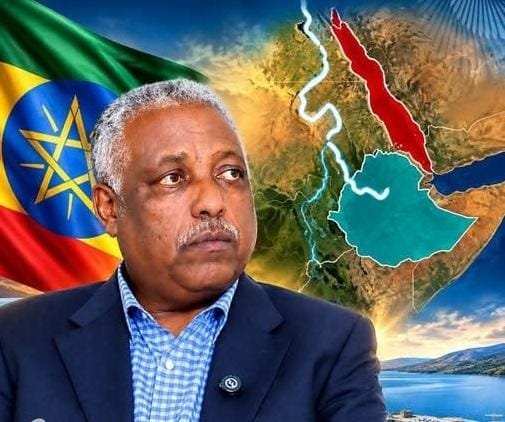
By HORN OF AFRICA GEOPOLITICAL REVIEW
EXECUTIVE SUMMARY
In October 2026, former Speaker of the House of Peoples’ Representatives and Major General Abadula Gemeda delivered remarks through official channels that went well beyond routine political commentary. What he articulated may come to be seen as a defining Ethiopian position on maritime sovereignty one that draws on decades of institutional experience, military understanding, and elder-statesman reflection.
His declaration that “no entity can prevent Ethiopia from securing access to the sea” is not simply a policy position; it is the crystallization of a strategic worldview shaped by decades inside the state apparatus

This analysis examines Abadula Gemeda’s career as a window into Ethiopian strategic culture, his institutional contributions to regional governance and media infrastructure, and the geopolitical significance of his intervention on the Red Sea question at this pivotal juncture.
PART ONE: THE ARCHITECT AND THE ARCHITECTURE
I. Military Foundation: The Strategist’s Formation
Abadula Gemeda’s path from military commander to civilian statesman represents a distinctive model of Ethiopian leadership one that bridges the tactical clarity of military service with the deliberative demands of federal governance.
- Chief of Operations (1991): Post-Derg transition strategic planning.
- Chief of Intelligence (1996): Development of national security architecture.
- Ground Force Commander (1998): Operational leadership during critical defense periods.
- Minister of National Defense (2001–2005): Civilian oversight and military modernization.
When Abadula Gemeda speaks on national security, he speaks with the authority of an architect who personally helped design and execute Ethiopia’s modern defense apparatus.
II. The Oromia Presidency: Institutional Crucible (2005–2010)
As President of the Oromia Regional State, Abadula Gemeda transformed abstract governance frameworks into functioning institutions during a critical era of state-building in Ethiopia’s most populous region.
Administrative Architecture - Organization and restructuring of regional administrative executive offices.
- Oversight and formal establishment of civil security force structures.
- Development and execution of comprehensive decentralized governance frameworks.
Media Infrastructure - Foundational launch and structural support for the Oromia Broadcasting Network (OBN).
- Expansion of regional public media capacity and Afaan Oromo-language broadcasting.
- Direct integration of regional media platforms into the national information architecture.
By establishing the communicative and administrative pillars of Oromia, Abadula Gemeda created an institutional foundation upon which subsequent generations of regional and federal leaders have built their political careers.
III. Legislative Leadership & Party Legacy
- Speaker of the House (2010–2017): Occupying the third-highest constitutional office, he demonstrated significant legislative control and coalition management. His principled 2017 resignation reflected a commitment to institutional integrity.
- OPDO & Prosperity Party Lineage: As a founding member of the Oromo People’s Democratic Organization (OPDO), his mentorship helped cultivate the political leadership that now guides Ethiopia’s federal trajectory.
PART TWO: THE MARITIME IMPERATIVE & GEOPOLITICAL ENVIRONMENT
IV. Strategic Value of Seaports vs. Geographical Realities
Seaports serve as foundational pillars of state power, handling over 80% of international trade. For a nation exceeding 120 million people, landlocked status presents a severe structural anomaly.

Key Takeaway: While commercial agreements and leased terminal facilities offer operational advantages, they do not automatically resolve long-term sovereign trade security. Reconciling landlocked transit imperatives with coastal sovereignty requires durable, legally binding, and mutually beneficial frameworks.
V. The Legal and Historical Question
Abadula Gemeda’s intervention reopens fundamental legal questions regarding how Ethiopia lost its sea coast during the early 1990s:
- Constitutional Mandate: Did the transitional authorities possess the formal legal mandate to permanently alienate coastline?
- Procedural Defects: Abadula directly notes that “there was no decision reached regarding the issue of sea access through discussions held or agreements concluded in a formal, legal forum.”
- External Manipulation: Cold War dynamics and regional interference were leveraged against Ethiopia during periods of internal fragmentation.
PART THREE: THE DOCTRINE OF IRREVERSIBLE ACCESS
Abadula Gemeda’s framework rests on four key pillars:
- Temporal Dimension (Non-Negotiable Core): Framing maritime access as an unalterable, long-term national imperative that transcends short-term political cycles.
- Capability Dimension: Demonstrating confidence in national demographic, economic, and strategic leverage to achieve maritime goals.
- Peaceful Negotiation Framework: Full endorsement of diplomatic avenues based on mutual benefit and give-and-take negotiations.
- Countering External Interference: Identifying external containment strategies (historically pointing to actors like Egypt) while warning against modern iterations.
- National Cohesion: Elevating sea access above regional or ethnic divisions into a unifying national goal.
PART FOUR: STRATEGIC IMPLICATIONS
I. For Ethiopian Policy Makers
- Institutionalization of Maritime Doctrine: Establishes a permanent strategic reference point that guides diplomatic strategy across changing political cycles and increases overall negotiating leverage.
II. For Regional Coastal States - Clear Strategic Signaling: Demonstrates deep national consensus on sea access while confirming a firm commitment to peaceful, win-win negotiation structures.
III. For International Observers - Long-Term Strategic Predictability: Indicates that Ethiopia’s pursuit of maritime outlets is an enduring national policy rather than a temporary trend.
CONCLUSION: THE STRATEGIST’S GIFT
Abadula Gemeda’s October 2026 intervention provides clarity of purpose. By combining military realism, constitutional critique, and an unwavering commitment to peaceful diplomatic negotiation, he has provided the Ethiopian state with a clear strategic posture:
“It is impossible to keep Ethiopia cut off from the sea.”
The doctrine is defined, the historical record is framed, and the path forward patient, diplomatic, and persistent—is established.
APPENDIX A: CAREER CHRONOLOGY
- 1958: Born (July 5)
- 1991: Chief of Operations, ENDF
- 1996: Chief of Intelligence, ENDF
- 1998: Ground Force Commander, ENDF
- 2001–2005: Minister of National Defense
- 2005–2010: President of Oromia Regional State
- 2010–2017: Speaker, House of Peoples’ Representatives
- 2018: National Security Advisor & Formal Retirement
- 2026: Articulation of Red Sea Maritime Access Doctrine
APPENDIX B: CORE DECLARATIONS
- On Sea Access Constraints: “No entity can prevent Ethiopia from securing access to the sea.”
- On Historical Process: “There was no decision reached regarding the issue of sea access through discussions held or agreements concluded in a formal, legal forum.”
- On National Isolation: “It is impossible to keep Ethiopia cut off from the sea.”
- On Diplomatic Method: “Securing sea access through peaceful negotiations, mutual interests and a give and take approach.”
HORN OF AFRICA GEOPOLITICAL REVIEW፡Special Analysis Series •


