
Writer: Dr. Dawit Tesfay
Opening: A Debate Over Legacy and Responsibility
The political legacy of the Tigray People’s Liberation Front (TPLF) remains one of the most contested and emotionally charged subjects in modern Ethiopian politics. Supporters continue to portray the organization as a liberation movement that defended Tigrayan identity and played a central role in overthrowing the Derg regime in 1991. Critics, however, argue that the movement gradually evolved into a highly centralized political structure that prioritized elite control and institutional survival over democratic governance and public accountability.
This analysis presents the latter argument. It examines the TPLF through the framework of patrimonial governance and argues that many of the crises experienced in Tigray over the past several decades, including the devastating 2020 to 2022 war, were rooted not only in external conflict but also in structural political failures within the organization itself.
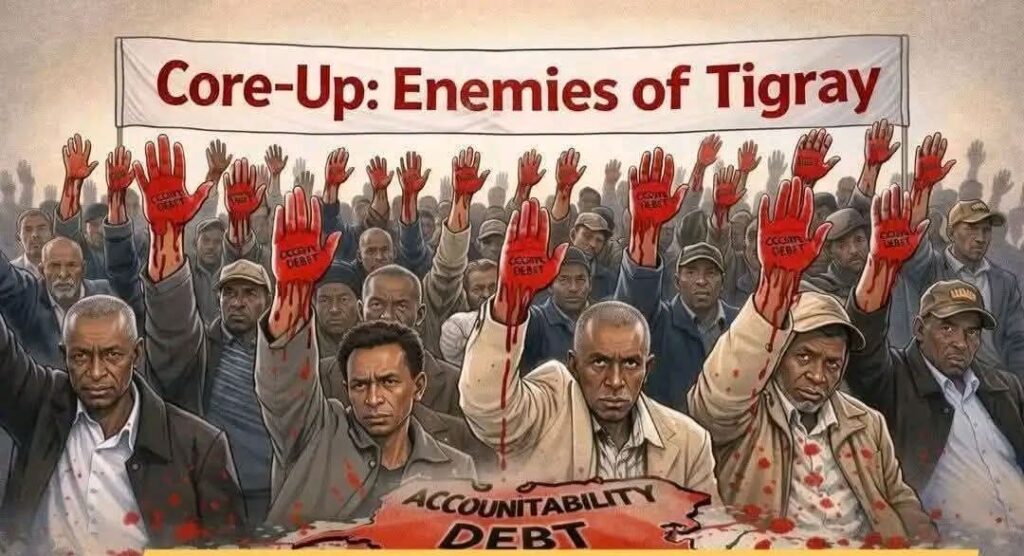
The central claim is that the TPLF increasingly blurred the distinction between party interests and public interests, creating a political order in which loyalty to the organization became deeply tied to economic access, institutional power, and political survival.
Part One: Understanding Patrimonial Governance
In political science, patrimonialism refers to a system in which political authority operates through personal loyalty networks rather than through transparent institutions and rule based governance. In such systems, public institutions formally exist, but real decision making is concentrated within informal circles tied to elite patronage.
Critics of the TPLF argue that this model became deeply embedded in both regional governance in Tigray and federal governance during the years in which the organization dominated Ethiopian politics.
Under patrimonial systems, several recurring patterns tend to emerge:
Public resources are increasingly controlled through political loyalty networks rather than institutional procedures.
Economic opportunity becomes linked to political alignment.
Independent institutions such as courts, media organizations, and civil society groups lose autonomy.
Political pluralism weakens as ruling parties portray themselves as the sole legitimate representatives of the population.
External threats are frequently emphasized to reinforce internal cohesion and justify centralized authority.
According to critics, each of these characteristics became visible within the TPLF’s political structure over time.
Part Two: The Transformation From Liberation Movement to Governing Elite
The TPLF was founded in 1975 as a Marxist Leninist guerrilla movement during a period of deep political unrest in Ethiopia. In its early years, the organization gained support by presenting itself as a defender of Tigrayan self determination against state repression and marginalization.
Following the collapse of the Derg regime in 1991, however, the movement transitioned from insurgency to state power. Critics argue that this transition fundamentally changed the organization’s relationship with power and governance.
Economic Centralization and Political Loyalty
One of the strongest criticisms directed at the TPLF concerns the relationship between political loyalty and economic access.
Opponents allege that access to government employment, business opportunities, agricultural support, contracts, and local administrative influence often depended on political alignment with the ruling party structure. This created conditions in which many citizens became economically dependent on political compliance.
According to analysts critical of the TPLF, such dependency weakened the development of independent political thought and undermined broader democratic participation.
Restrictions on Political Pluralism
Critics also argue that the TPLF positioned itself as the exclusive political representative of Tigrayan identity. Under this framework, opposition movements and dissenting voices were frequently portrayed as threats not only to the party but to Tigray itself.
Independent political actors, journalists, and civil society organizations often faced pressure, marginalization, or restrictions. While the TPLF maintained formal governmental institutions, critics contend that meaningful political competition remained limited for many years.
Internal Factional Competition
Although the TPLF publicly projected unity and organizational discipline, internal factional rivalries were a persistent feature of the movement.
According to political observers, these struggles were often less about ideological differences and more about control over political influence, economic networks, and institutional authority. Following the TPLF’s loss of federal power in 2018, these divisions became increasingly visible.
The internal disputes that later emerged among senior figures reflected deeper tensions within a system heavily dependent on centralized patronage and elite competition.
Part Three: War and the Human Cost of Political Failure
The 2020 to 2022 war in northern Ethiopia became one of the deadliest and most destructive conflicts in recent African history. The conflict involved multiple armed actors and produced widespread civilian suffering, including mass displacement, food insecurity, infrastructure destruction, and documented human rights abuses.
Critics of the TPLF argue that the war did not emerge suddenly or in isolation. Rather, they view it as the culmination of years of political polarization, institutional breakdown, and zero sum political calculations.
According to this perspective, the TPLF leadership increasingly viewed political competition through an existential lens in which compromise was interpreted as surrender and rivals were viewed primarily as enemies rather than political counterparts.
This political culture, critics argue, contributed to escalating confrontation following the rise of Prime Minister Abiy Ahmed and the TPLF’s loss of federal dominance.
The consequences for ordinary civilians were catastrophic. Hundreds of thousands of people were killed or displaced, while much of Tigray’s economy and infrastructure suffered severe destruction.
Continuing Controversies After Pretoria
Even after the signing of the Pretoria Peace Agreement in 2022, tensions and political disputes have continued within Tigray.
Critics accuse TPLF authorities of maintaining coercive political practices, including controversial military recruitment campaigns and continued efforts to preserve centralized political dominance. The unilateral reinstatement of the Tigray regional assembly in 2026 has also been interpreted by opponents as evidence that deeper structural political reforms remain unresolved.
Part Four: Ideology, Power, and Institutional Survival
Political theorists have long debated how liberation movements can evolve into systems primarily focused on preserving power. Critics of the TPLF argue that this transformation occurred gradually as institutional survival became increasingly prioritized over democratic accountability.
The organization continued to frame many of its decisions through the language of liberation, resistance, and ethnic self defense. Supporters viewed these positions as necessary responses to historical threats facing Tigray.
Opponents, however, argue that such narratives were also used to justify political centralization, suppress dissent, and maintain monopoly control over public life.
This debate remains central to understanding the TPLF’s historical legacy and the broader political future of Tigray.
Part Five: The Search for Political Alternatives
For many analysts, the central issue facing Tigray today is not only reconstruction after war but also the question of political transformation.
Critics argue that sustainable recovery requires stronger democratic institutions, independent civil society organizations, transparent governance, and genuine political pluralism.
Opposition groups, including the Council for Peace and Change in Tigray, have presented themselves as alternatives to the TPLF dominated political order. Whether such movements can establish durable institutions rooted in accountability and public trust remains uncertain.
What remains clear is that many Tigrayans continue to demand political systems capable of moving beyond prolonged cycles of factionalism, militarization, and centralized elite competition.
Conclusion: An Unfinished Political Transition
The debate surrounding the TPLF is ultimately a debate about governance, accountability, and the meaning of liberation itself.
Supporters continue to credit the organization for defending Tigrayan identity and reshaping Ethiopia’s political landscape after decades of authoritarian rule. Critics, however, argue that the movement ultimately reproduced many of the centralized and exclusionary political structures it once claimed to oppose.
This analysis presents the argument that the TPLF’s governance model evolved into a patrimonial system that weakened institutions, narrowed political space, and contributed to one of the most devastating humanitarian crises in modern Ethiopian history.
Political patrimonialism is a system in which political power is built not on institutions, merit, or the rule of law, but on personal loyalty, patron-client networks, and informal power structures. Public institutions gradually become extensions of party interests or elite circles, while state resources, appointments, and opportunities are distributed according to allegiance rather than competence.
In the Tigray context, the Tigray People’s Liberation Front has frequently been cited by critics and political analysts as one of the clearest examples of this system. Over time, governance structures became increasingly tied to networks of loyalty and political patronage. As a result, dissenting voices were marginalized, institutional independence weakened, and political access became closely linked to proximity to power.
The future of Tigray, according to this perspective, depends not on the survival of any single political organization but on the creation of institutions capable of delivering accountability, transparency, political inclusion, and long term stability.
For many observers, that remains the unfinished political task facing Tigray and the wider Horn of Africa.
Dr. Dawit Tesfay | Post War Military, Security and Transitional Justice Affairs Expert
Editor’s Disclaimer:
The views and opinions expressed in articles published by Horn News Hub are those of the authors and do not necessarily reflect the official position or editorial stance of Horn News Hub. Publication does not imply endorsement.