
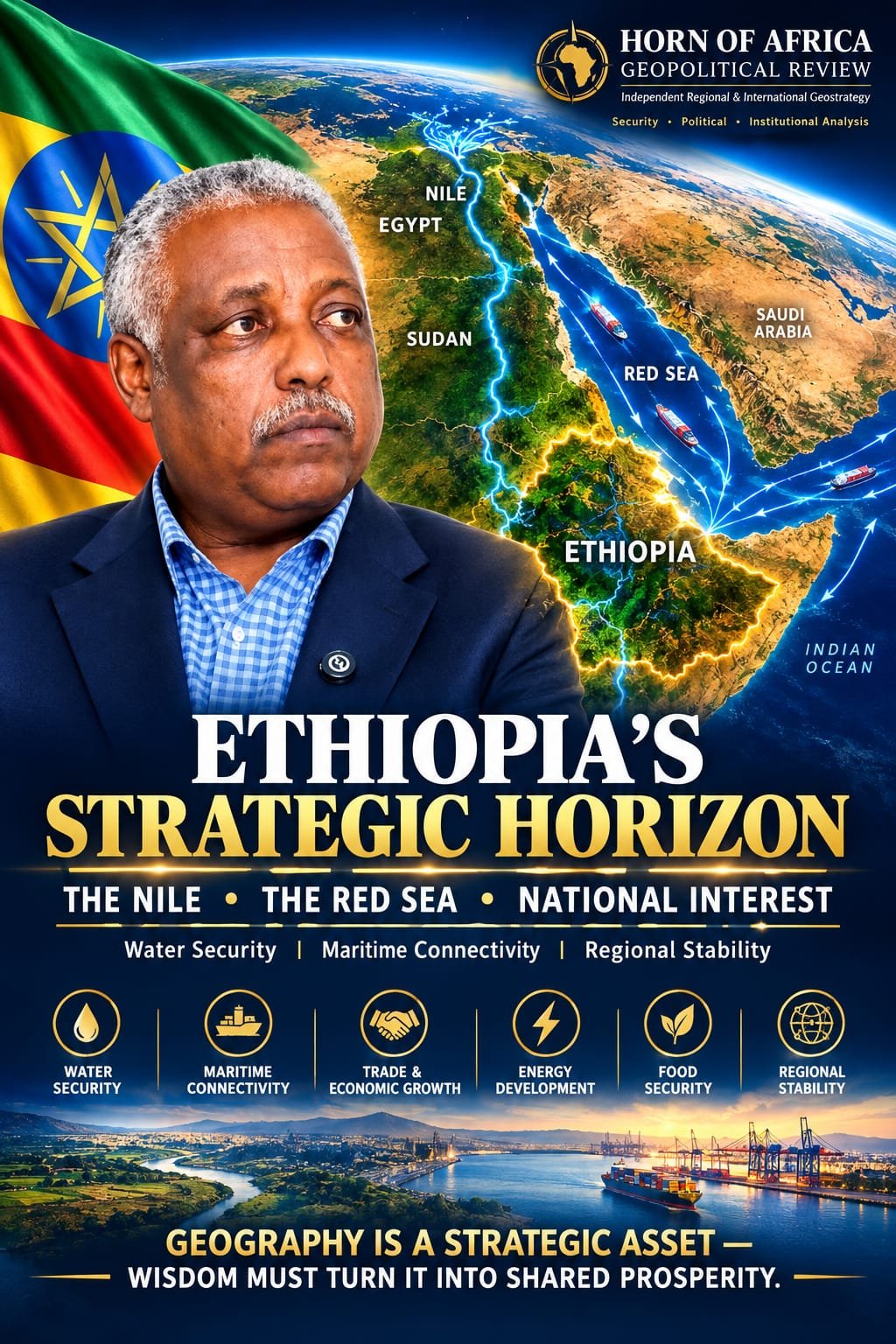
By the Horn of Africa Geopolitical Review (HAGR)
Strategic Reflection Analysis
Straight from the Horse’s Mouth: Abadula Gemeda’s Revelations on the Red Sea, the Inside Mole, and the TPLF–Egypt Collusion Against Ethiopia’s National Interest
A Rare Insider’s Testimony on the Conspiracy That Landlocked a Nation of 120 Million
I. Executive Summary
In an October 2026 interview with the Ethiopian News Agency (ENA) and broadcast across state media platforms including the Ethiopian Broadcasting Corporation (EBC) and Oromia Broadcasting Network (OBN), former Speaker of the House of Peoples’ Representatives Abadula Gemeda delivered what must be regarded as one of the most consequential strategic testimonies in modern Ethiopian political history.
This was not a routine media appearance. It was, in the truest sense, straight from the horse’s mouth an insider’s account delivered by a man who sat at the very center of Ethiopia’s military, intelligence, and political establishment for three decades.
Abadula Gemeda did not speak in riddles. He named the historical error. He identified the internal collaborators. He pointed to the external architect. And he affirmed, with the quiet authority of a man who knows where the institutional bodies are buried, that no entity can permanently prevent Ethiopia from securing access to the sea.
This analysis examines his testimony, the historical record it illuminates, and the strategic implications for Ethiopia’s national interest.
II. The Man Behind the Testimony: Why Abadula Gemeda’s Words Carry Weight
To understand why this interview matters, one must understand the man.
Abadula Gemeda (born Minase Woldegiorgis, 1958) is not a commentator on Ethiopian security affairs. He is a product and architect of them. His career trajectory placed him at the epicenter of every major decision, crisis, and consolidation of power in post-Derg Ethiopia:
- Chief of Operations, National Defense Force (1991)
- Chief of Military Intelligence (1996)
- Commander of Ground Forces
- Minister of National Defense (2001–2005) — serving directly under Prime Minister Meles Zenawi
- President of Oromia Region
- Speaker of the House of Peoples’ Representatives (2010–2018)
- Founding member of the Oromo People’s Democratic Organization (OPDO) the political ancestor of today’s Prosperity Party
- National Security Advisor to Prime Minister Abiy Ahmed (briefly, 2018)
This is a man who worked alongside Meles Zenawi. A man who interacted directly with Sebhat Nega the co-founder, chief ideologue, and so-called “Godfather” of the Tigray People’s Liberation Front (TPLF). A man who oversaw the state’s security apparatus during the Ethiopian-Eritrean war and the fractious 2001 TPLF internal split.
Political observers have long characterized Abadula as someone who “knows a lot but speaks little.” His insider knowledge of the TPLF’s historical betrayals, the machinations of the old guard, and the clandestine decisions that reshaped Ethiopia’s geopolitical standing is widely acknowledged yet largely unrevealed.
When such a man speaks, Ethiopia listens. And it should.
III. The Core Testimony: Five Strategic Revelations
Revelation 1: The Inevitability of Sea Access
Abadula Gemeda’s central declaration was unambiguous: “No entity can prevent Ethiopia from securing access to the sea.”
He framed maritime access not as a luxury or a bargaining chip, but as an essential, long-term major national interest a strategic inevitability for a nation of Ethiopia’s geographic size, population (over 120 million), and economic potential. To keep such a nation landlocked, he argued, is a historical anomaly that cannot be sustained indefinitely.
Revelation 2: The “Historical Error” and Its Illegal Foundations
Abadula did not shy away from naming the original sin. He characterized the process by which Ethiopia lost its direct maritime outlet specifically the port of Assab following Eritrea’s independence in the early 1990s as a profound historical error executed by a small faction without broad public consultation or a legitimate constitutional framework.
| Claim | Implication
| Lack of Broad Consultation | The decision was made by a limited number of individuals without national debate.
| No Formal Legal Deliberation | It was never subjected to adequate national discussion or legal scrutiny.
Lack of Constitutional Authority The transitional government had no constitutional mandate for such a far-reaching geopolitical decision.
Revelation 3: The External Architect
Egypt’s Long War Against Ethiopia
Here, Abadula Gemeda’s testimony becomes explosive. He asserted that historical adversaries specifically Egypt supported the establishment of the TPLF and the EPLF (Eritrean People’s Liberation Front) as internal proxies to compromise Ethiopia’s national interests through proxy warfare, the weaponization of internal fault lines, and the ultimate objective of landlocking Ethiopia.
Revelation 4: The Inside Mole Sebhat Nega at the Egyptian Council for Foreign Affairs
Perhaps the most startling element of Abadula’s broader testimony concerns Sebhat Nega, the TPLF’s co-founder and chief ideologue.
In December 2014, Abadula Gemeda led an official Ethiopian public diplomacy delegation to Cairo, Egypt. According to Abadula’s testimony, Sebhat Nega was present at the Egyptian Council for Foreign Affairs (ECFA) meeting with top Egyptian officials without the knowledge of the official Ethiopian delegation.
This is evidence of a shadow diplomatic track that bypassed legitimate state representatives and served interests fundamentally opposed to Ethiopia.
Revelation 5: The Verdict on the Current Diplomatic Strategy
Despite the weight of historical betrayal, Abadula Gemeda voiced strong support for the current government’s focus on securing sovereign or reliable maritime access through peaceful dialogue, negotiation, and mutual benefit rather than military confrontation.
IV. The Man Who Knew Too Much: Sebhat Nega and the TPLF–Egypt Nexus
To fully appreciate the gravity of Abadula Gemeda’s testimony, one must understand Sebhat Nega. Born in 1935 in Adwa, Sebhat is the co-founder, chief ideologue, and longtime mastermind of the TPLF.
The question that Abadula’s testimony raises is simple yet profound: Why would the TPLF’s Godfather be meeting with Egyptian officials at the ECFA, without the knowledge of the official Ethiopian delegation, while that delegation was in Cairo to negotiate on matters of vital national interest?
If Sebhat Nega was there without the delegation’s knowledge, he was either acting unilaterally, acting on behalf of the TPLF over the nation, or acting in coordination with Egypt. None of these possibilities is benign.
V. The Strategic Framework: How External Adversaries Weaponized Internal Fault Lines
- Phase 1: Direct Military Confrontation (Failed): Historical attempts by Egypt to defeat Ethiopia militarily failed, culminating in Ethiopian victories at Gundet, Gura, and Adwa (1896).
- Phase 2: Proxy Warfare (Partially Successful): Shifting to backing internal insurgencies, separatist movements, and opposition fronts to exploit Ethiopia’s ethnic, regional, and political fault lines.
- Phase 3: Geopolitical Sabotage (Ongoing): Facilitating Eritrea’s independence and the loss of Assab, leaving a landlocked Ethiopia dependent, vulnerable, and constrained.
VI. The Courage of Abadula Gemeda: An Acknowledgment
Abadula Gemeda’s willingness to speak represents an act of considerable political courage. He has broken ranks with the old guard, publicly criticized historical atrocities, questioned the legality of landlocking decisions, and identified external adversaries and internal collaborators by name. At a critical juncture in Ethiopia’s history, he has chosen to speak truth as he understands it.
VII. The Lion’s Share: Abadula’s Role in Ethiopia’s Political Transition
Abadula served as a critical generational bridge, mentoring younger Oromo politicians who would ultimately reshape federal politics—including Prime Minister Abiy Ahmed, Shimelis Abdisa, and Lemma Megersa. His historic October 2017 resignation as Speaker of Parliament fractured EPRDF internal discipline, creating the vital space for the “Team Lemma” reform movement. His subsequent transition into a quiet retirement and role as an elder statesman reinforced his commitment to institutional respect over clinging to office.
VIII. The Strategic Implications: What Must Be Done
- Confront the Historical Record: Fully investigate, legally scrutinize, and publicly debate the decisions that stripped the nation of its sea access.
- Hold Collaborators Accountable: Demand truth-telling, legal accountability, and institutional reform regarding internal collaborators who conspired with external adversaries. Unify Around the National Interest: Treat Ethiopia’s quest for sea access as a unified national project rather than a divisive political football.
- Remain Vigilant Against External Interference: Build alliances with regional and international partners who respect Ethiopia’s sovereignty against ongoing diplomatic and economic pressures.
- Empower the New Generation: Continue mentoring leaders who understand Ethiopia’s history and prioritize national interest above personal ambition.
IX. Conclusion: A Testimony That Demands to Be Heard
Abadula Gemeda’s October 2026 interview is a historic testimony that demands to be heard by all Ethiopians. It raises uncomfortable questions regarding the shadow meetings, unauthorized decisions, and external conspiracies that shaped Ethiopia’s current predicament.
Ethiopia’s quest for sea access is not a provocation; it is a fundamental national right. As Abadula Gemeda has shown, the future must be built on truth.
Historical Accountability. Strategic Clarity. National Interest. Regional Stability.
Published by the Horn of Africa Geopolitical Review (HAGR)
Independent platform for regional and international geostrategy.
Sources and References
- Ethiopian News Agency (ENA) interview with Abadula Gemeda, October 2026
- Ethiopian Broadcasting Corporation (EBC) & Oromia Broadcasting Network (OBN) coverage
- Borkena, Africa Confidential, Addis Standard, and The Reporter Ethiopia archives (2014–2026)
- Egyptian Council for Foreign Affairs (ECFA) public records