
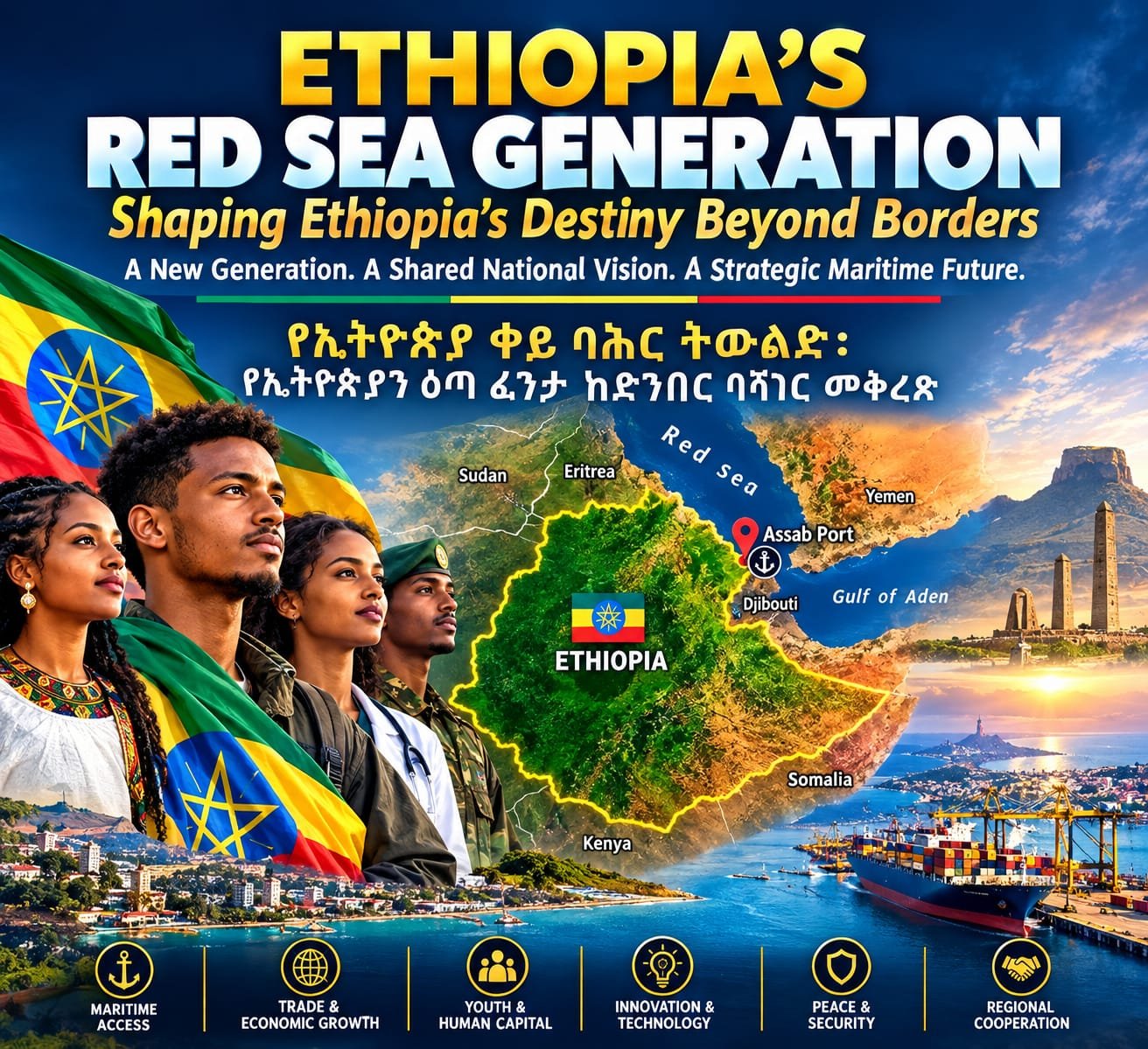
A New Generation. A Shared National Vision. A Strategic Maritime Future.
የኢትዮጵያ ቀይ ባሕር ትውልድ፦ የኢትዮጵያን ዕጣ ፈንታ ከድንበር ባሻገር መቅረፅ
Written by: Horn of Africa Geopolitical Review (HAGR)
- Executive Vision: A Generation Must Help Shape Its Own Future
Ethiopia’s relationship with the Red Sea is about more than geography. It touches the country’s economic prospects, national security, international trade, regional diplomacy, and capacity to compete in an increasingly interconnected world.
For a nation of Ethiopia’s population, economic ambitions, and development needs, dependable access to maritime trade routes is a strategic necessity. Transport costs affect the price of imported goods, the competitiveness of exports, the expansion of manufacturing, and the willingness of investors to commit capital. The reliability of shipping corridors also influences national supply chains, industrial development, and economic resilience.
Maritime access should therefore be treated as a serious question of national economic security, not simply a symbol of historical identity or national pride.
Yet geography alone does not determine a nation’s destiny. Historical arguments, however important, cannot substitute for sound policy, capable institutions, effective diplomacy, and a realistic assessment of available options. Ethiopia needs a long-term national strategy that connects historical experience with contemporary economic realities and the changing geopolitical environment of the Horn of Africa.
It is within this context that the Horn of Africa Geopolitical Review (HAGR) introduces Ethiopia’s Red Sea Generation: a strategic concept for placing young Ethiopians at the centre of national development, maritime policy, economic transformation, and responsible regional engagement.
The central proposition is straightforward: the generation that will inherit Ethiopia’s future must have a meaningful role in preparing the country for it.
That responsibility extends well beyond maritime access. It encompasses education, technological innovation, entrepreneurship, institutional accountability, national cohesion, environmental sustainability, and the development of an economy capable of creating productive opportunities for millions of people.
At the heart of this vision is a commitment to intergenerational nation-building through cooperation, shared responsibility, and self-reliance. The Ethiopian philosophy of Medemer bringing people, knowledge, experience, and resources together to achieve more through cooperation offers a useful starting point for this conversation.
- Historical Context: Understanding the Past Without Becoming Its Prisoner
Ethiopia’s historical relationship with the Red Sea and the wider maritime world has influenced its commercial connections, diplomatic relationships, political development, and strategic outlook for centuries. Changes in the country’s relationship with coastal territories and maritime routes have also shaped continuing debates about sovereignty, national identity, economic independence, and regional power.
These questions deserve serious examination. They should be investigated through historical documents, diplomatic records, reliable scholarship, and careful legal analysis rather than political slogans or selective interpretations.
- History matters because it helps explain the circumstances in which present-day realities emerged. It can reveal the consequences of earlier decisions, the opportunities that were pursued or lost, and the calculations that continue to influence contemporary policy.
- Historical accountability requires intellectual honesty. It means examining the decisions of past leaders in their historical context, recognising their achievements where warranted, and assessing their failures where the evidence supports criticism.
- Legal distinction is equally vital: historical use, geographical proximity, commercial dependence, and economic necessity can inform a country’s strategic interests, but they do not, by themselves, establish a present-day sovereign right over the territory of another state.
For Ethiopia’s emerging generation, studying history should not be an exercise in cultivating permanent grievance, but a means of developing the knowledge and judgment necessary to make better decisions.
- The Strategic Imperative: Why Maritime Access Matters to Ethiopia
Ethiopia’s landlocked position creates substantial economic and logistical challenges, exposing its trade to transport costs, corridor disruptions, customs delays, infrastructure limitations, and political developments beyond its borders.
To address these vulnerabilities, HAGR’s framework breaks down maritime strategy into six critical operational areas
- Port Access and Commercial Agreements: Establishing dependable arrangements that provide predictable access to port facilities, assessing costs, duration, commercial terms, operational requirements, and political risk objectively.
- Transport Corridors and Logistics: Ensuring roads, railways, dry ports, customs systems, freight networks, and border infrastructure function as an integrated logistics system.
- Trade Competitiveness: Lowering transport costs and logistical predictability to help Ethiopian businesses compete globally and access modern machinery and export markets.
- Industrial and Export Development: Aligning maritime policy with manufacturing, agricultural processing, industrial services, and reliable energy infrastructure.
- Strategic Resilience: Diversifying port access and logistics arrangements where commercially and financially viable to provide flexibility and strengthen national resilience.
- Diplomacy and Regional Cooperation: Engaging neighbouring states and regional partners through sustained dialogue rooted in international law, security concerns, and mutual benefit.
- The Generational Challenge: Moving Beyond Political and Ethnic Fragmentation
Ethiopia’s future will depend in part on its ability to develop a shared national agenda amid ethnic tensions, competing historical narratives, institutional weaknesses, and disagreements about the structure and direction of the state. These disagreements cannot be dismissed; they reflect different historical experiences and unresolved grievances.
At the same time, Ethiopia’s younger generations should not be expected to accept political fragmentation as a permanent condition of national life. Young people need meaningful opportunities to engage with the questions that will shape their futures: education, employment, industrialisation, technology, public administration, entrepreneurship, environmental protection, and international economic integration.
- Civic Inclusion: The initiative must remain open to supporters and critics of the government, advocates of different constitutional arrangements, religious citizens, and secular citizens alike.
- Core Principles: Upholding human dignity, evidence-based discussion, peaceful participation, institutional accountability, and a strict rejection of collective blame or ethnic stereotyping.
- Constructive Diversity: National unity is not achieved by demanding uniformity, but by enabling people with different convictions to cooperate on shared objectives while retaining their identities and legitimate differences.
- Six Strategic Pillars
- Pillar I: Maritime Access and National Economic Security Pursuing dependable, affordable, and legally sound maritime access through rigorous research and long-term institutional commitment.
- Pillar II: Economic Transformation and Industrial Development Connecting maritime strategy directly to domestic production, job creation, and productivity growth.
- Pillar III: Education, Technology and Innovation Equipping young Ethiopians with advanced skills in digital customs, supply-chain analytics, artificial intelligence, and scientific research.
- Pillar IV: Intergenerational Nation-Building, Medemer and Self-Reliance
Fostering structured cooperation between senior professional experience and youth energy, building true self-reliance without international isolation.
- Pillar V: National Unity and Civic Responsibility Cultivating a culture of responsibility, mutual respect, and peaceful civic participation that transcends ethnic and political divides.
- Pillar VI: Regional Diplomacy, Security and Sustainable Development Integrating climate-smart agriculture, renewable energy, and cooperative regional diplomacy into Ethiopia’s overarching maritime and economic policy.
- A Strategic Roadmap: From Vision to Measurable Progress
To transition from a conceptual framework to tangible outcomes, HAGR proposes a structured, four-phase implementation model:
- Phase One: Research and Foundation (First 6 Months)
Establish intellectual, legal, and organisational foundations; map trade corridors; review historical and treaty records; and consult multidisciplinary experts. - Phase Two: Public Engagement and Strategic Dialogue (6–12 Months)
Open structured youth policy forums, expert roundtables, and digital discussions across diverse communities to debate evidence-based policy proposals. - Phase Three: Policy Development and Regional Perspectives (12–24 Months)
Formulate detailed policy papers regarding maritime connectivity, infrastructure, and institutional reform, inviting constructive regional perspectives where mutual interests overlap. - Phase Four: Long-Term Impact and Accountability (24–36 Months)
Evaluate the initiative’s contribution against published objectives, measuring research quality, participant diversity, and practical policy influence.
- Institutional Role & Research Standards
As an independent regional and international geostrategic platform, the Horn of Africa Geopolitical Review (HAGR) serves as the analytical sponsor and originator of this concept.
- Editorial Integrity: HAGR’s publications clearly distinguish between verified facts, unconfirmed reports, legal assessments, competing political interpretations, and policy recommendations.
- Independence and Credibility: HAGR maintains a clear distinction between its independent research activities and any future independent organisational structures that may emerge from the Red Sea Generation concept.
- A Platform for Dialogue: By convening academics, policymakers, entrepreneurs, and young professionals, HAGR aims to improve the quality of questions asked, evidence considered, and policies proposed for Ethiopia’s future.
- A Public Call to Action
Ethiopia’s Red Sea Generation begins with an open invitation to young Ethiopians, scholars, entrepreneurs, engineers, economists, legal professionals, historians, policymakers, and members of the diaspora:
- Research and Evidence: Contribute rigorous historical, legal, and economic assessments.
- Youth Leadership and Professional Development: Build professional networks and practical policy solutions.
- Innovation and Enterprise: Explore technology, logistics, and industrial ventures to expand global trade participation.
- National Dialogue and Civic Responsibility:
Promote respectful debate that rejects intimidation and embraces diverse perspectives.
- Regional Cooperation: Advance legal, commercially sound arrangements that respect neighboring sovereignties while safeguarding Ethiopian national interests.
Final Statement - A generation that understands its history.
- A nation that invests in its people.
- An economy that creates opportunity.
- Institutions that serve the public.
- A maritime strategy grounded in law and diplomacy.
- A regional future shaped by cooperation and strategic clarity.
The future is not simply inherited. It is built together, deliberately and responsibly.
Institutional Note
Initiated and presented by: Horn of Africa Geopolitical Review (HAGR)
Independent Regional & International Geostrategy Security, Political, and Institutional Analysis.