

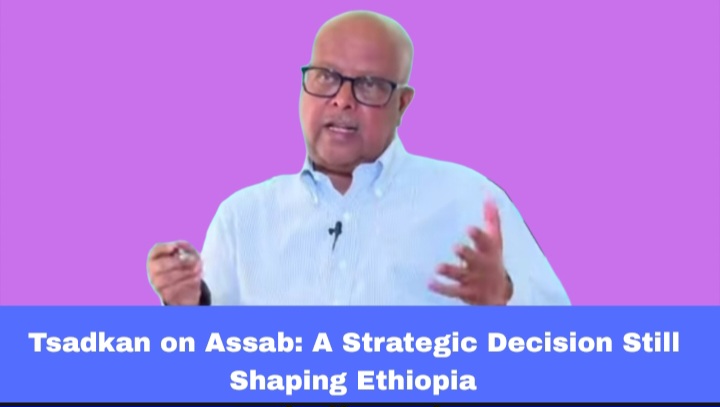
Assab, Strategy, and the Cost of Being Landlocked: What General Tsadkan’s Interview Reveals About Ethiopia’s Long-Term Challenges
Addis Ababa, Ethiopia — April 13, 2026 | Horn News Hub
A recent interview by Lieutenant General Tsadkan Gebretensae has reignited debate over one of Ethiopia’s most consequential strategic decisions: losing direct access to the Red Sea and the port of Assab.
Tsadkan’s remarks, combined with claims presented in a documentary aired by Ethiopian Broadcasting Corporation, frame the issue as more than a historical disagreement. They present it as a long-term structural challenge affecting Ethiopia’s economy, sovereignty, digital security, unemployment, and migration pressures toward Europe.
The discussion also touches on decisions made during the leadership of Meles Zenawi, alongside relations with Sebhat Nega and Isaias Afwerki, which Tsadkan and the documentary describe as creating a “time bomb” whose consequences are unfolding today.
A Strategic Opportunity That Was Not Taken
According to Tsadkan, during the 1998–2000 Ethiopia–Eritrea war, Ethiopia had both military advantage and diplomatic leverage to take control of Assab. He argued that since Eritrea initiated the war, Ethiopia could have reversed what he described as the 1991 strategic mistake of relinquishing Assab.
However, the proposal was rejected by political leadership at the time. Tsadkan says the disagreement widened political divisions within the TPLF and contributed to his eventual departure from both the military and party leadership.
More than two decades later, the debate has resurfaced as Ethiopia continues to face the structural realities of being the world’s most populous landlocked country.
Economic Cost of Being Landlocked
Ethiopia’s loss of direct Red Sea access reshaped its economic trajectory. Today, over 90 percent of Ethiopia’s imports and exports move through Djibouti. This heavy dependence creates multiple economic vulnerabilities:
First, transport costs remain high. Ethiopian businesses pay significantly more for shipping compared to coastal economies. These costs are passed on to consumers, contributing to inflation and high living expenses.
Second, dependence on a single corridor creates supply chain risks. Political instability, infrastructure disruption, or diplomatic tensions can quickly affect imports such as fuel, fertilizer, and food.
Third, the absence of domestic port infrastructure limits Ethiopia’s industrial ambitions. Manufacturing competitiveness suffers when logistics costs remain high.
Over the years, Ethiopia has attempted diversification through agreements with Somaliland’s Berbera port and renewed dialogue with Eritrea, but these efforts remain incomplete or politically sensitive.
Tsadkan’s argument suggests that retaining or reclaiming Assab could have fundamentally altered Ethiopia’s economic structure, lowering costs and accelerating industrial growth.
Sovereignty and Strategic Autonomy
Beyond economics, access to the sea carries deep sovereignty implications. Maritime access influences defense capability, trade independence, and diplomatic leverage.
Ethiopia’s dependence on external ports means critical national supply chains rely on the stability and goodwill of neighboring countries. This dependency reduces strategic flexibility during crises.
Tsadkan’s framing of Assab as a national security issue reflects a growing consensus within parts of Ethiopia’s political and security establishment that maritime access is not only an economic matter but a sovereignty concern.
Recent government statements have increasingly described port access as essential for Ethiopia’s long-term survival and security.
Cyber Security and Digital Infrastructure
Less discussed but increasingly important is the cyber and digital dimension of landlocked dependency.
Modern economies rely on submarine internet cables that typically land at coastal ports. Countries with direct coastal access host landing stations and gain control over digital infrastructure.
Ethiopia, without direct access to the sea, depends heavily on cross-border fiber connections routed through neighboring countries, particularly Djibouti.
This creates several vulnerabilities:
Limited redundancy in digital connectivity
Potential exposure to surveillance risks
Higher costs for bandwidth and infrastructure
Reduced bargaining power in digital negotiations
In an era where digital economy and cyber security are central to national competitiveness, lack of coastal infrastructure presents long-term strategic challenges.
Unemployment and Economic Pressure
High logistics costs and limited industrial competitiveness also affect employment.
Manufacturing and export-oriented industries create large-scale jobs. But when production costs remain high due to logistics challenges, industrial growth slows.
This contributes to unemployment, particularly among Ethiopia’s rapidly growing youth population.
Tsadkan’s argument indirectly connects maritime access to job creation. Lower logistics costs could attract investment, expand exports, and generate employment opportunities.
Without such structural advantages, economic growth struggles to absorb millions of young job seekers entering the labor market each year.
Migration and European Concerns
Economic pressure and unemployment are also linked to migration trends.
Ethiopia has become a significant source of migrants heading toward the Middle East and Europe. Economic hardship, limited job opportunities, and instability push many young Ethiopians to seek opportunities abroad.
European policymakers increasingly view migration from the Horn of Africa as both a humanitarian and security concern.
If structural economic challenges persist, migration pressures may grow. In that sense, the Assab debate is not only a regional issue but one with implications for Europe.
Improved economic performance, job creation, and stability in Ethiopia could help reduce migration flows and refugee pressures.
A Debate That Is Returning to the Center
Tsadkan’s interview reflects a broader shift. What was once considered a closed chapter is now re-emerging as a strategic debate.
Ethiopia’s population has surpassed 120 million. Its economy is expanding but faces structural constraints. Regional geopolitics is also changing.
In this context, access to the Red Sea and the role of Assab are no longer purely historical discussions. They are increasingly seen as long-term strategic questions.
Whether Ethiopia pursues diplomatic, economic, or regional integration solutions, the debate raised by Tsadkan suggests that maritime access will remain central to Ethiopia’s future.
What was once described as a “time bomb” may now be shaping policy discussions across security, economics, and diplomacy.
And as Ethiopia’s ambitions grow, so too does the urgency of addressing the structural challenges highlighted in Tsadkan’s remarks.
Editor’s Disclaimer:
The views and opinions expressed in articles published by Horn News Hub are those of the authors and do not necessarily reflect the official position or editorial stance of Horn News Hub. Publication does not imply endorsement.