
Author: Dr. Dawit Tesfay
Institutional Policy & Post-War State-Building Researcher
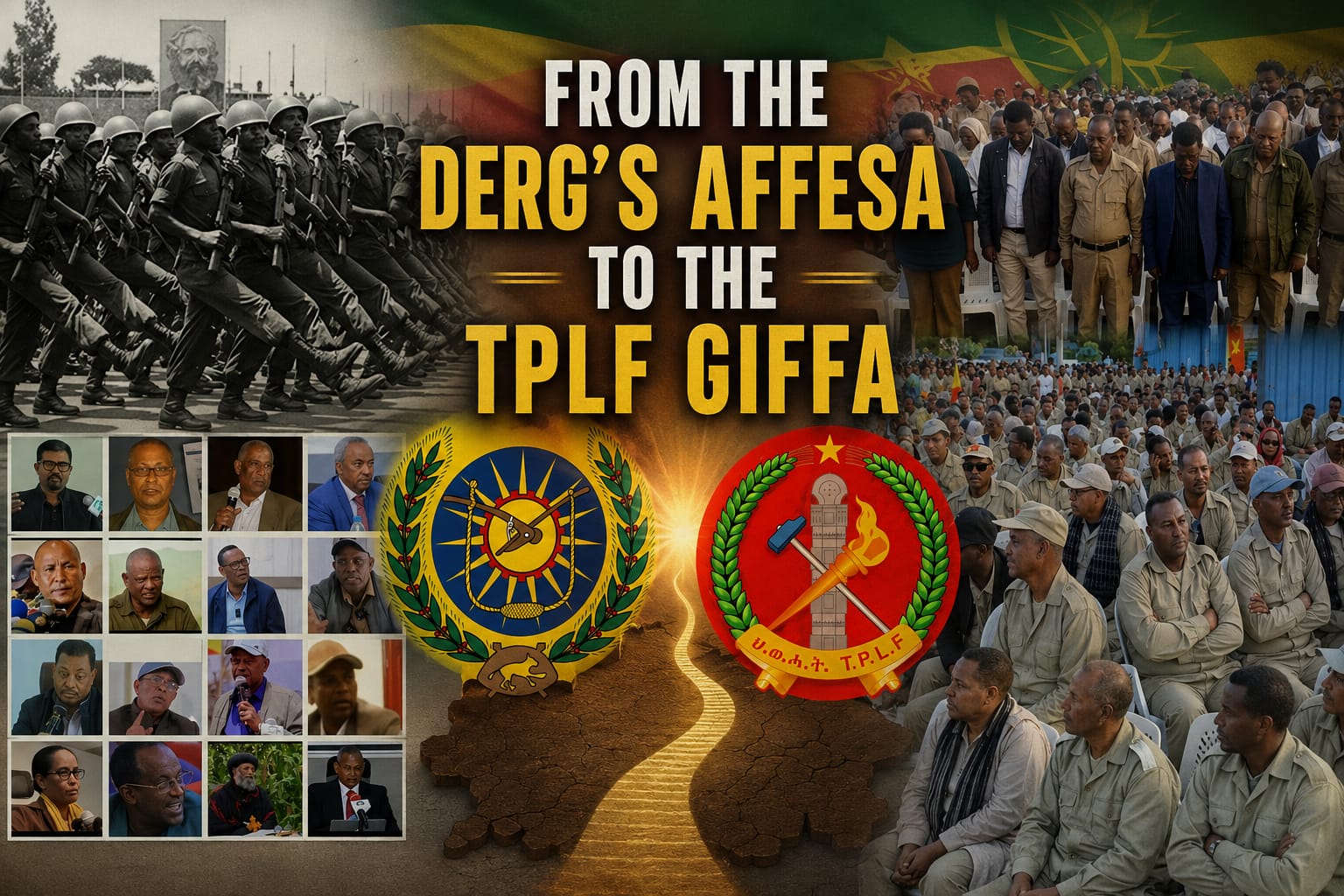
FROM AFFESA TO GIFFA:
The Revolutionary Paradox of Power, Coercion, and Political Decay in Tigray and Ethiopia
How a Liberation Movement Came to Mirror and in Some Respects Reproduce the Logic of the Regime It Once Fought
Executive Assessment
Modern Ethiopian political history contains few ironies as profound as the trajectory of the Tigray People’s Liberation Front (TPLF). Founded in 1975 as a revolutionary movement dedicated to resisting the authoritarian rule of the Derg military junta, the organization emerged from a struggle against repression, forced mobilization, political exclusion, and centralized state domination.
Yet decades later, many of the criticisms once directed at the Derg would be directed at the TPLF itself.
This is the central paradox: a movement born in opposition to authoritarianism gradually developed governing structures that critics argue reproduced many of the same coercive political practices it once condemned.
The comparison between the Derg’s “Affesa” and the contemporary allegations surrounding “Giffa” is therefore not merely a comparison of security tactics. It is a comparison of political philosophies, institutional behavior, and the cyclical nature of power.
The deeper question is not whether history repeats itself.
The deeper question is why revolutionary movements so often become what they once fought against.
The Great Historical Irony
The Derg justified repression in the name of revolution.
The TPLF justified control in the name of liberation.
The Derg claimed national unity required centralized authority.
The TPLF claimed self-determination required disciplined revolutionary leadership.
Both systems ultimately concentrated power in a narrow political elite.
This is where the historical irony becomes impossible to ignore.
The TPLF fought against a state that treated citizens as instruments of political survival. Yet critics increasingly argue that under its own rule, citizens likewise became instruments of party survival.
The language changed.
The ideology changed.
The symbols changed.
But the logic of political domination remained remarkably familiar.
Affesa and Giffa: Different Names, Similar Political Functions
Throughout Ethiopian history, coercive state mobilization has appeared under different governments and different ideological banners.
Under the Derg, Affesa became synonymous with forced roundups, mass conscription, and the arbitrary exercise of state power.
Markets were surrounded.
Schools were raided.
Young people were seized.
Citizens lived under the constant fear that the state could reach into their daily lives without warning.
The objective was straightforward: preserve a collapsing revolutionary state through coercion.
Contemporary allegations concerning Giffa are often viewed through a similar lens.
Critics describe it as a mechanism of forced recruitment, social pressure, political intimidation, and mass mobilization during periods of military and political crisis.
While operating in a different historical context, the underlying logic appears strikingly familiar.
Both emerged during moments when ruling authorities perceived existential threats.
Both relied upon fear as a mobilizing instrument.
Both reflected declining political legitimacy compensated for by expanding coercive power.
In this sense, Affesa and Giffa represent not merely security policies but symptoms of deeper political crises.
Why Coercive Systems Intensify During Political Decline
Political science offers a consistent lesson:
Governments that enjoy broad legitimacy rely primarily on consent.
Governments that lose legitimacy increasingly rely on coercion.
As institutional trust weakens, coercive mechanisms expand.
As political support shrinks, surveillance grows.
As voluntary participation declines, forced participation increases.
This pattern was visible during the final years of the Derg.
Many observers argue that similar dynamics can emerge whenever political movements face declining public confidence and organizational fragmentation.
The critical lesson is clear:
Mass mobilization campaigns do not create legitimacy.
They often reveal its absence.
The Derg’s Failure: Violence Without Legitimacy
The Derg possessed one of the largest military structures in Africa.
It controlled state institutions.
It monopolized weapons.
It dominated the national economy.
Yet it collapsed.
Why?
Because coercion proved incapable of solving underlying political contradictions.
Military strength could not compensate for declining public trust.
Forced recruitment could not generate genuine loyalty.
Fear could not indefinitely replace legitimacy.
The regime became trapped in a cycle where every new act of repression required even greater repression to sustain itself.
Eventually, the system exhausted itself.
The state remained powerful.
The regime became weak.
This distinction proved fatal.
The TPLF’s Strategic Paradox
The TPLF once understood this lesson better than anyone.
As an insurgent movement, it successfully exploited the Derg’s political failures.
It recognized that legitimacy matters more than coercion.
It understood that populations cannot be permanently governed through fear.
It argued that military force alone could never defeat a determined society.
Yet critics contend that after attaining power, the TPLF gradually abandoned many of these insights.
A sophisticated political structure emerged.
Party influence extended into local administration.
Economic networks became intertwined with political loyalty.
State institutions increasingly reflected partisan priorities.
Opposition voices faced narrowing political space.
The result was not a simple military dictatorship.
It was a highly institutionalized system of political management.
In some respects, critics argue, this made it more resilient than the Derg.
In other respects, it made the eventual crisis even more devastating.
The Danger of Institutionalized Authoritarianism
History demonstrates that overt dictatorships are often easier to identify.
Citizens recognize military rule.
They recognize martial law.
They recognize visible repression.
Institutionalized authoritarianism is different.
It operates through bureaucracies.
It functions through administrative structures.
It embeds itself within legal systems, economic networks, educational institutions, and local governance mechanisms.
Its power becomes normalized.
Its reach becomes invisible.
Its control becomes self-reinforcing.
This is why many scholars distinguish between brute-force authoritarianism and institutionalized hegemonic rule.
The latter can prove more durable because it appears ordinary.
Yet when it eventually fractures, the consequences can be even more severe.
Why Giffa Cannot Reverse Structural Decline
History offers another lesson.
Forced mobilization may temporarily increase numbers.
It cannot restore political legitimacy.
Mass recruitment may expand military capacity.
It cannot repair institutional trust.
Security crackdowns may silence criticism.
They cannot eliminate underlying grievances.
The Derg learned this lesson too late.
Military roundups did not save the regime.
Forced conscription did not restore legitimacy.
Affesa delayed collapse.
It did not prevent it.
The same principle applies universally.
No political movement can indefinitely substitute coercion for consent.
No ruling elite can permanently compel loyalty.
No system survives solely through force.
Eventually, political reality overwhelms coercive capacity.
The Broader Lesson for Tigray
The future of Tigray cannot be built upon the methods that contributed to its destruction.
Post-war recovery requires legitimacy.
Legitimacy requires accountability.
Accountability requires institutional renewal.
Institutional renewal requires political pluralism.
The central challenge is therefore not military.
It is institutional.
The question is not how to mobilize more people.
The question is how to rebuild trust between citizens and governing institutions.
No society emerges stronger by repeating the political mistakes of its past.
No region achieves stability by reproducing the mechanisms that previously generated instability.
History’s greatest warning is not that oppressive systems exist.
History’s greatest warning is that yesterday’s victims can become tomorrow’s practitioners of the same methods they once resisted.
That is the deepest tragedy.
And that is the enduring paradox of the TPLF, the Derg, Affesa, and Giffa.
The lesson is not merely Ethiopian.
It is universal.