
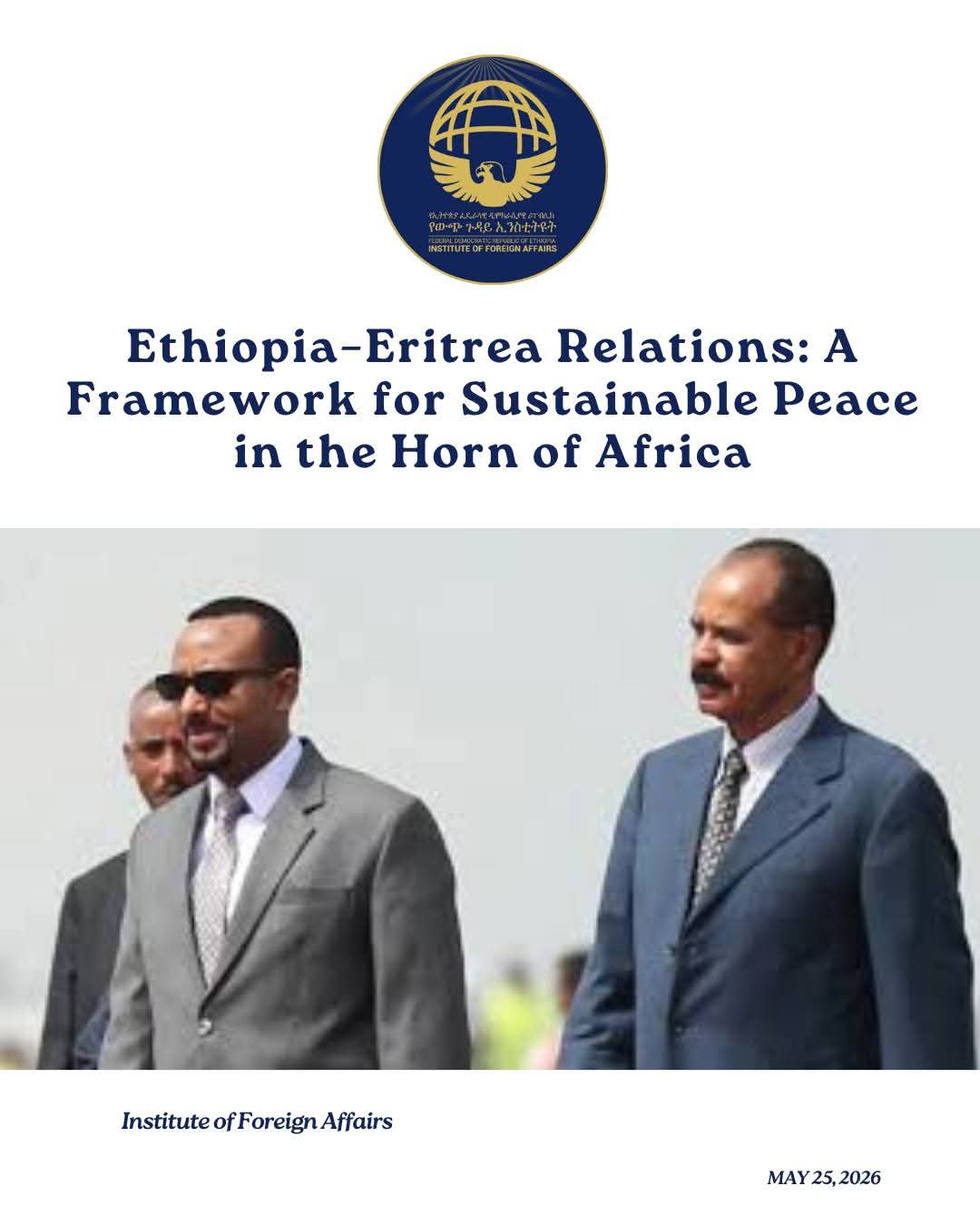
This statement sets out the considered position of Institute for Foreign Affairs on the conditions necessary for durable peace between Ethiopia and Eritrea, and the broader stability of the Horn of Africa. We issue it against the backdrop of renewed tensions, the unraveling of the Pretoria Agreement, and a growing risk of cross-border conflict that would carry severe humanitarian, economic, and security consequences for the region and for international partners with strategic interests in the Red Sea corridor.
In our assessment, peaceful coexistence between Ethiopia and Eritrea has been the exception rather than the rule across more than six decades. From the period preceding Eritrean independence in 1993 through the present, the bilateral relationship has been defined by sustained mistrust, recurrent armed confrontation, and only brief intervals of normalization. Despite a substantial body of analysis on the origins of these tensions, comparatively little detailed work has been advanced on the conditions under which a durable peace could be built. This statement is intended to contribute to that gap and to commit the institution to continued engagement in support of a constructive regional architecture.
I. Structural drivers of the current impasse
Three structural factors, in our analysis, sustain the present cycle of hostility.
First, the character of the Eritrean state. Political authority in Eritrea has been highly personalized and centralized, with the same individual serving as head of state for more than three decades. The country operates without a ratified constitution, a sitting parliament, or a published national budget, and maintains a system of indefinite national service that successive United Nations human-rights bodies have characterized as forced labor. Eritrea is among the most closed states in the world to trade, investment, and the free movement of persons. We assess that these conditions make conventional diplomatic and economic relations with any neighbor structurally difficult, and that external normalization efforts have repeatedly faltered for this reason.
Second, persistent insecurity within Eritrea’s political class regarding the country’s continued sovereignty. This anxiety has, in our view, been instrumentalized for domestic legitimation. The result is a foreign-policy disposition that treats Ethiopian stability as a strategic threat rather than an opportunity — a posture that is reinforced by the regime’s demographic and economic stagnation, including substantial out-migration of working-age citizens.
Third, contested grievances on the Ethiopian side regarding the terms of Eritrea’s secession. Concerns persist within Ethiopian political discourse regarding the procedures of the 1993 referendum, the role of the transitional authorities of the period, and the loss of sovereign access to the sea. These grievances remain politically salient in Addis Ababa and shape the domestic constituency for any normalization process.
The interaction of these factors has produced a vicious cycle. Credible reporting and government statements indicate that the Eritrean government has provided material support to armed groups operating on Ethiopian territory, including recent alignment with hardline elements of the Tigray People’s Liberation Front that has placed the Pretoria Agreement under severe strain. From Addis Ababa’s perspective, this constitutes active interference; from Asmara’s, Ethiopian intentions toward Eritrea’s coastal territories remain a source of acute concern. Both readings now drive escalation, and neither is being effectively de-escalated by current diplomatic channels.
II. A three-pillar framework for sustainable peace
We hold that the unraveling of the Pretoria Agreement underscores a broader truth: without a durable settlement of the Ethiopia–Eritrea relationship, internal peace in Ethiopia will remain fragile, and regional stability will remain contingent on personalities rather than institutions. The institution therefore advances the following three-pillar framework.
- Normalization of the Eritrean state. External efforts to normalize relations with Eritrea have repeatedly failed because the prevailing domestic arrangement treats openness as a regime-survival risk. A pragmatic, gradual transition — beginning with an end to indefinite national service and the restoration of basic instruments of public administration — is, in our view, a precondition for sustainable external normalization. This does not require Eritrea to become a liberal democracy. It requires that the orientation of the state shift from garrison to governance: that the social and economic well-being of citizens become the primary consideration of policy.
- Normalization of bilateral relations. The periods 1993–1998 and 2018–2022 demonstrated the constructive role that warm personal ties between leaders can play in opening political space for rapprochement. They also indicated, however, that personal relationships alone — however genuine — are difficult to sustain across leadership transitions and shifting domestic pressures without an underlying institutional framework to anchor them. We recommend that any normalization rest on five concrete pillars:
a provisional settlement of border issues and disputes that fosters predictability and reduces the risk of localized escalation;
a security framework providing mutual non-aggression and non-interference assurances, with verification mechanisms;
a framework for cross-border trade, investment, and economic exchange;
an agreement on transit, immigration, residence, and family-reunification matters;
a maritime and logistics agreement, including modalities for Ethiopia’s use of the port of Assab.
Given the existing acrimony, trusted third parties whose interests are aligned with long-term regional stability will likely be required to facilitate agreement on each pillar.
- A long-term institutional partnership. Normalization should not represent the ceiling of ambition. The depth of historical, cultural, and economic ties between the two peoples warrants a long-term framework for institutional cooperation — modeled, where instructive, on the post-war Franco-German rapprochement that anchored European integration. Such a framework would not diminish either state’s sovereignty; properly conceived, it would constitute its highest exercise. A Horn of Africa community founded on Ethiopia–Eritrea cooperation could, over time, provide the regional architecture for shared prosperity and durable peace.
III. The cost of inaction
We are mindful that the alternative to a managed, negotiated path is not the indefinite continuation of the status quo. A disorderly transition in Eritrea would carry severe regional and global consequences: a security vacuum in a strategically vital coastal state, threats to Red Sea shipping lanes, large-scale displacement, and openings for armed groups and trafficking networks. The international community, and partners with stakes in the stability of the Horn of Africa, have a clear interest in supporting an orderly and pragmatic path forward.
Institute for Foreign Affairs commits to supporting this process through sustained research, convening, and engagement with stakeholders in both countries and with international partners. We invite governments, multilateral institutions, and civil-society actors with aligned interests to engage with us on the proposals advanced in this statement.
Source: Institute of Foreign Affairs (IFA)
Editor’s Disclaimer:
The views and opinions expressed in articles published by Horn News Hub are those of the authors and do not necessarily reflect the official position or editorial stance of Horn News Hub. Publication does not imply endorsement.