

Inside the Shadow War Shaping the Current Political Crisis in Mekelle
Credible security sources in Mekelle say a new and increasingly serious phase of political confrontation is unfolding within the TPLF’s politico military establishment. What initially appeared to be a routine internal dispute is now emerging as a far more complex struggle involving competing military factions, political rivalries and alleged external interference.
At the center of the rapidly developing crisis is Lieutenant General Tadesse Werede Tesfay, a powerful military figure long associated with the inner circle of the TPLF’s politico military command structure.
According to security sources, the same power network that once elevated him is now reportedly turning against him. Observers say this reflects the dynamics often seen in oligarchic political systems, where alliances tend to be temporary and loyalty conditional, while power itself becomes the primary currency.
The Politico Military Oligarchy That Dominated Tigray
For decades, the political structure of Tigray was shaped by a tightly controlled oligarchic system in which political authority, military command and economic influence were concentrated among a small elite circle.
This politico military network consisted of senior party leaders, high ranking generals and influential economic actors whose connections frequently overlapped across political, security and business sectors.
Analysts say systems built around such concentrated authority rarely tolerate dissent. Power typically flows downward from the top while accountability rarely moves upward. In the absence of institutional checks and balances, personal rivalries can gradually replace structured political governance.
Developments now unfolding in Mekelle are widely seen by observers as an example of those structural weaknesses.
“Tximdo” and Allegations of External Influence
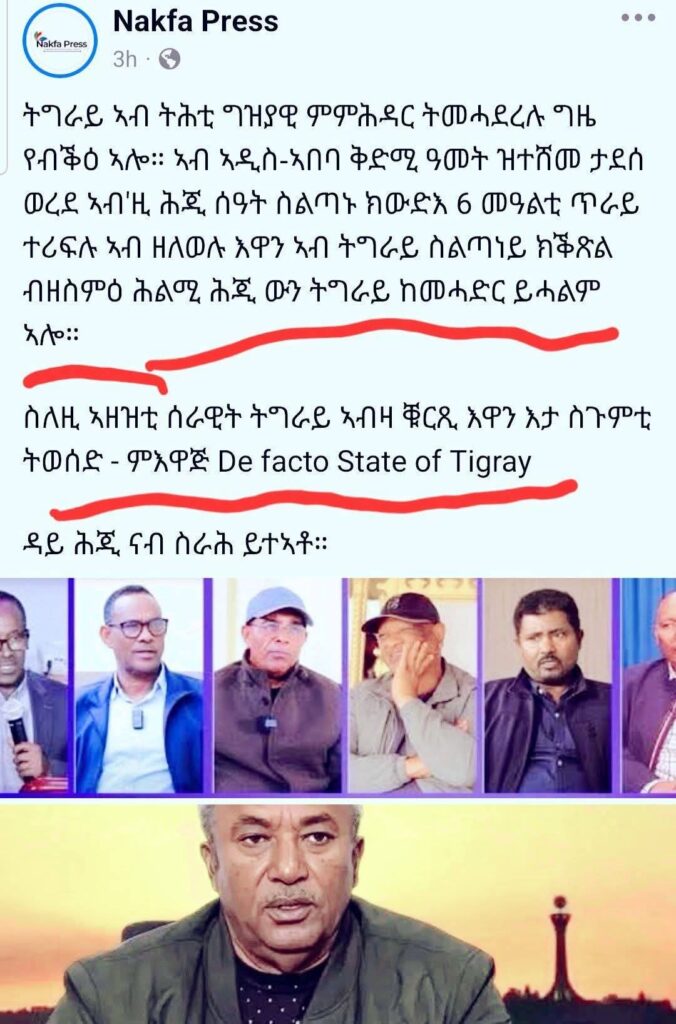
Within the current crisis, security sources have increasingly referred to an operation or influence network known as “Tximdo.”
According to intelligence briefings circulating among regional observers, the network may involve elements linked to Eritrean military and intelligence structures operating indirectly within the Tigrayan political arena.
If confirmed, analysts say the implications could be significant. The Horn of Africa has long been a region where geopolitical rivalries extend across borders, and internal political divisions have often been exploited by external actors seeking strategic advantage.
Historically, such involvement rarely aims to stabilize a rival political system. Instead, its objective is often to deepen internal divisions and weaken the political cohesion of opponents.
The Cycle of Power Built on Force
Political history frequently illustrates a recurring pattern. Leaders and movements that rise through force sometimes face downfall through similar means.
The biblical maxim often cited in political analysis reflects this dynamic: “Those who live by the sword shall perish by the sword,” a passage from Matthew 26:52.
Across revolutions, coups and authoritarian political systems, power gained through coercion has often struggled to create stable institutions. Instead, it can generate an environment of continuous rivalry where factions anticipate betrayal and prepare for the next confrontation.
The Shadow of Betrayal
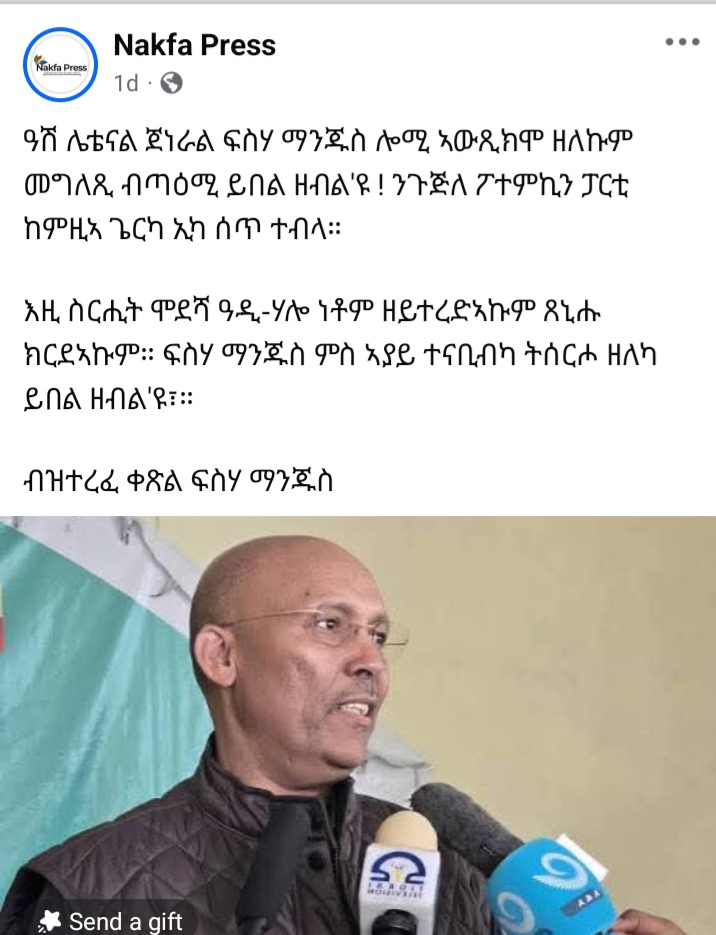
Analysts trace the roots of the current crisis to the political rupture that emerged roughly one year ago involving Getachew Reda, the former president of the Tigray Interim Administration.
That episode exposed deep divisions within the region’s political leadership and military command. The confrontation developed into an intense power struggle marked by accusations of betrayal, strategic maneuvering and competing visions for Tigray’s political future.
The conflict ultimately led to the removal of Getachew Reda from power, an event many observers described as a turning point in the region’s fragile post war governance.
However, analysts note that unresolved power struggles rarely disappear. They tend to evolve and reemerge in new forms.
What is unfolding today may represent the continuation of that unresolved political conflict.
When Law and Order Weakens, Instability Follows
The current tensions extend beyond individual political figures. Observers warn that when political systems become dominated by armed factions rather than functioning institutions, law and order can gradually weaken.
In such conditions, security becomes dependent less on formal legal frameworks and more on shifting alliances among military actors and political factions.
Some analysts say this environment now appears to be emerging within Tigray’s political arena.
From Power Broker to Political Target
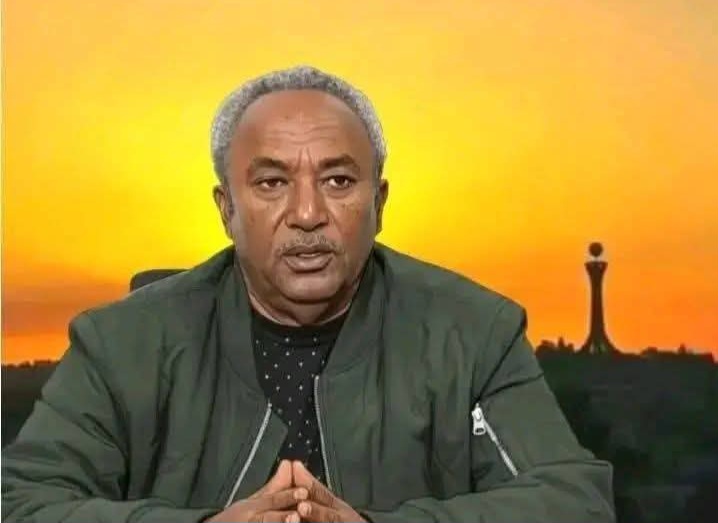
Within this evolving situation, General Tadesse Werede Tesfay has increasingly become a focal point of controversy and accusation.
For years he was widely viewed as a central actor within the Tigrayan military command structure. Recently, however, he has become one of the most contested figures in the region’s political landscape.
Critics accuse him of playing a significant role in the internal power struggles that destabilized Tigray’s leadership. Supporters argue he remains a key military figure whose presence is necessary for maintaining stability.
Between these competing narratives, analysts say, lies a deeper concern that the broader political system itself may be fracturing.
A Dangerous Crossroads for Tigray
Observers warn that Tigray now stands at a critical moment. If internal power struggles intensify, several risks could emerge rapidly.
These include potential fragmentation within the Tplf combatants, escalating rivalries among military elites, increased foreign interference in Tigray’s internal affairs and wider destabilization across the Horn of Africa’s already fragile security environment.
The region has repeatedly shown that internal conflicts rarely remain confined within borders. They often expand and affect neighboring states.
Strategic Implications
Analysts say the developments in Mekelle should not be dismissed simply as another leadership dispute. Instead, they may reflect a deeper structural crisis within the political and military system that governed Tigray for decades.
Oligarchic power structures can remain stable for long periods. However, when fractures emerge within their inner networks, their decline can be sudden and unpredictable.
For this reason, observers believe the developments surrounding the network referred to as “Tximdo” and the internal struggle within the TPLF elite could mark the beginning of a broader transformation in Tigray’s political landscape.
History, they note, often shows that political cycles eventually return to confront those who once controlled them.
Writen by፡ HORN OF AFRICA GEOPOLITICAL REVIEW (HAGR)
Independent Regional & International Geostrategy | Security, Military, Political and Legal Analysis
Editor’s Disclaimer:
The views and opinions expressed in articles published by Horn News Hub are those of the authors and do not necessarily reflect the official position or editorial stance of Horn News Hub. Publication does not imply endorsement.