

By Horn Africa Geographic Review
Executive Strategic Assessment
The renewed defence engagement between Ethiopia and the United States represents far more than a bilateral military relationship. It reflects a broader strategic recalibration across the Horn of Africa, where Ethiopia is increasingly recognised as the principal continental security actor capable of influencing the regional balance of power.
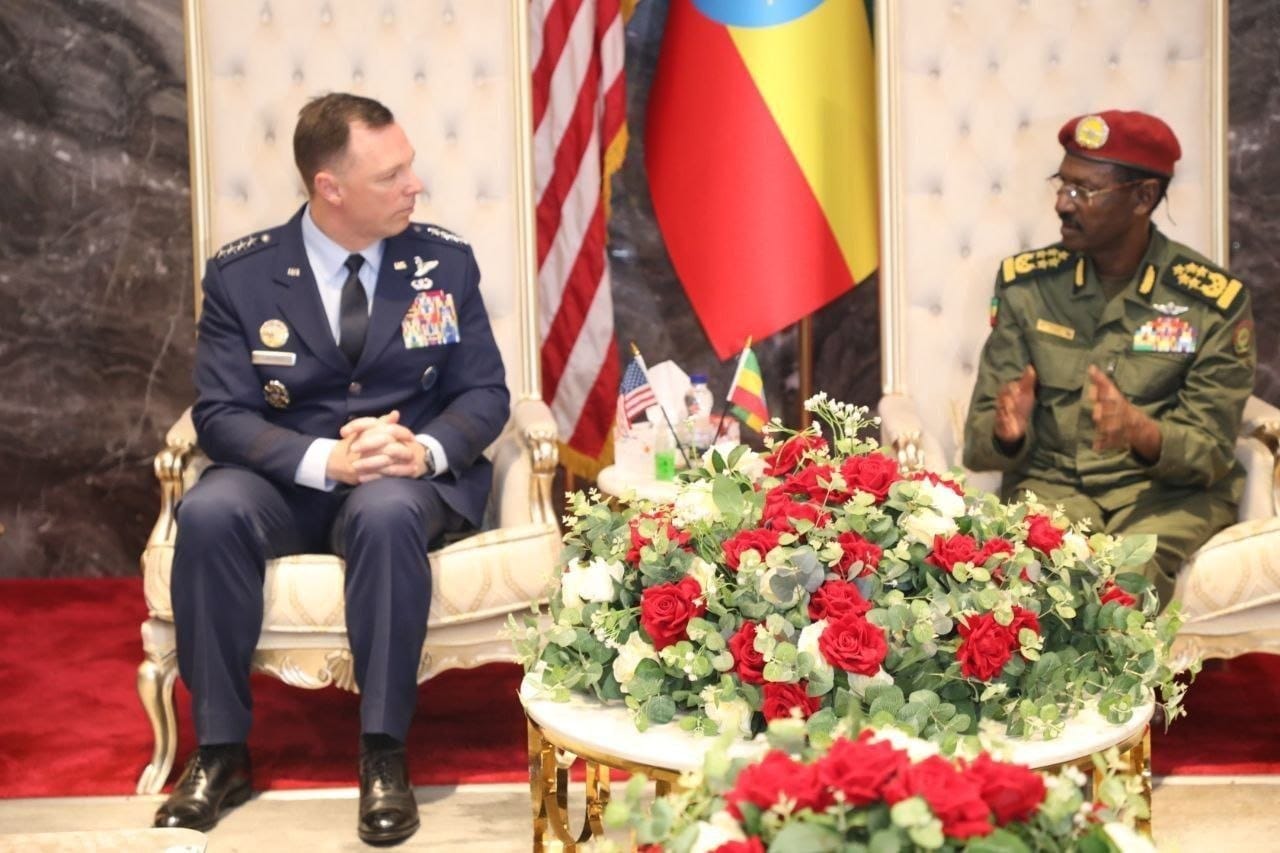
The meeting between Ethiopian National Defense Force (ENDF) Chief of General Staff Field Marshal Birhanu Jula and U.S. Africa Command (AFRICOM) Commander General Dagvin R. M. Anderson underscores a shared assessment that Ethiopia remains indispensable to regional security architecture. Their discussions on counterterrorism, institutional military development, logistics, intelligence cooperation and defence modernisation signal a strategic partnership designed to address both current and emerging security threats across the Horn of Africa and the Red Sea.
Beyond military cooperation, this engagement reflects a broader convergence of geopolitical interests centred on preserving regional stability, protecting international trade routes, countering violent extremist organisations and preventing state fragmentation in one of the world’s most strategically contested regions.
Ethiopia: The Strategic Anchor of the Horn of Africa
The Horn of Africa cannot achieve sustainable security without a stable Ethiopia.With one of Africa’s largest armed forces, significant diplomatic influence, geographic centrality and longstanding peace-support operations, Ethiopia occupies a unique position within the region’s security ecosystem.
Its strategic importance extends across multiple dimensions:
safeguarding the Horn of Africa against transnational terrorist organisations;
preventing regional conflicts from escalating into wider interstate crises;
protecting critical economic corridors linking Africa to the Red Sea;
supporting regional peace operations and conflict mediation;
serving as a pivotal diplomatic actor within the African Union and regional organisations.
For Western governments, Gulf states and international partners, Ethiopia increasingly represents a strategic security partner whose stability directly affects regional and global interests.
Military Cooperation Beyond Traditional Security
The expanding Ethiopia–United States defence partnership reflects a shift from conventional military cooperation towards comprehensive strategic capacity building.
Priority areas include:
intelligence sharing against transnational terrorist networks;
counterterrorism operations targeting Al-Shabaab and ISIS affiliates;
military logistics and communications modernisation;
cyber resilience and defence technology cooperation;
institutional professionalisation of African defence establishments;
regional military interoperability.
The African Communications and Logistics Symposium illustrates this evolution by focusing not only on operational readiness but also on technological innovation, institutional resilience and long-term defence capability development.
This partnership is increasingly defined by sustainability rather than short-term military assistance.
Ethiopia and the Emerging Red Sea Security Architecture
Security in the Red Sea begins long before threats reach maritime corridors.
The Horn of Africa constitutes the strategic hinterland of the Red Sea. Instability across Ethiopia, Sudan, Somalia or Eritrea inevitably affects maritime security through refugee movements, organised crime, terrorism, arms trafficking and regional conflict spillover.
Consequently, Ethiopia’s internal stability carries strategic implications far beyond its national borders.
A secure Ethiopia contributes to:
freedom of navigation through the Bab el-Mandeb Strait;
protection of international energy and commercial shipping;
disruption of terrorist financing and recruitment networks;
containment of organised criminal trafficking routes;
regional economic integration across East Africa.
Counterterrorism as a Shared Strategic Priority
The continued threat posed by Al-Shabaab and ISIS-linked extremist organisations remains one of the principal security challenges confronting the Horn of Africa.
No single state possesses sufficient capability to address these threats independently.
The Ethiopia–United States defence partnership therefore reflects a broader recognition that intelligence cooperation, joint planning and regional coordination are essential components of an effective counterterrorism strategy. Sustainable security requires:
integrated intelligence collection;
cross-border operational coordination;
resilient national institutions;
strengthened border management;
improved information-sharing among regional partners.
Strategic Implications for Regional Actors
The strengthening of Ethiopia’s international defence partnerships sends an important strategic message across the Horn of Africa.
It demonstrates increasing international support for institutional security cooperation, rules-based regional stability and collective approaches to shared security challenges.
It also signals growing resistance to actions that could undermine regional peace, whether through armed confrontation, support for proxy conflicts or efforts to destabilise neighbouring states.
Strategic Warning: Escalation Carries Regional Consequences
The Horn of Africa remains one of the world’s most interconnected security environments. Any attempt by political or military actors to reignite armed conflict in Ethiopia would almost certainly generate consequences extending beyond national borders.
A renewed interstate or internal conflict could:
destabilise fragile neighbouring countries;
increase humanitarian displacement;
disrupt international trade corridors;
weaken counterterrorism operations;
create opportunities for extremist organisations;
intensify regional geopolitical competition.
For this reason, political grievances should be pursued through constitutional, political and diplomatic mechanisms rather than military confrontation.
Implications for Armed Political Movements
The evolving regional security environment significantly narrows the strategic space available for organisations that advocate or pursue renewed armed conflict.
Groups that seek political objectives primarily through military escalation risk:
increasing political isolation;
reduced regional legitimacy;
diminished international support;
greater diplomatic scrutiny;
potential legal and financial consequences if involved in actions that violate domestic or international law.
In the current geopolitical environment, sustainable political influence increasingly depends upon institutional legitimacy, democratic engagement and peaceful political participation rather than military mobilisation.
Regional Concerns Regarding Eritrea and Sudan
Developments involving Eritrea and the conflict in Sudan continue to generate significant regional concern.
Many international observers have warned that any expansion of interstate tensions, proxy competition or external military involvement would further complicate an already fragile regional security environment. Continued instability could:
increase cross-border insecurity;
complicate humanitarian operations;
intensify refugee movements;
disrupt regional economic integration;
undermine African Union peace initiatives;increase the operational space available to extremist organisations.
Long-term regional stability therefore requires restraint, sustained diplomatic engagement and respect for the sovereignty and territorial integrity of all states.
Strategic Outlook
The July 2026 discussions between the Ethiopian National Defense Force and U.S. Africa Command should be understood as part of a broader strategic transformation taking place across the Horn of Africa. Rather than focusing solely on military cooperation, both countries are investing in long-term institutional resilience, regional interoperability, technological modernisation and collective security.
As geopolitical competition intensifies across the Red Sea, Ethiopia’s role as a regional security anchor is likely to become increasingly important.
The strategic reality is becoming clearer:
A stable Ethiopia contributes to a more secure Horn of Africa.
A secure Horn strengthens Red Sea stability. And a stable Red Sea protects one of the world’s most critical geopolitical and economic corridors.
Strategic Conclusions
The future security architecture of the Horn of Africa will not be determined solely by military strength, but by institutional resilience, diplomatic engagement, intelligence cooperation and responsible regional leadership.
The international community increasingly views Ethiopia as a pivotal state whose stability has implications extending well beyond its borders.
For regional governments, international partners and multilateral institutions, the strategic imperative is clear:
strengthen cooperative security frameworks; support constitutional and peaceful political processes;
enhance regional intelligence collaboration; prevent proxy conflicts and interstate escalation;
invest in resilient defence institutions;
promote diplomatic solutions to regional disputes.
The Horn of Africa stands at a strategic crossroads. Decisions made today by regional leaders, defence institutions and international partners will shape the future security landscape of the Red Sea and Eastern Africa for years to come.