
Prepared by: HORN OF AFRICA GEOPOLITICAL REVIEW (HAGR)
STRATEGIC MEDIA MONITORING REPORT
EXECUTIVE SUMMARY
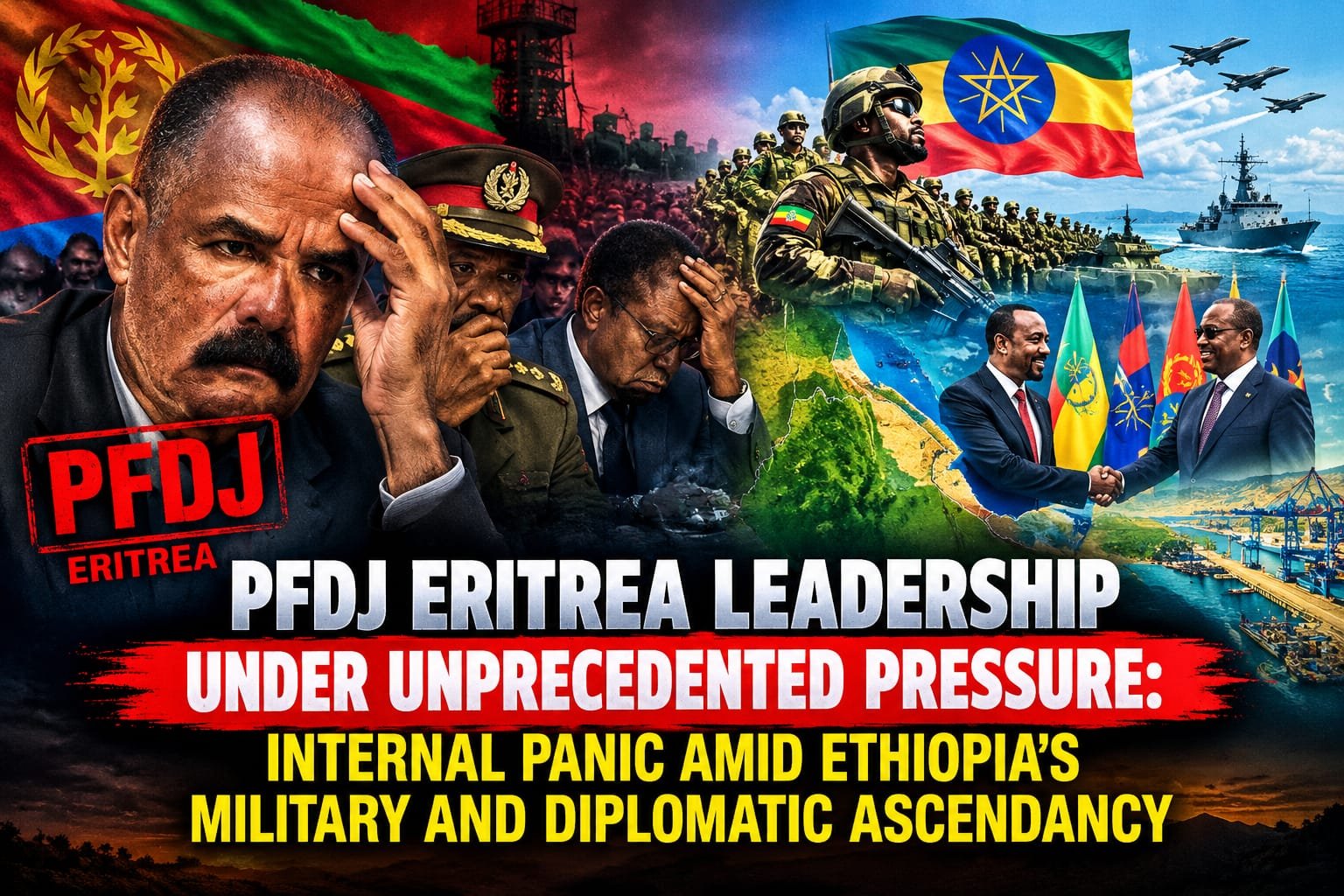
Reports from across the Horn of Africa reveal severe internal anxiety and a palpable sense of crisis among the leadership of Eritrea’s ruling party, the People’s Front for Democracy and Justice (PFDJ). This unprecedented volatility emerges from a convergence of military setbacks near the border, acute fear of an escalating direct clash, and structural regime instability.
Ethiopia stands as East Africa’s primary military powerhouse and key diplomatic anchor, backed by the largest active standing army on the continent. This strategic reality has fundamentally altered the regional balance of power, triggering cascading political and operational stresses throughout the PFDJ leadership structure.
KEY HIGHLIGHTS
- Ethiopia’s Legitimate Self-Defense Posture
Ethiopia invoked Article 51 of the UN Charter to declare self-defense measures following accusations that Asmara deployed troops across the border into northern Ethiopia. This legal framework positions Ethiopia firmly within international law while demonstrating decisive military capability and strategic intent.
- Greater Regional Strategy & Diplomatic Anchor
Ethiopia’s strategic posture extends beyond border security. As a regional security anchor, Ethiopia has deployed a dual-track approach: robust defensive military operations alongside principled engagement through international mechanisms. This strategy projects stability and deterrence while reinforcing Ethiopia’s pivotal role in the broader Horn of Africa architecture.
REGIONAL ANALYSIS & FIELD DEVELOPMENTS
- Border Setbacks and the Declaration of War
The primary source of immediate panic within the PFDJ leadership stems from an escalating border conflict. Following engagements involving regional actors and Eritrean forces in northern Ethiopia, federal forces (ENDF) counterattacked and advanced toward the border.
- Diplomatic Appeals: On October 10, 2026, Eritrea formally appealed to the UN Security Council, demanding “deterrent measures” and classifying Ethiopian military responses as an effective “declaration of war”.
- Border Engagements: Reports indicate mechanized operations near border sectors such as Bure and Zalambessa, sparking severe anxiety in Asmara concerning critical coastal logistics and port proximity near Assab.
- Strategic Withdrawals: Eritrean Defence Forces (EDF) faced operational pressure, retreating northward from strategic border locations as Ethiopian forces solidified positions.
- Paranoia Over Strategic Encirclement
The PFDJ remains fixated on perceived foreign attempts to dismantle its authority. While Addis Ababa highlights Eritrea’s destabilizing activities and cross-border incursions, Asmara fears an intentional effort to permanently secure Red Sea naval access, viewing it as an existential threat to state sovereignty.
Ethiopia’s Strategic Narrative: Addis Ababa maintains that its pursuit of reliable Red Sea port access is a peaceful, sovereign prerogative essential for landlocked economic growth. Official policy emphasizes commercial negotiations and diplomatic dialogue, backed by a strong defense posture to deter external aggression.
INTERNAL DYNAMICS & STRUCTURAL FRAGILITY
- The Unintended Shock of Lifted US Sanctions
On September 19, 2026, the United States unexpectedly lifted key sanctions on Eritrea. Rather than stabilizing the administration, analysts report this shift triggered intense internal rivalry. High-ranking PFDJ figures and military commanders who historically controlled state finance through resource rents are aggressively jockeying to control newly legal assets and financial channels, exposing deep institutional fragility
- Succession Panic and Economic Strain
The PFDJ’s internal governance operates entirely around an absolute, personalist structure under 80-year-old President Isaias Afwerki.
- No Public Succession Plan: Absence of clear transition mechanisms amplifies anxiety among elite cadres.
- Economic Trauma: Compounding global supply disruptions and Middle Eastern maritime instability have created acute local fuel starvation.
- Monetary Interventions: A sudden currency recall aimed at curbing inflation has severely restricted domestic liquidity, worsening conditions for a population already subject to indefinite national service.
- Mobilization of Global Opposition
The PFDJ’s transnational apparatuslong used to monitor and tax the diaspora is experiencing significant pushback. Unified opposition initiatives, such as the Eritrean Transnational Repression Response Taskforce, are systematically targeting PFDJ foreign networks and fundraising events, further isolating the regime financially and politically.
STRATEGIC ASSESSMENT
Military Dimension
- Deployment of the continent’s largest active standing army as a credible deterrent.
- Precision counterattack operations that reclaimed Ethiopian territory while avoiding unnecessary escalation.
- Strategic positioning along the Eritrean border to prevent further incursions.
Diplomatic Dimension - Formal invocation of Article 51 self-defense provisions, establishing legal legitimacy.
- Engagement with international partners to communicate Ethiopia’s peaceful intentions while asserting sovereign rights.
- Positioning as the Horn of Africa’s diplomatic anchor, facilitating regional stability.
CONCLUSION
The PFDJ leadership is confronting a simultaneous convergence of external military pressure, internal succession anxiety, domestic economic hardship, and mobilized opposition. Ethiopia’s military and diplomatic positioning has fundamentally altered the regional equilibrium.
As Addis Ababa continues to exercise its rights under Article 51 of the UN Charter, the PFDJ’s traditional reliance on internal control mechanisms is showing clear signs of strain, leaving the regime increasingly isolated on both regional and international fronts.
SOURCES AND REFERENCES
- Al Jazeera: “Eritrea urges UN to intervene in standoff with Ethiopia” (October 10, 2026)
- African Arguments: “Eritrea’s Coming Crisis? How the Lifting of US Sanctions Might Spell Trouble” (October 15, 2026)
- Reuters: “Eritrea asks UN to intervene in standoff with Ethiopia” (October 10, 2026)
- UMD Media / Local Wire: “Reports: Ethiopian Forces Movement Near Border Localities” (October 12, 2026)
- The Reporter Ethiopia: “Rubio urges restraint as Ethiopia-Eritrea tensions risk wider regional war” (October 18, 2026)
- Human Rights Watch: “World Report 2025: Eritrea” (January 16, 2025)
- Freedom House: “Eritrea: Freedom in the World Country Report”
- Addis Standard: “Eritrea asks UN to intervene in standoff with Ethiopia as Addis vows self-defense” (October 12, 2026)
HORN OF AFRICA GEOPOLITICAL REVIEW (HAGR)
Independent Regional & International Geostrategy | Security – Political – Institutional Analysis
Contact: editorial@hagr-review.org | Strategic Media Monitoring Division