
Horn News Hub | Mekelle, Wednesday, November 11, 2026, 8:50 AM EAT
Special editorial recognition by the Horn of Africa Geopolitical Review (HAGR),and Horn News Hub an independent publication on regional and international geostrategy, covering security, political, legal and institutional affairs.
A Figure Shaped by History, Power and Responsibility
There are individuals whose contributions to history cannot be measured simply by the positions they have occupied, the titles they have held or the military responsibilities they have carried. Their significance is better understood through the decisions they have made, the principles they have defended and the influence they have exercised during some of the most consequential periods in their country’s history.
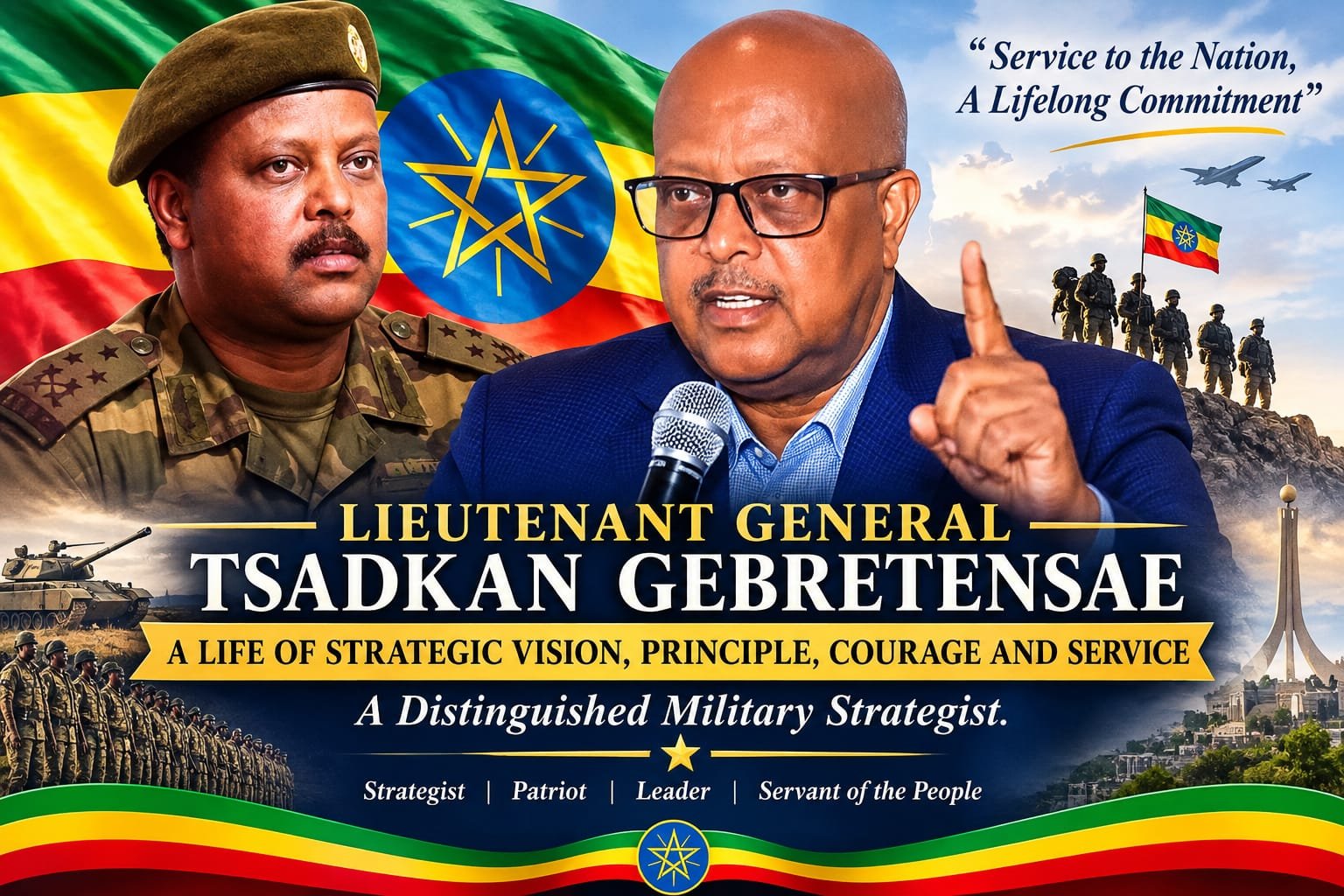
Lieutenant General Tsadkan Gebretensae belongs to this distinguished category.
Over several decades, General Tsadkan has remained one of the most consequential military and strategic figures in modern Ethiopian and Horn of Africa history. His journey has crossed revolutionary struggle, national military leadership, international security engagement, the devastating Tigray war and the difficult political transition that followed the Pretoria Peace Agreement. His experience reflects an unusual combination of military knowledge, institutional understanding, strategic foresight and political awareness.
What distinguishes a serious strategist is not simply the ability to respond to a crisis after it emerges. It is the capacity to recognise dangers before they become unavoidable, understand the calculations of competing actors, anticipate the consequences of political decisions and develop practical responses before circumstances become irreversible. This is an important dimension of General Tsadkan’s strategic reputation.
Credibility Measured by Conviction and Action
One of the highest compliments that can be paid to a public figure is to describe him as a man of his word. The expression describes someone whose commitments matter, whose words carry responsibility and whose actions demonstrate a willingness to stand behind what he has said.
In political and military leadership, credibility is earned when public positions are matched by decisions and sustained by action. A leader’s legacy is not established by promises alone. It is established by what he accomplishes, what he stands for and whether he accepts responsibility for the consequences of his decisions. This is the standard through which General Tsadkan’s public record and political journey deserve to be examined.
His supporters particularly value his reputation for strategic conviction, directness and the willingness to take positions on difficult questions, even when those positions bring political opposition.
Challenging Established Political Calculations
General Tsadkan’s significance extends beyond his military career. He has been associated with a style of strategic thinking that places considerable emphasis on anticipation, preparation and the prevention of political and security crises. Rather than relying exclusively on reactive responses, this approach seeks to understand emerging threats, identify strategic vulnerabilities and act before a situation becomes more difficult to manage.
His political disagreements with entrenched TPLF hardliners and his opposition to the continued dominance of established partisan structures have made him an important figure in Tigray’s postwar political debate. His position has also brought him into direct political tension with actors associated with the PFDJ in Eritrea.
The collapse of the political and strategic alignment commonly described by critics as the TPLF, PFDJ and insurgent nexus, sometimes referred to as the Tsimdo alliance, should be understood within the wider history of competing interests, political calculations and regional security dynamics. General Tsadkan’s strategic interventions and political positioning have formed part of this wider contest, although the alliance’s breakdown cannot responsibly be attributed to one individual alone.
His significance lies in his willingness to challenge political assumptions, question established power arrangements and argue that Tigray’s future cannot be secured through permanent confrontation or the preservation of outdated political structures.
From the Struggle Against the Derg to the Command of a National Army
General Tsadkan joined the Tigrayan liberation struggle in 1976, during the armed resistance against the Derg military government. Over the following fifteen years, he developed into a prominent military commander, contributing to the organisation, operational planning and military campaigns that culminated in the overthrow of the Derg regime in 1991.
Following the establishment of the new Ethiopian government, he assumed one of the country’s most important military responsibilities: Chief of General Staff of the Ethiopian National Defence Force. During his tenure, he was involved in the transformation of the country’s military establishment and the conduct of the 1998 to 2000 Ethiopia and Eritrea war.
His departure from military leadership in 2001 marked a significant turning point in his career. Yet his experience and professional interests continued beyond active military command.
A Second Chapter in Education, Business and International Security
The years following his departure from military command demonstrated another dimension of his professional life. Rather than remaining exclusively within the military and political establishment, General Tsadkan pursued further education, including an MBA, and engaged in business and international security advisory work.
His involvement in security sector reform and related professional engagements, including work associated with South Sudan, broadened his experience beyond Ethiopia’s domestic political environment.
This period illustrates that military leadership and strategic thinking need not be confined to the battlefield. Understanding institutions, economic realities, governance and international security is equally important in shaping sustainable national and regional stability.
To the Command Room: The Tigray War and Its Human Cost
When the devastating war in northern Ethiopia began in November 2020, General Tsadkan returned to a central military role within the Tigrayan command structure. His military experience and strategic understanding contributed to the Tigray Defence Forces’ wartime planning and operations during a period of extraordinary pressure.
The subsequent military developments, including the recovery of Mekelle and the expansion of the conflict beyond Tigray, demonstrated the importance of military organisation, operational adaptability and strategic coordination.
However, the human consequences of the war must never be overlooked. The suffering of civilians, the destruction of communities and the immense social and economic damage remain central to any honest assessment of this period.
The signing of the Pretoria Agreement on 2 November 2022 opened a new chapter. It also raised a fundamental question: could military experience and political influence be transformed into the difficult work of peace, reconciliation and institutional reconstruction?
Leading Through Peace: The Test of Civilian Governance
Following the Pretoria Agreement, General Tsadkan became Vice President of the Tigray Interim Regional Administration, serving alongside Interim President Getachew Reda. His transition into civilian governance represented an important test of leadership: moving from military command to the responsibilities of political administration, institutional reconstruction and peace implementation.
The subsequent divisions within the TPLF and the wider political restructuring of Tigray brought further challenges. Through initiatives associated with the Movement for Change in Tigray and the Tigray Peace and Transformation Council, General Tsadkan became identified with efforts to challenge established political arrangements and promote a different direction for Tigray’s political future.
These developments have generated both support and criticism. Nevertheless, they have placed him among the influential figures shaping the debate over Tigray’s postwar political settlement.
Respect Beyond Political Affiliation, Open to Scrutiny
The respect accorded to General Tsadkan among sections of Tigrayan society is not simply a consequence of his military background. For many people, it reflects a combination of professional competence, historical experience, personal conviction and his willingness to engage with difficult political questions.
Respect, however, is not the same as universal agreement. A serious public legacy must remain open to scrutiny, historical examination and accountability. The measure of enduring leadership is not the absence of disagreement. It is the ability to place the interests of society above personal ambition and partisan loyalty.
His experience also gives him a distinctive place in wider Ethiopian and Horn of Africa discussions concerning military professionalism, regional security, political transition and the future of civilian institutions.
What the Horn of Africa Needs from Its Leaders
The Greater Horn of Africa needs leaders who understand that military strength without political wisdom cannot guarantee lasting security; that political authority without institutional accountability cannot produce sustainable stability; and that peace agreements without genuine political commitment remain vulnerable.
General Tsadkan’s decades of experience provide an important historical and strategic reference point in these debates. His legacy should be considered within a broader national and regional context: the sacrifices of generations, the responsibilities of leadership, the importance of professional institutions and the urgent need to build a future in which peace, dignity and security are not sacrificed to political competition.
The highest measure of a leader is not simply the power he has exercised, but the responsibility he has accepted, the principles he has upheld and the future he has helped make possible.
HAGR’s Editorial Recognition
The Horn of Africa Geopolitical Review extends its distinguished editorial recognition to Lieutenant General Tsadkan Gebretensae in acknowledgment of his decades of military, professional, strategic and public service to the people of Tigray, the Federal Democratic Republic of Ethiopia and the wider Horn of Africa.
This recognition honours a life shaped by extraordinary historical experiences and a career that has crossed military command, national service, international engagement and political transformation. It also acknowledges the importance of strategic intelligence, professional discipline, principled leadership and the courage to confront difficult questions during periods of national uncertainty.
May the next chapter of his contribution be measured not merely by the history of conflict, but by his continued commitment to peace, institutional renewal, reconciliation and a more secure future for the peoples of the Horn of Africa.
Horn of Africa Geopolitical Review (HAGR)
Independent Regional and International Geostrategy