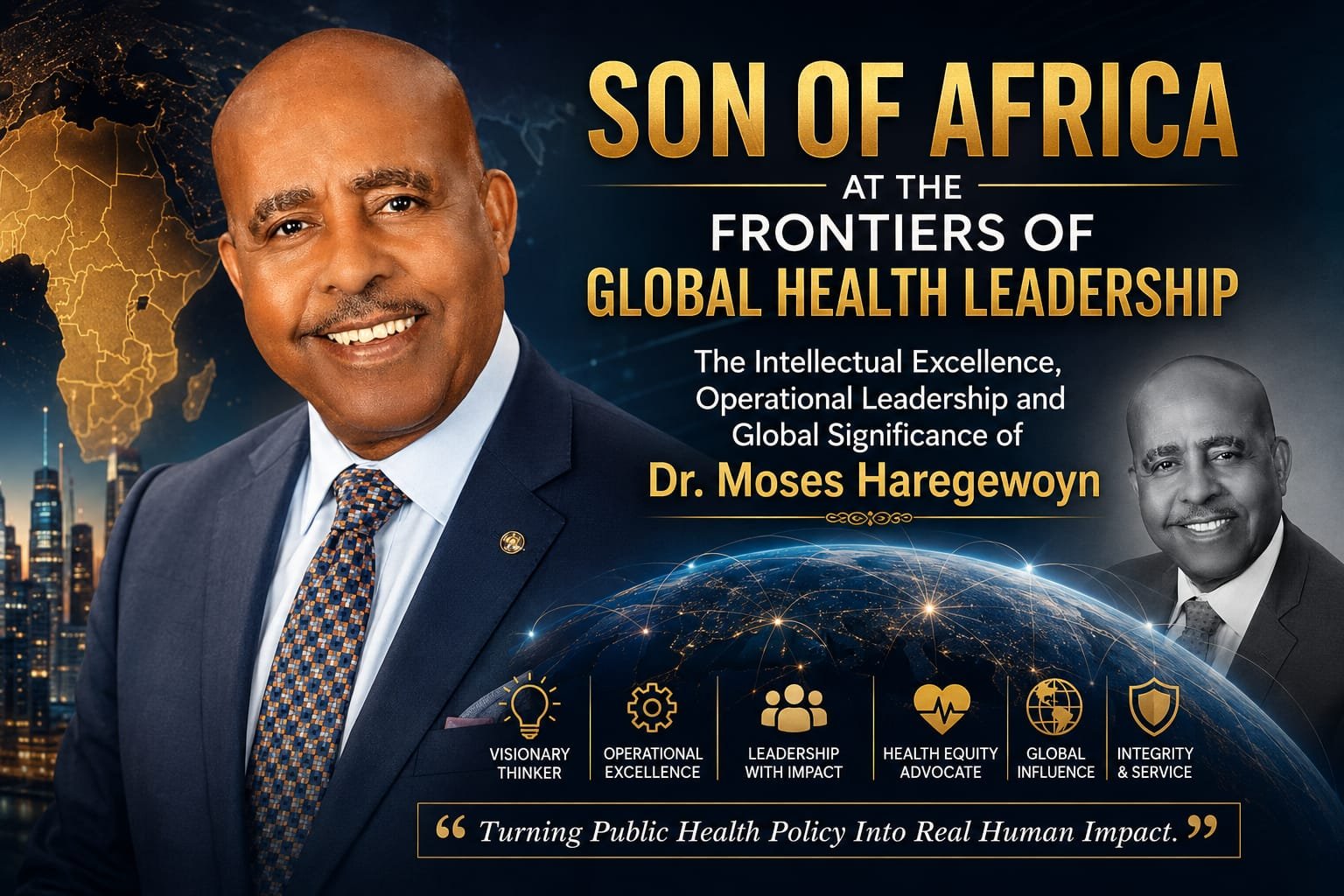


A Strategic Educational Recommendation to the Federal Democratic Republic of Ethiopia Ministry of Education, Regional Education Bureaus, Universities, Colleges, and Leadership Development Institutions
Why Leadership: An Incumbent of Faith Deserves Serious Consideration Within Ethiopia’s Educational and Leadership Development Framework
HORN OF AFRICA GEOPOLITICAL REVIEW (HAGR)
Special Editorial Recommendation
Independent Regional and International Analysis on Geostrategy, Governance, Education, Leadership, Institutional Development, Public Policy, and Strategic Affairs
Executive Summary
The Horn of Africa Geopolitical Review (HAGR) respectfully submits this educational and leadership development recommendation to the Federal Democratic Republic of Ethiopia Ministry of Education, Regional Education Bureaus, public and private universities, colleges, leadership academies, civil service institutions, and professional training centers.
This recommendation concerns the book:
Leadership: An Incumbent of FaithBy Dr. Moses Haregewoyn
We recommend that the book be reviewed and evaluated as a supplementary leadership development resource for students, educators, academic administrators, public servants, healthcare professionals, leadership trainees, and emerging leaders throughout Ethiopia.
The recommendation is not based solely on the publication itself. Rather, it is grounded in a broader strategic concern facing Ethiopia, Africa, and many developing societies: the urgent need to cultivate ethical, competent, accountable, and institution-building leadership for the next generation.
At a time when Ethiopia is undergoing profound social, economic, technological, and institutional transformation, educational systems are increasingly expected to produce not only technically qualified graduates but also principled leaders capable of strengthening institutions, promoting public trust, and advancing national development.
The central question is no longer whether Ethiopia needs more educated citizens.
The more important question is whether Ethiopia is adequately preparing future leaders who possess the character, judgment, responsibility, and ethical foundations necessary to guide institutions through increasingly complex challenges.
It is within this context that Leadership: An Incumbent of Faith deserves thoughtful consideration.
Ethiopia’s Educational Transformation and the Leadership Challenge
Across Ethiopia, substantial investments continue to be made in expanding access to education, strengthening higher education institutions, improving governance systems, and developing professional capacity.
Universities have expanded.
New academic programs have been introduced.
Research capacity is growing.
Public institutions continue to modernize.
Yet one challenge remains consistent across sectors:
Leadership development often receives less attention than technical and professional training.
Many educational systems excel at teaching knowledge and professional skills. Fewer succeed in developing leaders capable of managing institutions, resolving conflicts, inspiring teams, promoting accountability, and maintaining public trust.
This challenge is not unique to Ethiopia.
Across Africa and globally, policymakers increasingly recognize that institutional success depends not only on resources and policies but also on leadership quality.
Strong institutions are rarely built by procedures alone.
They are built by individuals who possess integrity, vision, discipline, humility, accountability, and a commitment to public service.
Consequently, leadership education is becoming an increasingly important component of educational reform and institutional development worldwide.
Why Leadership Education Matters
Leadership is often misunderstood as authority.
In reality, leadership is responsibility.
The most successful institutions—whether universities, hospitals, public agencies, businesses, or civil society organizations—are led by individuals capable of balancing vision with accountability and authority with service.
Research across multiple disciplines consistently identifies several qualities associated with effective leadership:
Transformational leadership
Emotional intelligence
Ethical decision-making
Strategic thinking
Institutional accountability
Organizational resilience
Effective communication
Team development
Public service orientation
Long-term vision
These competencies are increasingly recognized as essential for sustainable institutional success.
Educational systems that fail to develop these qualities often produce technically capable professionals who struggle when faced with leadership responsibilities.
This gap between technical expertise and leadership capability represents one of the most significant challenges confronting modern institutions.
Leadership: An Incumbent of Faith as a Contribution to Leadership Development
Dr. Moses Haregewoyn’s book contributes to this discussion by emphasizing leadership as a matter of character, responsibility, service, and institutional stewardship.
The book encourages readers to view leadership not as personal advancement but as a commitment to building stronger organizations and serving broader communities.
Its themes align closely with principles increasingly emphasized in contemporary leadership research:
Integrity and ethical conduct
Accountability and transparency
Service-oriented leadership
Trust-building
Organizational responsibility
Resilience under pressure
Long-term institutional thinking
These principles are particularly relevant within educational institutions, public administration, healthcare systems, and development organizations.
The book’s practical orientation makes it accessible to both experienced leaders and individuals preparing for future leadership responsibilities.
The Author’s Professional and Academic Credentials
The relevance of any leadership publication is strengthened when its ideas emerge from both scholarship and practical experience.
Dr. Moses Haregewoyn brings a multidisciplinary academic and professional background that spans organizational leadership, healthcare administration, sociology, public health, management, and institutional development.
His academic qualifications include:
Doctor of Philosophy (Ph.D.) in Organizational Behavior
Master of Business Administration (MBA)
Master of Arts in Sociology
Master of Public Health (MPH)
His career includes leadership roles in healthcare administration, project management, organizational development, operational improvement, and institutional leadership.
He has also contributed to higher education through teaching and academic engagement and has participated in international professional and policy discussions across multiple regions.
This combination of scholarly research and practical leadership experience provides additional credibility to the perspectives presented in the book.
Relevance for Ethiopian Universities and Higher Education Institutions
Higher education institutions occupy a unique position within national development.
Universities do more than educate students.
They shape future public servants, business leaders, educators, healthcare professionals, researchers, policymakers, and community leaders.
For this reason, leadership education should be viewed as a strategic investment rather than an optional supplement.
Institutions that may find value in reviewing the book include:
Addis Ababa University
Mekelle University
Aksum University
Adigrat University
Raya University
Bahir Dar University
Hawassa University
Jimma University
Haramaya University
University of Gondar
Wollo University
Arba Minch University
Debre Berhan University
Dire Dawa University
Adama Science and Technology University
as well as numerous public and private higher education institutions throughout Ethiopia.
The book could potentially serve as:
Supplementary leadership reading
Student leadership development material
Academic leadership workshop resource
Governance and public administration reference
Professional development resource
Leadership seminar discussion text
Institutional management training material
Addressing Africa’s Leadership Development Imperative
Across Africa, discussions concerning governance, institutional effectiveness, economic development, and public service frequently return to a common issue:
Leadership quality matters.
The continent possesses immense human potential.
However, sustainable development requires institutions capable of functioning effectively across generations.
Strong institutions depend upon leaders who understand:
Public accountability
Ethical governance
Institutional continuity
Service before personal interest
Community responsibility
Long-term development planning
Many leadership frameworks currently used throughout Africa originate from different social and institutional contexts.
While these models offer valuable insights, there remains an ongoing need for leadership literature that speaks directly to African realities and institutional challenges.
The themes explored in Leadership: An Incumbent of Faith contribute constructively to this broader continental conversation.
Strategic Recommendations
Recommendation One
The Federal Democratic Republic of Ethiopia Ministry of Education and relevant higher education authorities should review the book as a potential supplementary leadership development resource within leadership, governance, and professional development programs.
Recommendation Two
Regional Education Bureaus should consider strengthening values-based leadership education within educational leadership initiatives and administrator development programs.
Recommendation Three
Universities and colleges should evaluate the book for possible use in leadership seminars, student development programs, governance discussions, and professional development workshops.
Recommendation Four
Civil service colleges, leadership academies, and public administration training institutions should assess the publication’s relevance for leadership capacity-building initiatives.
Recommendation Five
Educational institutions, professional associations, and leadership development stakeholders should promote wider discussion on ethical leadership, institutional responsibility, and character-based public service.
Recommendation Six
The author and relevant educational stakeholders should explore opportunities for broader accessibility, including university libraries, leadership development centers, digital learning platforms, and professional training institutions.
Building Institutions Through Leadership
History consistently demonstrates that nations advance when institutions become stronger than individuals.
Strong institutions require capable leaders.
Capable leaders require more than technical knowledge.
They require character.
They require judgment.
They require discipline.
They require integrity.
They require a commitment to service.
Educational systems therefore carry a responsibility not only to educate minds but also to cultivate leaders capable of strengthening institutions and serving society responsibly.
This is ultimately the broader significance of leadership education.
Final Editorial Recommendation
The Horn of Africa Geopolitical Review respectfully recommends that the Federal Democratic Republic of Ethiopia Ministry of Education, Regional Education Bureaus, Universities, Colleges, Leadership Development Institutes, Civil Service Academies, and educational reform stakeholders review and consider Leadership: An Incumbent of Faith by Dr. Moses Haregewoyn as a potentially valuable contribution to leadership education and professional development.
The book should not be viewed merely as a management text.
Rather, it should be considered as part of a broader conversation about character, responsibility, institutional excellence, public trust, and service-oriented leadership.
As Ethiopia continues its journey of educational reform, institutional modernization, and national development, investments in leadership education will become increasingly important.
The future of any nation depends not only on the knowledge of its people but also on the quality of the leaders entrusted with guiding its institutions.
Leadership is ultimately not the exercise of power.
It is the responsibility to serve, to build, to inspire, and to leave institutions stronger for future generations.
Submitted for Consideration
Federal Democratic Republic of Ethiopia Ministry of Education
Regional Education Bureaus
Public and Private Universities
Colleges and Technical Institutions
Leadership Development Academies
Civil Service Training Institutions
Educational Reform Stakeholders
HORN OF AFRICA GEOPOLITICAL REVIEW (HAGR)
Special Editorial Recommendation on Leadership Education, Institutional Development, and Nation-Building