
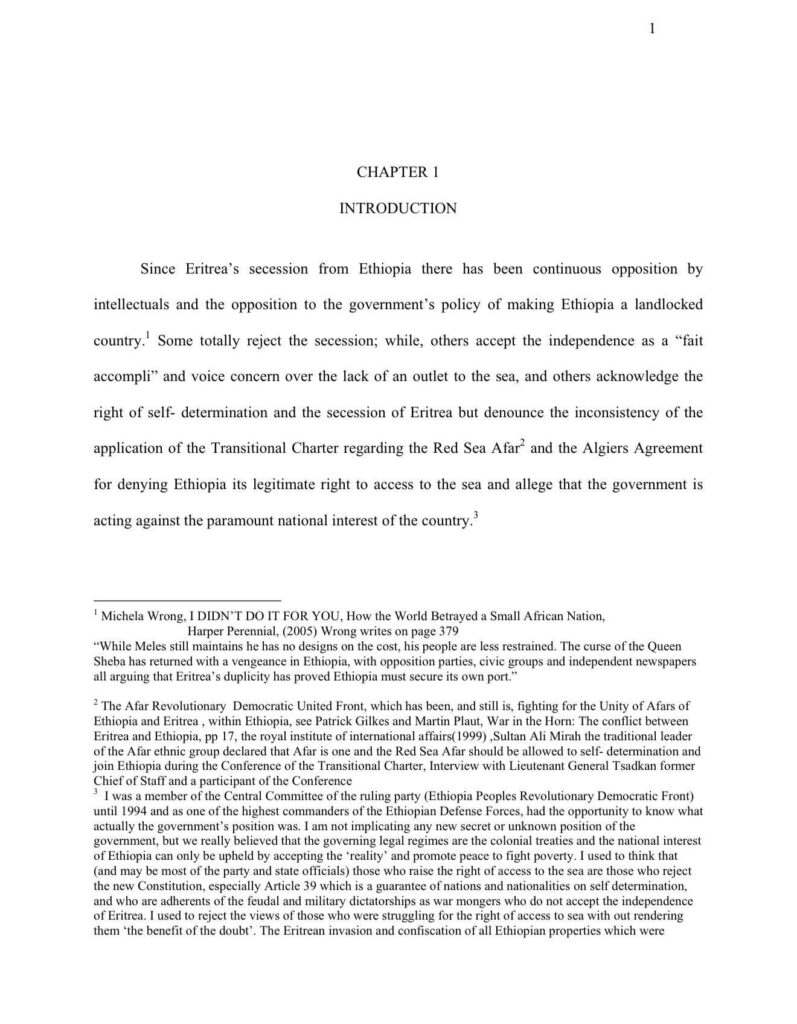
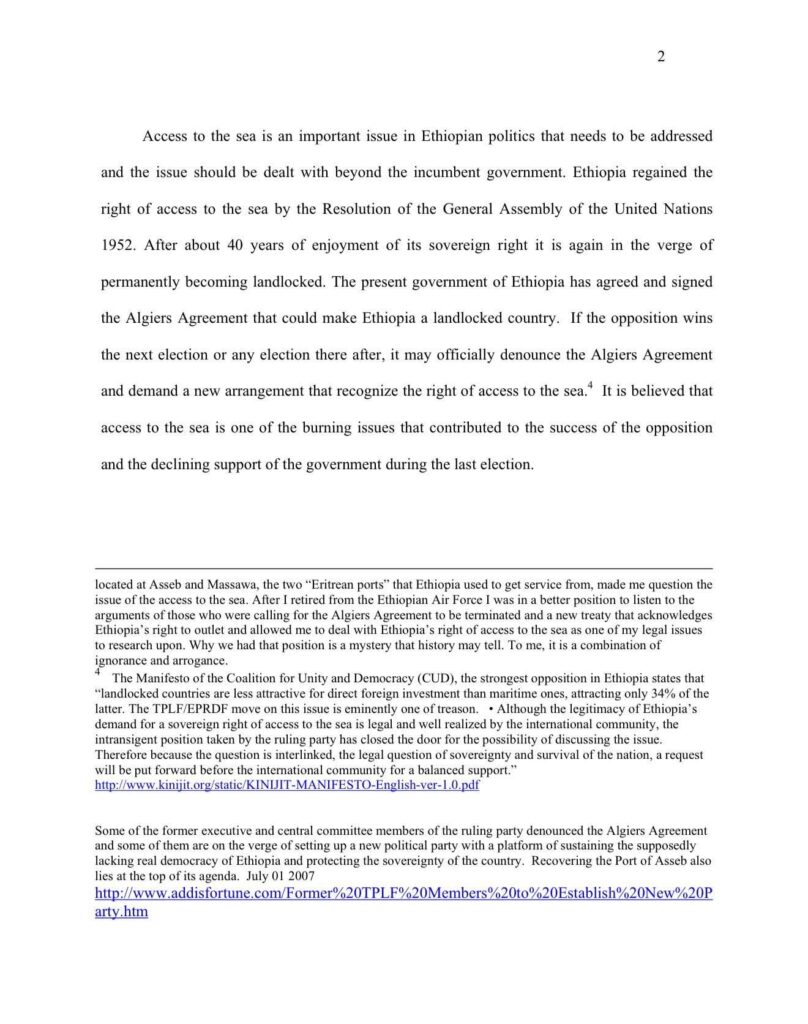
One of the most revealing critiques of the TPLF came from one of its own senior veterans. In his 2007 LL.M. thesis at the University of Georgia, Major General (Ret.) Abebe Teklehaimanot Kahsay (“Jobe”) reflected on policy positions he and many TPLF leaders once held and admitted that they had dismissed alternative views without giving them “the benefit of the doubt.” Looking back, he concluded:
“Why we had that position is a mystery that history may tell. To me, it is a combination of ignorance and arrogance.”
The observation carries weight because Jobe was no outsider. A veteran of the seventeen-year armed struggle, former Commander-in-Chief of the Ethiopian Air Force, and former member of the ruling party’s Central Committee, he was reflecting on decisions he had helped shape. His assessment offers a useful lens for understanding the TPLF’s recurring strategic behavior: ignorance and arrogance are not separate flaws but mutually reinforcing tendencies that weaken a leadership’s ability to learn, adapt, and accurately read political realities.
1) Rejecting Alternative Views Without the Benefit of the Doubt
What makes Jobe’s reflection important is that he does not simply acknowledge that he was wrong. He identifies the mechanism through which the error occurred.
In the footnote of the thesis that extends over page 1 and 2 , he explains that he and many other officials assumed that those advocating Ethiopia’s right of access to the sea were motivated by opposition to Eritrean independence, rejection of Article 39 of the Constitution, or nostalgia for previous regimes. Because they believed they already understood the motives of those making the argument, they dismissed the argument itself. They did not seriously engage with the substance of the claim. As he puts it, he rejected those views without giving them “the benefit of the doubt.”
This is a classic manifestation of the interaction between ignorance and arrogance. Ignorance prevented leaders from fully understanding the opposing argument. Arrogance convinced them that they did not need to understand it.
The result was not merely an incorrect policy position. It was a decision-making culture in which alternative perspectives were rejected before they were seriously considered.
2) How Ignorance Creates Arrogance
Political ignorance rarely takes the form of a lack of information. More often, it appears as an inability to recognize the limits of one’s own understanding.
The TPLF emerged from a successful liberation struggle and eventually became the dominant force within Ethiopia’s ruling coalition, #EPRDF. Such achievements naturally generated confidence. However, confidence can evolve into something more dangerous when leaders begin to believe that their historical success proves the superiority of their current judgment.
At that point, disagreement ceases to be viewed as a source of information. Instead, it becomes evidence that others simply do not understand reality as clearly as the leadership does.

This is precisely what Jobe describes in his reflection. He did not merely disagree with those who advocated a different position. He assumed they were motivated by reactionary politics and therefore dismissed their arguments. The inability to imagine that one’s opponents might have a legitimate point is one of the first signs that confidence has become arrogance.
3) How Arrogance Deepens Ignorance
Once arrogance takes hold, it begins to generate further ignorance.
Leaders who believe they already possess the correct answers have little incentive to listen carefully to critics. Information that confirms existing assumptions is welcomed. Information that challenges those assumptions is ignored, discounted, or attributed to hostile motives.
Over time, this creates an increasingly narrow information environment. Decision-makers hear fewer dissenting voices and receive less accurate feedback. Yet because they encounter less disagreement, they become even more convinced that their views are correct.
The cycle becomes self-reinforcing. Ignorance creates false certainty. False certainty discourages learning. The absence of learning produces even greater ignorance.
What Jobe described regarding the debate over Ethiopia’s access to the sea can therefore be understood not simply as an isolated policy error but as evidence of a broader organizational tendency.
4) The Relevance to the Current Political Crisis
Jobe’s observation is especially relevant because it helps explain why political organizations sometimes fail to recognize major changes in their external environment.
The danger is not simply that leaders make mistakes. Every political actor makes mistakes. The greater danger is that they become incapable of recognizing when they are making them.
Organizations trapped in the ignorance-arrogance cycle often interpret criticism as hostility, warnings as conspiracies, and changing political realities as temporary misunderstandings. Instead of examining whether their assumptions remain valid, they seek explanations that preserve those assumptions.
As a result, they frequently misread political signals that would otherwise prompt reflection and course correction.
5) The U.S. Visa Restrictions and the Risk of Misinterpretation
Yesterday’s decision by the U.S. State Department to impose targeted visa restrictions on individuals it identifies as hardline members of the TPLF presents a contemporary example of the kind of challenge Jobe’s framework helps illuminate.
The State Department’s announcement is significant because it publicly identifies hardline TPLF actors as contributing to tensions that threaten peace and stability in northern Ethiopia. Regardless of whether one agrees with #Washington’s assessment, the announcement represents an important shift in the way #American policymakers are framing the current crisis.
A leadership culture influenced by the dynamics that Jobe described may struggle to interpret this signal correctly.
Instead of asking why a government that previously devoted considerable diplomatic attention to the humanitarian suffering in Tigray now feels compelled to sanction TPLF hardliners, leaders may instinctively search for explanations that preserve existing assumptions. They may conclude that American officials have been manipulated by rivals, that the measure is largely symbolic, or that Washington will eventually return to a more favorable position.
Such interpretations may be politically comforting, but they risk missing the central point. The issue is not whether the leadership believes Washington’s assessment is fair. The issue is that Washington has reached that assessment and is now acting upon it.
6) The Danger of Focusing on Motives Rather Than Reality
One aspect of Abebe’s reflection is his admission that he judged the motives of those advancing an argument before seriously considering the argument itself.
The same tendency can appear in contemporary politics. When leaders focus primarily on why a critic is speaking rather than on what the critic is saying, they often lose the ability to learn from external feedback.
A party operating within the ignorance-arrogance framework may therefore devote enormous energy to explaining why the State Department is wrong while devoting very little energy to understanding why the State Department reached its conclusion.
Yet in international politics, perceptions matter. A leadership that ignores changing perceptions because it believes those perceptions are unfair places itself at risk of strategic surprise.
The enduring insight lies in the relationship between the two concepts. Ignorance generates certainty where doubt is needed. Arrogance discourages learning where learning is essential. Together they create a closed political universe in which criticism becomes hostility, warnings become conspiracies, and changing realities are ignored until they become crises.
7) Advancing Tigray’s Priorities
The greatest challenge facing Tigray, and potentially its greatest opportunity, does not lie in pressure from Addis Ababa, Washington, or any other external actor. It lies in whether Tigrayans can break free from the cycle of ignorance and arrogance that Jobe identified and reclaim the capacity to critically examine long-held assumptions about their political and military leaders. In that sense, the recent U.S. visa restrictions may prove less significant as a policy measure than as a test of whether such self-reflection and political renewal remain possible.
If Jobe’s diagnosis of “ignorance and arrogance” remains relevant, those seeking to free Tigray from TPLF domination should be cautious about expecting rapid change from within the organization because of the US visa restriction or similar pressures. Entrenched political movements rarely reform quickly, especially when they have long equated their own interests with those of the people.
At the same time, opponents of TPLF dominance must avoid falling into the same trap. Tigray’s future cannot be built on a new form of political arrogance, but on openness, accountability, and democratic competition.
Most importantly, the focus should remain on the priorities that unite #Tigrayans across political divides: restoration of Tigray’s constitutionally recognized territory, the safe return of #IDPs, recovery and reconstruction, and #justice and accountability for war crimes and atrocities. Political change should be judged not by who holds power, but by who can most effectively advance these national priorities and ensure that no single organization again claims a monopoly over the voice and future of the Tigrayan people.
Writen by Professor Getachew Asefa.(Ujiveristy of Toronoto)