
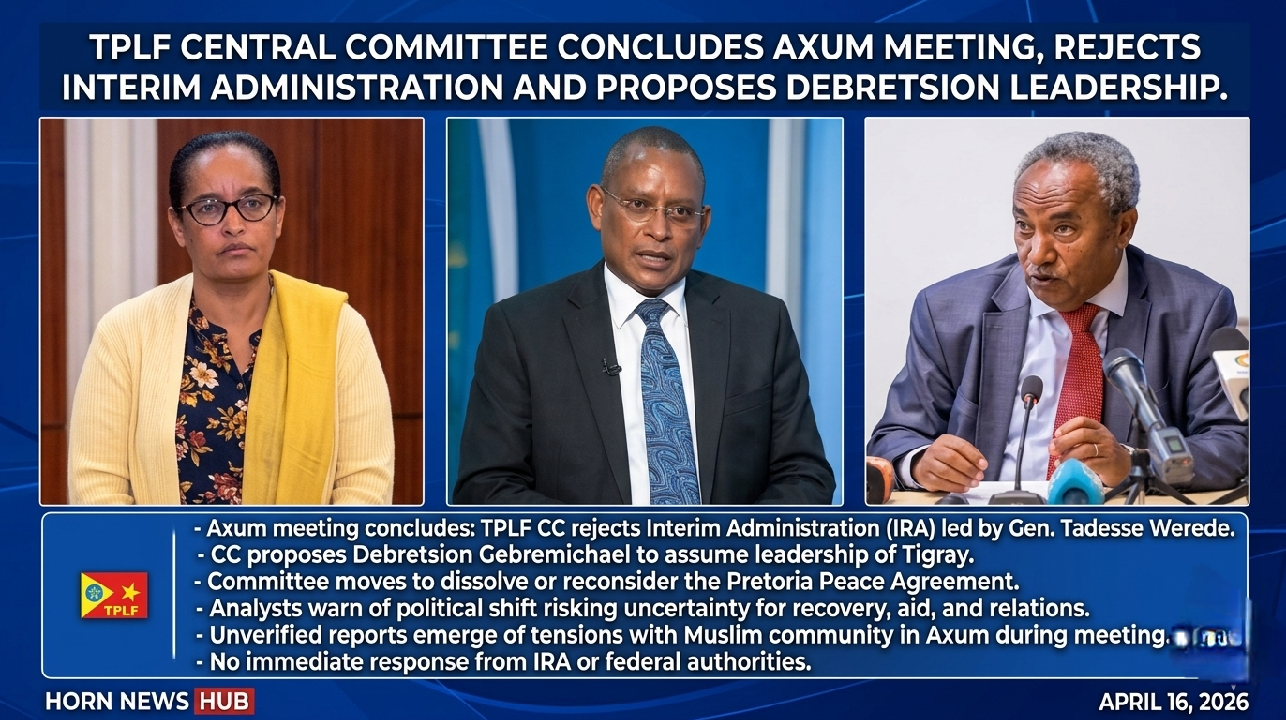
TPLF Central Committee Concludes Axum Meeting, Rejects Interim Administration and Proposes Debretsion Leadership
Addis Ababa, Ethiopia — April 16, 2026 | Horn News Hub
The Tigray People’s Liberation Front Central Committee has concluded its meeting in Axum, announcing a series of decisions that could significantly reshape the political landscape in Tigray.
Information emerging from the meeting indicates that the Tigray People’s Liberation Front Central Committee rejected the interim administration led by Gen. Tadesse Werede and proposed Debretsion Gebremichael to assume leadership of Tigray.
The same information also indicates that the committee moved to dissolve or reconsider the Pretoria Peace Agreement, a framework that ended active hostilities in northern Ethiopia in November 2022.
The decisions follow days of deliberations that had already generated debate across political circles in the region. While some figures described the meeting as an internal party process, others raised concerns about its implications for the ongoing transition and fragile peace process.
No immediate response has yet been issued by the interim administration led by Gen. Tadesse Werede. Federal authorities have also not publicly commented on the developments as of the time of publication.
Observers note that the interim administration was established under the Pretoria Agreement with the support of federal authorities and international partners. Any move affecting that framework could therefore have broader implications for governance, humanitarian access, and reconstruction efforts in the post-conflict period.
Some analysts describe the decision as a significant political shift that could complicate Tigray’s recovery. They argue that rejecting the interim administration and reconsidering the Pretoria framework risks creating uncertainty at a time when the region remains heavily dependent on humanitarian assistance, reconstruction funding, and political normalization.
Others also warn that the move could strain relations with the federal government and international partners, potentially affecting aid flows and diplomatic engagement that have supported recovery efforts since the end of the conflict.
Reports emerging from Axum during the meeting have also raised concerns among local observers. Some sources alleged tensions involving members of the Muslim community in the city while the high-level gathering was taking place. These claims, however, remain difficult to independently verify, and no official statements have yet addressed the reports.
Analysts say that if confirmed, such developments could deepen internal divisions in Tigray at a time when social cohesion remains fragile. Axum holds deep religious and historical significance for multiple communities, and any tensions along religious or ethnic lines could further complicate the region’s political transition.
Observers emphasize that political shifts during fragile recovery periods often carry broader social consequences. They warn that internal fragmentation, coupled with leadership disputes, could weaken governance structures and delay reconstruction efforts.
The situation remains fluid, with further reactions expected from political stakeholders, civil society groups, the federal government, and international partners in the coming hours and days.
Editor’s Disclaimer:
The views and opinions expressed in articles published by Horn News Hub are those of the authors and do not necessarily reflect the official position or editorial stance of Horn News Hub. Publication does not imply endorsement.