

The Great Coalition Imperative: A Strategic Blueprint for Unified Opposition in Tigray
HORN OF AFRICA GEOPOLITICAL REVIEW (HAGR)
Independent Regional and International Geostrategy | Security | Military | Political and Legal Analysis
Executive Directive
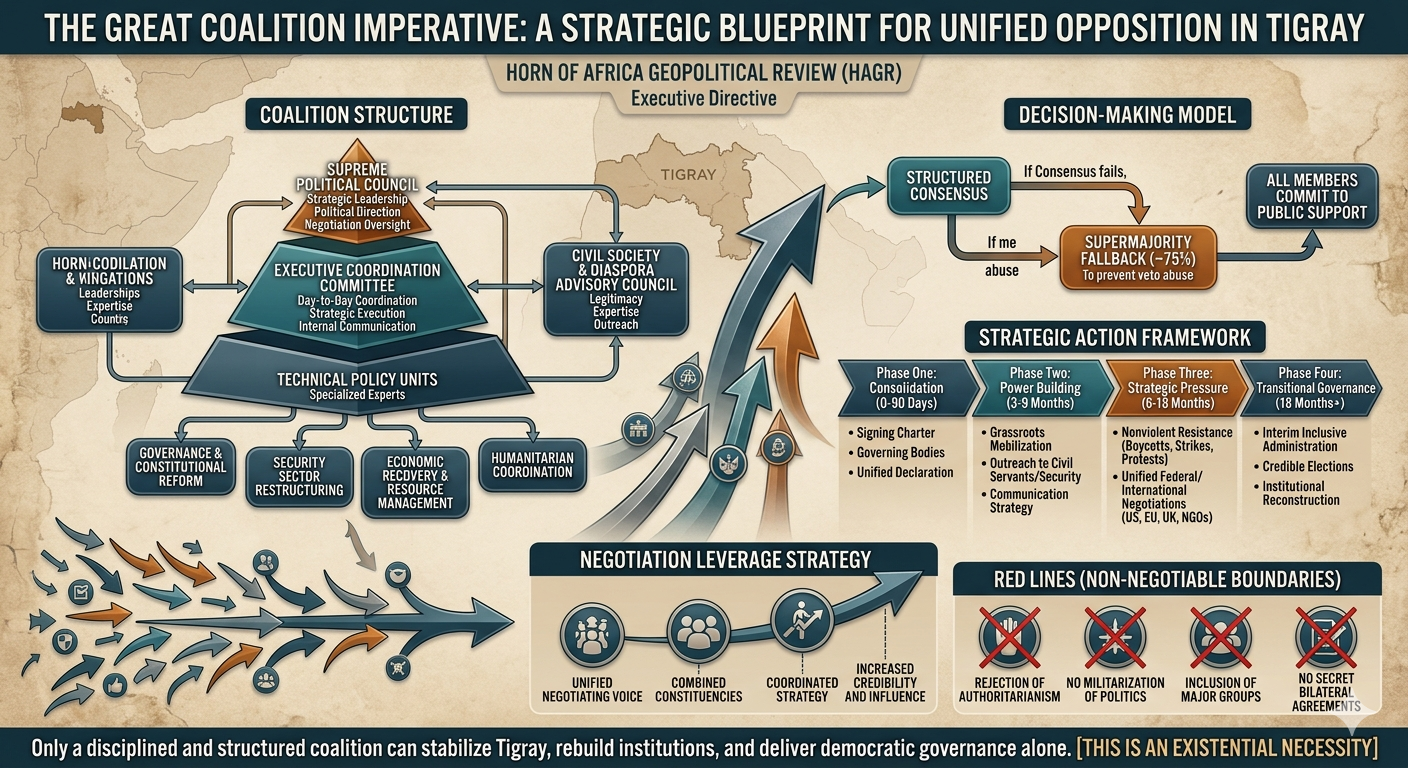
A new strategic policy blueprint titled “The Great Coalition Imperative” has outlined a structured framework aimed at unifying opposition forces in Tigray and guiding a potential democratic transition. The document argues that the region’s opposition landscape remains fragmented, underpowered, and strategically incoherent, while the residual TPLF politico military system continues to maintain influence largely due to divisions among its challengers.
The blueprint presents what it describes as a formal, actionable, and time sensitive framework designed to build a unified opposition coalition capable of dismantling entrenched authoritarian structures, restoring political legitimacy, preventing systemic collapse, and leading a credible democratic transition.
According to the document, failure to implement coalition politics could result in continued political paralysis and eventual political collapse.
Strategic Principle
The document emphasizes that unity should be operational rather than ideological. Coalition formation, it argues, should focus on agreement around immediate priorities rather than full ideological alignment.
The core doctrine outlined in the blueprint calls for alignment on survival first, with political competition to follow later.
Coalition Objectives
The blueprint identifies five central objectives for the proposed coalition:
Dismantling the TPLF politico military dominance
Establishing an inclusive transitional governance framework
Preventing internal conflict and political fragmentation
Restoring institutional legitimacy and rule of law
Stabilizing humanitarian, economic, and security conditions
Membership Criteria
Coalition membership, according to the document, would be conditional rather than symbolic. Participating political parties, including Baytona, TIP, Salsay Woyane, Tigray Democratic Solidarity, Movement of Tigrayans for Change, and Tigray Generation Party, would be required to commit to a shared minimum political charter.
This includes acceptance of democratic pluralism, rejection of authoritarian governance models, and commitment to peaceful political competition.
Members would also agree to avoid unilateral negotiations with the TPLF system, refrain from parallel political strategies outside the coalition framework, and follow a code of political conduct that discourages public attacks among coalition partners.
In addition, parties would be expected to contribute operational capacity, policy input, and technical expertise.
Coalition Structure
The blueprint proposes a multi tiered coalition structure designed to ensure strategic leadership and operational coordination.
Supreme Political Council
The Supreme Political Council would serve as the strategic leadership body composed of senior representatives from each member party. It would set political direction, approve negotiation positions, and oversee coalition discipline.
Executive Coordination Committee
The Executive Coordination Committee would handle day to day coordination, translate strategy into action, and manage communication across coalition members.
Technical Policy Units
Specialized Technical Policy Units would focus on governance and constitutional reform, security sector restructuring, economic recovery and resource management, and humanitarian coordination. These units would be staffed primarily by experts.
Civil Society and Diaspora Advisory Council
The document also proposes an advisory council that includes youth groups, women’s organizations, professionals, and diaspora networks to broaden legitimacy and expertise.
Decision Making Model
The coalition would adopt what the blueprint describes as a structured consensus model. The primary goal would be broad agreement, with a fallback supermajority mechanism of approximately 75 percent if consensus cannot be reached.
The model also aims to prevent veto abuse, ensuring that no single party can paralyze decision making. Once decisions are made, all members would be required to publicly support the final position.
Strategic Action Framework
The blueprint outlines four phases for implementation.
Phase One Consolidation (0 to 90 Days)
This phase includes signing a coalition charter, establishing governing bodies, issuing a unified public declaration, and halting unilateral political actions.
Phase Two Power Building (3 to 9 Months)
This phase focuses on coordinated grassroots mobilization, outreach to civil servants and security actors, engagement with business networks, and implementation of unified communication strategies.
Phase Three Strategic Pressure (6 to 18 Months)
The document proposes nonviolent resistance campaigns, including boycotts, strikes, and coordinated protests. It also calls for unified political negotiations with the Ethiopian federal government and engagement with international actors including the United States, European Union, United Kingdom, human rights organizations, and multilateral institutions.
Phase Four Transitional Governance (18 Months and Beyond)
The final phase envisions establishing an interim inclusive administration, preparing for credible elections, and beginning institutional reconstruction.
Negotiation Leverage Strategy
The blueprint argues that a unified coalition would significantly increase political leverage. A single negotiating voice, combined constituencies, and coordinated strategy are presented as key advantages that could strengthen credibility and influence.
According to the document, fragmented actors are often ignored, while unified actors are more likely to be engaged in negotiations.
Risk Management
The blueprint identifies potential risks, including internal leadership conflicts, ideological rigidity, external infiltration, and loss of public trust.
To mitigate these risks, the document recommends binding discipline mechanisms, transparent communication, conflict mediation structures, and continuous public engagement.
Red Lines
The coalition framework outlines several non negotiable boundaries, including rejection of authoritarian governance, avoidance of militarization of political competition, inclusion of major societal groups, and prohibition of secret bilateral agreements that undermine coalition unity.
Urgency Directive
The document emphasizes urgency, warning that delays could strengthen entrenched systems, weaken opposition credibility, and deepen humanitarian challenges.
Final Strategic Message
The blueprint concludes that no single party can stabilize Tigray, rebuild institutions, negotiate effectively, or deliver democratic governance alone. It argues that only a disciplined and structured coalition can achieve these goals.
The document frames coalition building not as an ideological choice but as an existential necessity, warning that failure to unite could lead to political irrelevance and potential collapse.