
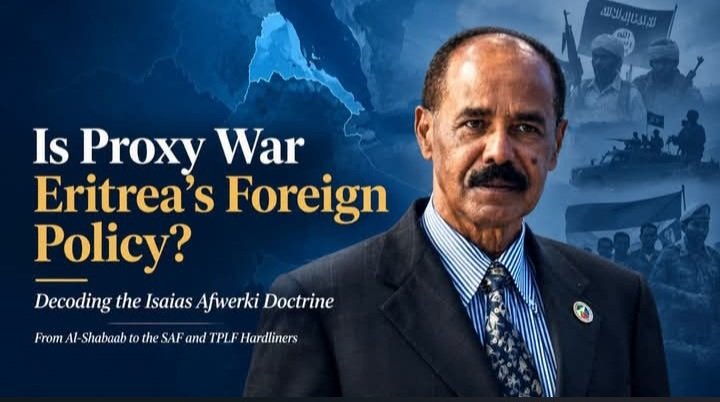
Decoding the Isaias Afwerki Doctrine From Al-Shabaab to the SAF and TPLF Hardliners
Eritrean foreign policy cannot be separated from Isaias Afwerki’s personal control over the state. Since independence in 1993, Isaias has ruled without a ratified constitution, a functioning legislature, term limits, or scheduled elections. Indefinite national conscription and a garrison-state economy have left Eritrea with limited conventional means to compete with a far larger, better-resourced Ethiopia. This asymmetry has pushed Eritrea toward low-cost, high-leverage instruments: support to non-state armed groups, cultivation of cross-border ethnic and kin-based militias, and opportunistic alliances that shift as regional power balances shift. Three features distinguish this approach from ordinary regional diplomacy. First, Eritrea’s targets are chosen less for ideological alignment than for whichever government in Addis Ababa, Khartoum, or Mogadishu is perceived as hostile to Asmara at a given moment. Second, Eritrea rarely commits to a single proxy relationship; it hedges, at times cultivating multiple, mutually hostile factions simultaneously to preserve flexibility. Third, Isaias has shown a willingness to reverse decades of enmity abruptly his pivot from TPLF’s principal wartime adversary in 2020–2022 to patron of a TPLF faction within roughly three years is the clearest illustration of this.
It is worth noting that this state-level rivalry sits awkwardly alongside the deep cultural, linguistic, and historical ties that bind large parts of Ethiopian and Eritrean society ties that predate, and in the view of many ordinary people on both sides, transcend the 1993 political separation. That popular affinity has not translated into restraint at the level of the state. Since independence, Isaias has continually sought to convert Eritrea’s geographic and demographic leverage over northern Ethiopia into political and economic advantage in Addis Ababa, using destabilization as one tool among several to keep the Ethiopian federal government off balance.
Somalia and the Al-Shabaab (2006-2018)
Eritrea’s involvement in Somalia originated in its rivalry with Ethiopia, which intervened in Somalia in 2006 to oust the Union of Islamic Courts. Asmara backed the Courts, and after Al-Shabaab split from that movement, the UN Security Council imposed an arms embargo and targeted sanctions on Eritrea in December 2009 under Resolution 1907, on findings that Eritrea was providing political, financial, and logistical support to armed groups in Somalia and to insurgents seeking to undermine the Ethiopian state.
The sanctions regime was expanded under Resolution 2023 in December 2011, after the UN Monitoring Group on Somalia and Eritrea reported that Eritrea had conceived and directed a failed plot to bomb the January 2011 African Union summit in Addis Ababa. The Security Council formally lifted all sanctions on Eritrea in November 2018, alongside the Ethiopia-Eritrea rapprochement under Prime Minister Abiy Ahmed, citing improved regional relations. The strategic logic both critics and UN monitors described at the time Eritrea used the Somali, as it later used Sudan, as a venue to constrain Ethiopian influence, largely through local proxies rather than direct Eritrean deployment which Isayas and his inner circle elite sought territorial independence from its home Ethiopia but they never abandoned the Ethiopian political realm.
Sudan and the Sudanese Armed Forces (2023-Present)
Eritrea’s posture in Sudan’s civil war, which erupted in April 2023 between the Sudanese Armed Forces (SAF) under General Abdel Fattah al-Burhan and the paramilitary Rapid Support Forces (RSF) under Mohamed Hamdan Hemedti Dagalo, illustrates a similar logic at a larger scale. After early, ambiguous contacts with both sides, Isaias committed Eritrea firmly behind the SAF, hosting repeated visits from Burhan and senior Sudanese officials in Asmara and receiving public thanks from Burhan for Eritrea’s support after the SAF recaptured Khartoum in March 2025.
That support has taken concrete forms documented by regional and international reporting: the mobilization of cross-border militia networks in eastern Sudan, over which Eritrea has cultivated influence for decades; the training in Eritrea of irregular pro-SAF units such as the so-called Eastern Battalion; and coordination on border security between the two governments’ senior military and intelligence officials which counted more than 25000 by deviding them in Tigrigna Speaking as they are hostage by the regime to other time spoiler force inside Sudan stable government and the other group as a fire to the current unnecessary devastating war.
Elements of the TPLF’s armed apparatus remnants of a formation known informally as Army 70, cut off in eastern Sudan after the 2020-2022 Tigray war have fought alongside SAF and Eritrean forces in Sudan’s east, including in the contested town of Kurmuk, with significant losses reported among both Army 70 and Eritrean Defence Force personnel. This linkage converts what might otherwise be a contained Sudanese civil war into a connective corridor between Port Sudan, Asmara, and armed actors hostile to the Ethiopian federal government.
The TPLF Hardliner Faction: The Enemy of My Enemy
The most striking illustration of Isaias’s transactional approach is his realignment with elements of the TPLF itself. Eritrean forces fought the TPLF-led Tigray Defense Forces from November 2020 to November 2022 alongside the Ethiopian federal army; independent investigations documented widespread atrocities, including systematic looting and grave human rights violations, committed by Eritrean forces against Tigrayan civilians during that campaign. The November 2022 Pretoria Agreement ended the federal–TPLF war but excluded Eritrea from the settlement, leaving Eritrean forces present in disputed border areas and leaving Tigray’s leadership divided over how to normalize relations with Addis Ababa.
That division hardened into open factional conflict from August 2024, when the National Election Board of Ethiopia refused to register TPLF as a legal party, splitting TPLF chairman Debretsion Gebremichael’s camp from the more federally cooperative bloc led by Getachew Reda, then head of Tigray’s Interim Regional Administration. According to the International Crisis Group, Debretsion’s allies expelled Getachew and his senior team from the party in September 2024 and steadily took over local administrative bodies over the following months; by late January 2025, roughly 200 security officers had publicly called for the dissolution of Getachew’s administration, and Debretsion’s forces consolidated control of Mekelle by March.
Getachew relocated to Addis Ababa, where the federal government appointed him Minister Advisor for East African Affairs in April 2025. He went on to found a new party, Tigray Democratic Solidarity, known as ‘Simret,’ which received provisional registration in May 2025. Debretsion’s faction, meanwhile, has continued to consolidate power: Al Jazeera reported that in May 2026 the Tigray regional council was reinstated and elected Debretsion as its president meaning the faction Eritrea has been accused of courting is no longer a mere challenger but now holds the region’s formal leadership.
The most striking illustration of Isaias’s transactional approach is his realignment with the TPLF itself. Eritrean forces fought the TPLF-led Tigray Defense Forces from November 2020 to November 2022 alongside the Ethiopian federal army; independent investigations documented widespread atrocities, including systematic looting and grave human rights violations, committed by Eritrean forces against Tigrayan civilians during that campaign. The November 2022 Pretoria Agreement ended the federal-TPLF war but left Eritrean forces present in disputed border areas and left Tigray’s leadership divided over how to normalize relations with Addis Ababa.
That division hardened into open factional conflict from August 2024, when TPLF chairman Debretsion Gebremichael’s camp and the more federally cooperative bloc led by Getachew Reda, then head of Tigray’s Interim Regional Administration, split over the National Election Board’s refusal to register TPLF as a legal party. Debretsion commanders subsequently seized administrative control of Mekelle, forcing Getachew’s relocation to Addis Ababa, where the federal government appointed him a senior adviser and where he later founded a rival party TPF (Tigray Peace Force).
As this rift widened, independent analysts documented Eritrea’s move to cultivate the Debretsion-led hardliner faction its former wartime enemy on the logic that ‘the enemy of my enemy is my friend,’ rather than strategic objective and rationales. Isaias’s as a pop of conspiracy and master of looking every aspect from security than anything else see the TPLF hardliners/Debretsion team as an opportunistic move to keep Addis Ababa off balance amid the Red Sea dispute create a buffer zone in Tigray and Amhara region, rather than as genuine reconciliation with Tigrayan nationalism which he believe as antithesis of his vision.
Proxy Conflict as a deliberate foreign policy tool nothing else in their foreign policy experience
• Asymmetric compensation: Facing a materially stronger Ethiopia, Eritrea substitutes proxy leverage and border-community mobilization for conventional military parity.
• Ideological flexibility: Isaias has backed and fought the same actors most starkly the TPLF within a single decade, indicating that partner selection tracks immediate utility against Addis Ababa rather than fixed alignment.
• Plausible deniability: Support is typically channelled through militias, cross-border kin networks, or trained irregular units, allowing Asmara to deny direct state involvement while retaining influence a pattern consistent from the Al-Shabaab-era to today’s Sudan-based SAF.
• Linkage across theatres: Documented coordination between SAF-aligned forces, Eritrean units, and TPLF remnants in eastern Sudan suggests Asmara increasingly treats Sudan and northern Ethiopia as a single interconnected front rather than separate bilateral disputes.
This pattern matters because it converts what might otherwise be discrete, locally contained conflicts a Sudanese civil war, an intra-Tigrayan leadership dispute into instruments of a wider regional contest. It also means that diplomatic normalization with Asmara on any one bilateral track, as occurred after 2018, does not reliably predict Eritrean restraint on another, since the underlying incentive structure driving proxy sponsorship remains intact.
The convergence of these proxy relationships is unfolding against the most dangerous backdrop in the Ethiopia-Eritrea relationship since the 1998-2000 border war. Concretely, Eritrea’s proxy strategy raises regional risk along several dimensions. In Sudan, deepening Eritrean-SAF coordination in the eastern states threatens to open a new front layered onto an already catastrophic civil war, drawing in militias with their own local grievances and risking direct clashes near the Eritrean border, as illustrated by drone strikes on Sudanese army positions close to that frontier. In Tigray region, Eritrean courtship of TPLF hardliners risks reigniting a war that caused immense civilian harm between 2020 and 2022, while undermining the Pretoria framework and the authority of the more federally cooperative Tigrayan camp.
Eritrea’s proxy strategy is best understood as one significant driver of Horn instability and Sudan’s internal collapse not as the sole cause of regional volatility, even where it represents the most consistently documented pattern of destabilizing behavior over the longest period of time.
Recommendations
• Reframe proxy sponsorship as strategic doctrine, not episodic behavior. Diplomatic engagement with Asmara should account for the recurring pattern documented above rather than treating each theatre (Somalia, Sudan, and Ethiopia) as an isolated bilateral dispute.
• Support independent or Reinstating or resourcing a Horn-wide monitoring mechanism modeled on the former UN Somalia-Eritrea Monitoring Group but covering Sudan and northern Ethiopia would improve the evidentiary basis for future policy responses and reduce reliance on contested, unverified claims from any single government.
• Press for de-linkage of the Red Sea access question from proxy competition. Structured, third-party-mediated talks on Ethiopian maritime access separated explicitly from the Tigray and Sudan tracks would reduce Asmara’s and Addis Ababa’s incentive to use proxies as bargaining chips in the port dispute.
• Condition engagement with the TPLF hardliner faction on de-escalation. External actors should avoid legitimizing armed factions inside Tigray that maintain undisclosed coordination with Eritrea, while continuing to support Ethiopia’s electoral and administrative processes for a unified, accountable Tigrayan political track.
• Increase humanitarian and diplomatic pressure tied to the Sudan corridor. Donors and mediators engaging the SAF and RSF should explicitly address third-country military support, including Eritrean mobilization of eastern Sudanese militias, as part of any ceasefire or peace framework, rather than treating Sudan’s war as purely bilateral.
Isaias Afwerki’s has, for two decades, treated regional instability as usable terrain rather than a threat to be contained. From the contested but consequential Al-Shabaab-era allegations, through direct combat alongside Ethiopia against the TPLF, to today’s simultaneous backing of the Sudanese Armed Forces and courtship of a now-empowered TPLF hardliner faction against that same Ethiopian government, the through line is a foreign policy built on proxy leverage, tactical reversal, and denial. As Sudan’s war grinds on and Tigray’s internal balance of power shifts again, the risk is no longer three separate regional crises but one increasingly interconnected system of proxy competition capable of drawing the Horn of Africa’s largest militaries into direct confrontation. Recognizing that system for what it is a deliberate and recurring tool of statecraft, not a series of unrelated incidents is the necessary first step toward any external strategy for containing it.
Source፡Institute of Foreign Affairs (IFA)