
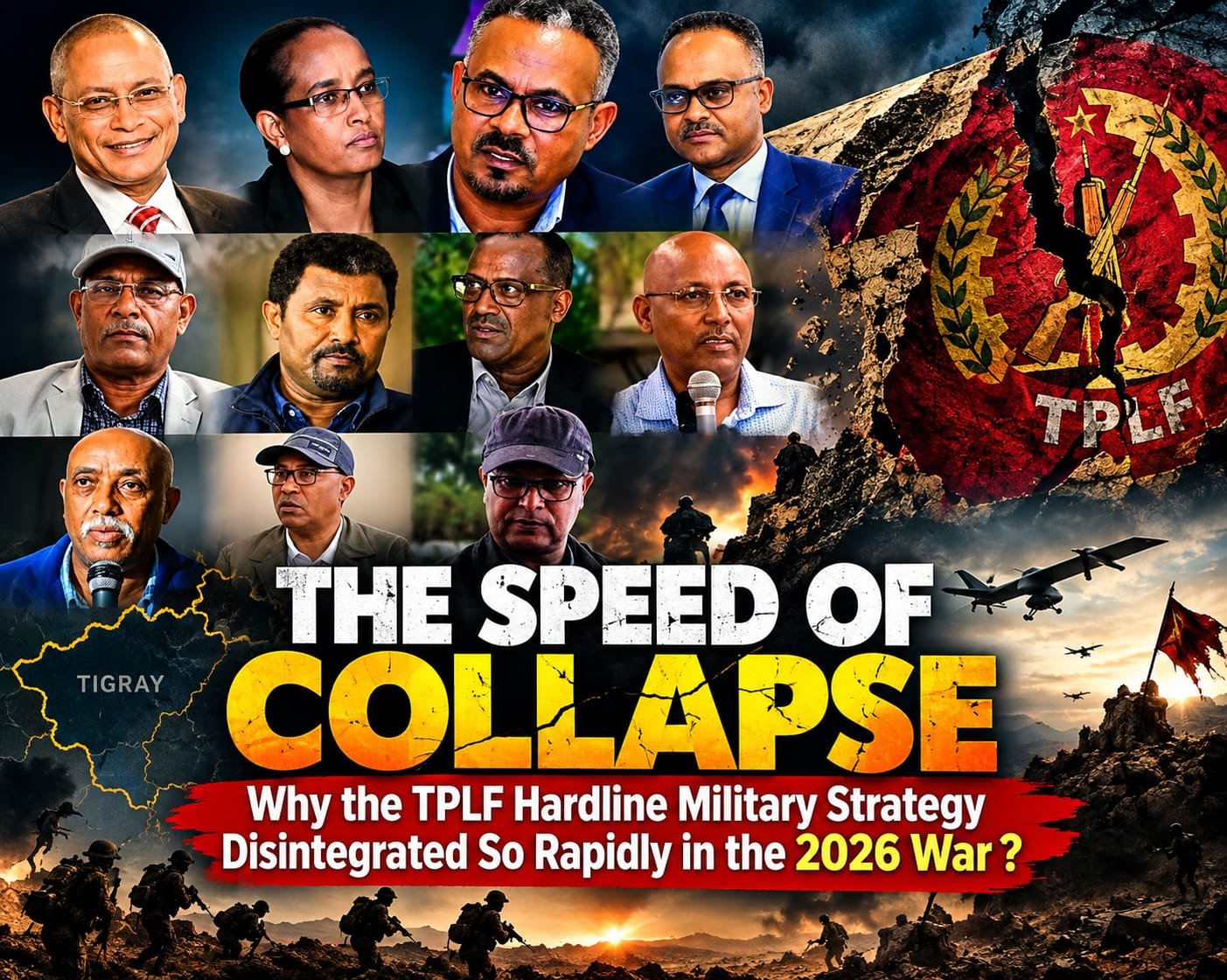
Why the TPLF Hardline Military Strategy Disintegrated So Rapidly in the 2026 War ?
By HORN OF AFRICA GEOPOLITICAL REVIEW — HAGR
EXECUTIVE ASSESSMENT
The renewed war in northern Ethiopia has developed with remarkable speed. Within a relatively short period, the military balance reportedly shifted from an initial TPLF-aligned offensive initiative toward a much more difficult position for the hardline military camp.
The phrase “collapse at the speed of light” captures the impression created by that reversal. It should not, however, be interpreted literally or as evidence of one decisive battlefield event. The more useful question is why the deterioration appeared to happen so quickly.
The explanation is unlikely to be found in any single factor.
Drones matter. Manpower matters. Geography matters. Logistics matter. Political cohesion matters. So does the ability of a military organization to translate an opening advantage into a sustainable campaign.
Several weaknesses appear to have interacted simultaneously:
a substantial technological and airpower asymmetry;
vulnerabilities in command and control;
internal political and military divisions;
logistical constraints;
difficulty converting initial tactical gains into durable strategic effects;
the federal government’s access to national-scale military infrastructure and resources; and
the emergence of alternative Tigrayan armed actors, most notably the Tigray Peace Force (TPF).
The last of these developments deserves particular attention.
The presence of a distinct Tigrayan armed organization operating alongside federal forces has complicated the political geography of the conflict. The war can no longer be adequately described as a simple confrontation between “Ethiopia” and “Tigray.” There are competing Tigrayan political and military actors, with different objectives and different relationships to the federal state.
That distinction is fundamental.
The TPLF is not Tigray. An armed faction is not an entire population. The military fortunes of one organization cannot be equated with the fate of a people.
Available reporting points to serious weaknesses within the TPLF-aligned military structure. At the same time, battlefield information remains fluid. Communications have been restricted, military claims are often partisan, and many reported developments cannot yet be independently verified.
HAGR therefore treats the current situation as a rapidly evolving military crisis rather than a settled final outcome.
I. THE CENTRAL QUESTION
Why Did the Military Situation Change So Quickly?
The central issue is not whether the TPLF-aligned forces retained the ability to fight. The opening phase of the renewed conflict suggests that they did.
They were able to mobilize forces, coordinate operations and generate an initial degree of battlefield momentum.
The harder question is what happened afterward.
An opening offensive has strategic value only when its initial gains can be consolidated and converted into lasting effects. A successful campaign normally requires some combination of destroying or immobilizing opposing formations, controlling strategically important territory, disrupting reinforcement routes, securing sustainable logistics, weakening the opponent’s political decision-making or creating bargaining conditions favorable to the attacker.
Temporary territorial gains are not enough.
If an attacking force cannot reinforce its positions, protect its supply lines or maintain command cohesion, the very momentum generated by the opening operation can become a burden.
That appears to be an important part of what happened in the present conflict.
The TPLF-aligned forces reportedly generated an initial shock. The federal side then recovered operationally and began applying pressure along important approaches. The character of the war consequently changed.
An offensive initiative became, increasingly, a struggle to maintain operational cohesion.
That distinction helps explain the apparent speed of the deterioration.
II. THE FIRST PROBLEM: TECHNOLOGICAL ASYMMETRY
1. The Drone Battlefield
The most visible structural difference between the opposing forces is technological.
The Ethiopian federal military has access to significant advantages in airpower, unmanned aerial systems, intelligence collection and national military infrastructure. Those capabilities fundamentally alter the operating environment for an opposing force.
A military that can identify troop concentrations, vehicles, artillery positions, supply routes and command facilities from the air can impose costs before an opposing formation reaches its intended objective.
The effects accumulate.
A force that cannot move safely becomes less mobile. A force that cannot concentrate becomes less capable of generating massed firepower. A logistics network exposed to persistent surveillance becomes increasingly difficult to sustain.
This produces a difficult tactical dilemma.
Concentration creates visibility. Dispersal reduces the ability to generate mass. Movement along major roads increases exposure. Withdrawal into difficult terrain may provide concealment while simultaneously making resupply and reinforcement harder.
Technology does not win wars by itself.
Its significance becomes much greater when it operates alongside superior logistics, intelligence and command infrastructure.
That interaction appears to be one of the defining characteristics of the 2026 battlefield.
III. THE SECOND PROBLEM: COMMAND COHESION
2. A Military Can Absorb Defeat. It Struggles to Survive Internal Disunity.
The most consequential weakness confronting the TPLF hardline military structure may ultimately prove organizational rather than technological.
Weapons matter, but military effectiveness depends equally upon the relationship between political leadership, senior command and frontline formations.
When those relationships remain stable, a military can sometimes absorb substantial battlefield losses without losing its ability to fight.
When they begin to fracture, deterioration can spread quickly.
Orders are questioned. Information becomes contested. Local commanders begin making independent calculations. Trust declines. Intelligence becomes less reliable. Political disagreements begin to affect operational decisions.
At that point, an organization can lose something more important than territory:
coherence.
Reports concerning disagreements within the TPLF and tensions among senior political and military figures therefore have direct strategic relevance.
If senior military figures opposed renewed hostilities, the matter cannot be treated merely as an internal political dispute. It raises a military question:
How much confidence can frontline commanders place in strategic decisions that are contested within their own leadership structure?
That kind of uncertainty can have immediate operational consequences.
A military organization does not need to suffer catastrophic casualties to begin losing cohesion. Sometimes uncertainty at the top is enough to slow decisions, fragment initiative and undermine confidence further down the chain of command.
IV. THE THIRD PROBLEM: INITIAL GAINS WERE NOT NECESSARILY STRATEGIC GAINS
3. Tactical Surprise Is Not Strategic Victory
The opening phase of the renewed war demonstrated that TPLF-aligned forces retained the capacity to conduct rapid operations.
Reports of advances and the seizure of important infrastructure created an early impression of momentum.
But momentum has to be converted into something more durable.
That requires logistics, reinforcement, command-and-control, territorial consolidation and political endurance.
The critical question is therefore not simply:
What did the TPLF-aligned forces capture during the opening days?
It is:
Could they hold those gains and use them to alter the wider strategic balance?
Subsequent federal counter-operations suggest that this conversion was incomplete.
This is the difference between tactical success and operational success.
A force can win an engagement, seize a position or surprise an opponent and still lose the campaign that follows.
The initial battlefield picture may therefore have been less decisive than it appeared.
V. THE SOUTHERN CORRIDOR
4. Why Alamata and Maychew Matter
The southern approach to Tigray has emerged as one of the most consequential operational axes in the renewed conflict.
Reported federal and allied advances around Alamata therefore matter for reasons extending beyond control of the town itself.
The southern corridor provides routes for:
troop movement;
logistics and resupply;
reinforcement;
pressure against defensive positions;
access toward Korem and Maychew; and
potentially, further pressure toward the approaches to Mekelle.
Reports of subsequent movement toward Maychew increased the strategic importance of this axis.
Even so, territorial advances should not automatically be interpreted as evidence of an inevitable final outcome.
Military campaigns rarely develop in straight lines.
Terrain can change the balance. Logistics can slow an advance. Defensive preparation can alter the cost of an operation. Civilian conditions can constrain military options.
Mekelle is also unlike an ordinary battlefield objective. It is the political and institutional centre of Tigray.
Any major military confrontation around the city would therefore carry consequences extending well beyond the immediate tactical situation.
VI. THE TPF FACTOR
5. The Emergence of a New Tigrayan Military Actor
One of the most consequential developments of the 2026 conflict is the emergence of the Tigray Peace Force (TPF) as a separate Tigrayan armed actor aligned with the federal side.
Its significance is not simply a question of troop numbers.
It changes the political landscape.
For decades, the TPLF occupied a dominant position in Tigrayan political and military life. The appearance of another organized Tigrayan armed formation demonstrates that this dominance can no longer simply be assumed.
The battlefield now includes competing Tigrayan actors.
That is historically significant.
The TPF should not be presented as synonymous with the Tigrayan population. The same principle applies to the TPLF.
A more precise interpretation is that Tigray is experiencing a form of political and military pluralization, in which authority is no longer concentrated in a single political-military organization.
How durable that transformation will be remains uncertain.
Its consequences, however, could extend well beyond the current fighting.
VII. THE TPF AS A MILITARY FACTOR
6. Local Knowledge and Battlefield Utility
A locally recruited force can possess operational advantages that outside formations may lack.
These can include:
familiarity with terrain;
knowledge of local roads and settlements;
linguistic familiarity;
access to local information networks;
understanding of movement patterns; and
relationships with communities and local actors.
When such forces operate alongside a larger national military, their contribution can extend beyond conventional combat. They may assist with reconnaissance, route identification, intelligence collection, local security and territorial consolidation.
Reports of TPF participation around Alamata and in subsequent southern operations therefore merit attention.
But two questions must remain separate.
Military effectiveness and political legitimacy are not the same thing.
The first requires evidence of battlefield performance. The second requires political, institutional and societal evidence.
Neither should be used as a substitute for the other.
VIII. THE LOGISTICS PROBLEM
7. The Invisible Centre of Gravity
Wars are often explained through maps.
Armies actually move because of logistics.
Every sustained military operation depends on ammunition, fuel, food, medical support, communications, vehicle maintenance, replacement personnel, intelligence and command infrastructure.
When those systems begin to fail, battlefield performance can deteriorate with surprising speed.
This is particularly relevant to the TPLF.
The organization entered the renewed confrontation after the Pretoria peace process had substantially altered its military position. It does not possess the same conventional military infrastructure it maintained during the earlier phase of the 2020–2022 war.
The federal government, by contrast, retains national-scale military institutions, logistics networks and access to substantially greater resources.
That structural imbalance cannot easily be overcome through morale or local battlefield initiative alone.
IX. THE POLITICAL FRAGMENTATION PROBLEM
8. Internal Divisions Can Become Military Weakness
Political divisions inside a military organization do not remain confined to political institutions.
They can eventually reach the battlefield.
A functioning military chain normally runs from:
political strategy → military command → operational execution.
When each level begins questioning the authority or judgment of the level above it, the chain becomes unstable.
The consequences can include:
conflicting orders;
competing chains of command;
declining trust;
intelligence failures;
poor coordination;
unauthorized operations;
declining morale; and
strategic miscalculation.
Reports concerning the detention or marginalization of senior military figures who opposed renewed hostilities, if independently substantiated, would therefore have significance beyond internal party politics.
They would raise questions about the resilience of the command structure itself.
Professional military organizations must be capable of absorbing disagreement without allowing disagreement to destroy operational unity.
When dissent becomes equated with disloyalty, senior leadership can become increasingly isolated from information coming from the battlefield.
That is a dangerous condition in any conflict.
X. MOBILIZATION AND THE CIVILIAN LIMIT
9. Tigray Is Not an Unlimited Manpower Reservoir
The human consequences of the 2020–2022 war remain central to understanding the present conflict.
Tigray entered the renewed confrontation after years of displacement, economic disruption, humanitarian crisis and social exhaustion. Reports of compulsory mobilization and alleged forced recruitment therefore warrant serious scrutiny. Human Rights Watch has previously documented allegations of forced recruitment in Tigray, including allegations involving minors, while the TPLF has denied conducting forced recruitment.
Those allegations require continued independent investigation and careful attribution. There is, however, a broader strategic consideration.
A population exhausted by prolonged war cannot indefinitely provide manpower without paying a heavy social and economic price.
Workers leave productive activity. Families are separated. Education is interrupted. Communities become increasingly militarized. Confidence in political institutions can deteriorate.
A military organization may be able to increase manpower through coercive mechanisms.
That does not necessarily increase its political legitimacy.
XI. THE ALLIANCE PROBLEM
10. Political Coalition Does Not Automatically Produce Military Unity
The emergence of a broader anti-government coalition has introduced another layer of complexity.
The organizations involved have different political histories, geographical interests and strategic priorities.
Their cooperation demonstrates that opposition to the federal government can bring previously competing actors into temporary alignment.
But political coalition-building and military integration are very different processes.
An effective military alliance requires:
shared intelligence → coordinated command → common logistics → compatible objectives → synchronized operations.
Without those elements, a coalition can appear politically substantial while remaining operationally fragmented.
Historical disputes between members make this particularly important.
Temporary strategic convergence does not erase older territorial, political or ideological disagreements.
XII. WHY 2026 IS DIFFERENT FROM 2020
11. The Previous Formula Cannot Simply Be Repeated
The TPLF demonstrated during the earlier war that it could absorb major losses, withdraw, reorganize and eventually regain the initiative.
That history should not be ignored.
But neither should it be treated as a template that automatically applies to 2026.
The strategic environment has changed.
The TPLF now faces:
greater political fragmentation;
reduced conventional military capacity;
stronger federal drone and air capabilities;
a different regional political environment;
competing Tigrayan armed organizations;
a population deeply affected by the previous war; and
a more complicated network of regional armed actors.
Historical precedent provides context.
It does not guarantee repetition.
A strategy that was viable under one set of military and political conditions can become ineffective when those conditions change.
XIII. THE CENTRAL SIGNIFICANCE OF THE TPF
12. The Political Monopoly Has Been Broken
Perhaps the most consequential long-term development is not the capture of one town or the loss of another.
It is the emergence of competing centres of Tigrayan political and military authority.
The TPF represents one expression of that transformation.
If it continues to expand its influence, any future political settlement will have to address questions that were previously framed largely around Addis Ababa and the TPLF.
Among them:
Who controls regional security?
How should armed groups be integrated or disarmed?
How should regional institutions be reconstructed?
How should political representation be organized?
What mechanisms of accountability should apply?
How can civilian authority be established over security institutions?
The emergence of multiple armed Tigrayan actors makes any future settlement more complicated.
It also makes one assumption increasingly difficult to sustain:
that a single political organization can automatically claim to speak for an entire region.
XIV. THE HUMANITARIAN CENTRE OF GRAVITY
13. The People of Tigray Must Not Become the Battlefield
Military analysis becomes dangerously incomplete when it loses sight of civilians.
The population of Tigray has already experienced enormous disruption. Renewed fighting compounds those losses.
Hospitals, roads, communications networks, humanitarian operations and commercial infrastructure are all vulnerable to further damage.
The civilian population must therefore remain analytically distinct from the armed organizations operating around it.
This is not merely a humanitarian principle.
It is also a strategic one.
Forced mobilization, collective punishment, indiscriminate attacks and destruction of civilian infrastructure can create grievances that outlive the fighting itself.
Military victory cannot, by itself, produce political stability.
XV. WHAT THE CURRENT BATTLEFIELD TELLS US
14. Eight Strategic Findings
Based on available open-source reporting as of 1 October 2026, HAGR identifies eight principal findings.
First: TPLF-aligned forces demonstrated that they retained offensive capability at the beginning of the renewed conflict.
Second: Federal forces demonstrated an ability to recover from the initial shock and regain operational momentum.
Third: The federal military possesses substantial advantages in airpower, drones, logistics and national military infrastructure.
Fourth: Internal political and military divisions represent a potentially serious vulnerability within the TPLF-aligned camp.
Fifth: The Tigray Peace Force has emerged as a significant Tigrayan armed actor operating alongside the federal side.
Sixth: The southern corridor has become an important operational axis, particularly following reported developments around Alamata and Maychew.
Seventh: The broader opposition alliance has expanded the strategic geography of the conflict while facing significant questions concerning command unity and long-term coordination.
Eighth: Battlefield reporting remains fluid. Claims of territorial control, casualties and operational success should therefore be treated as claims until independently corroborated.
XVI. THE CENTRAL STRATEGIC QUESTION
15. Is This a War Against Tigray?
The answer requires precision.
Fighting is occurring substantially within and around Tigray. But the principal military confrontation involves the federal government, TPLF-aligned forces and associated actors.
Those distinctions matter.
Tigrayans are not politically uniform.
Some support the TPLF. Some oppose it. Some support the federal government. Some support the TPF. Others may have little allegiance to any political faction and simply want the fighting to end.
That diversity should not be erased by military narratives from any side.
The fundamental distinction remains:
A political organization is not a people.
An armed faction is not a region.
The defeat of a military command is not the defeat of an ethnic community.
That distinction will be especially important in any post-war political process.
XVII. THE FUTURE OF THE TPLF
16. Military Setback Does Not Automatically Mean Political Extinction
Even a severe military setback would not necessarily mean the disappearance of the TPLF as a political organization.
Political movements can survive military defeats.
They can reorganize, fragment, negotiate, transform themselves into civilian political organizations or continue armed resistance.
The decisive question is whether the organization can separate political survival from continued military confrontation.
If it cannot, battlefield losses may become organizational losses.
If it can, the political consequences could be substantially different.
The future of the TPLF will therefore depend not only on the military map but also on decisions made within the organization after the immediate crisis.
XVIII. THE POST-WAR TPF QUESTION
17. What Happens to the TPF After the Fighting?
The future status of the TPF could become one of the most difficult questions in any post-war settlement.
If an armed Tigrayan organization emerges from the conflict with greater battlefield influence, it cannot simply remain a permanent parallel military structure indefinitely.
A sustainable political order requires accountable security institutions.
That raises difficult questions concerning:
disarmament;
demobilization;
reintegration;
professionalization;
civilian oversight;
regional policing;
military integration; and
political participation.
Those principles should apply to every armed organization.
The purpose of security-sector reform should not be to replace one factional security structure with another.
The objective should be the creation of institutions accountable to civilians rather than political factions.
XIX. WHAT COMES NEXT?
18. Immediate Strategic Priorities
Five issues deserve particular attention as the conflict develops.
19. Prevent major urban warfare
A major battle around Mekelle would carry enormous civilian, political and humanitarian consequences.
20. Preserve humanitarian access
Medical services, humanitarian organizations, civilian evacuation mechanisms and essential supplies require protection.
21. Establish independent battlefield verification
Competing military claims should be treated as claims until independently corroborated.
22. Prevent wider regionalization
External military intervention could transform an already dangerous internal conflict into a much broader regional confrontation.
23. Restore a political channel
Military operations can change bargaining positions. They cannot resolve the political disputes that produced the crisis.
XX. HAGR STRATEGIC CONCLUSION
The Speed of the Collapse Was a System Failure, Not a Single Battle
The most useful way to interpret the reported rapid deterioration of the TPLF hardline military position is not to assume that one side suddenly became overwhelmingly powerful while the other suddenly became incapable of fighting.
The deeper explanation is structural.
The TPLF-aligned military system entered the renewed war carrying accumulated political divisions, reduced conventional capacity, logistical constraints and a fundamentally different technological environment.
The federal military entered with national-scale resources, established logistics, substantial airpower and drone capabilities, and the institutional capacity to sustain a prolonged campaign.
Then another factor entered the equation:
the emergence of competing Tigrayan armed power.
The Tigray Peace Force altered the political and military geometry of the conflict.
Its emergence demonstrates that Tigrayan identity and political alignment with the federal government are not necessarily mutually exclusive. It also demonstrates that the TPLF’s former position as the dominant military-political representative of Tigray can no longer simply be assumed.
That development may ultimately prove more historically consequential than any individual battlefield.
The present conflict is therefore better understood as a contest among competing political organizations, armed formations and strategic interests operating within a society already deeply exhausted by war.
The TPLF hardliners may suffer severe military setbacks. Their command structure may fragment. Their territorial position may deteriorate. Their political influence may decline.
None of those developments, however, constitutes the defeat of Tigray.
The people of Tigray are not a military formation. They are the population that will ultimately live with the consequences of decisions taken by political and military leaders.
That is why HAGR’s assessment extends beyond the question of battlefield victory.
The more consequential question is whether the 2026 war produces another cycle of militarized politics or whether the breakdown of the old political-military equilibrium creates space for a different political order.
That outcome will depend on considerably more than military power.
It will depend on political legitimacy, institutional reform, civilian protection, accountability and the willingness of Ethiopian and Tigrayan political actors to move away from the assumption that political disputes can ultimately be settled through force.
The battlefield may determine the immediate balance of power.
It will not, by itself, determine the future of Tigray.
HAGR FINAL ASSESSMENT
The available evidence as of 1 October 2026 supports a cautious but significant assessment.
The renewed war has exposed serious structural weaknesses within the TPLF-aligned military-political system while simultaneously revealing a transformed Tigrayan political environment in which the TPLF is no longer the only organized centre of military power.
The federal government’s advantages in military scale, logistics, airpower and drone warfare are substantial. The emergence of the TPF introduces an important local military and political dimension. The broader opposition alliance expands the strategic geography of the conflict but faces its own coordination problems. The southern corridor has become increasingly important. Internal divisions within the TPLF may be amplifying the pressure on its military structure.
The conflict nevertheless remains fluid.
Claims of complete military collapse, final victory or irreversible political extinction should therefore be treated cautiously unless supported by independently verified evidence.
The strongest conclusion is narrower and more defensible:
The TPLF hardline military strategy appears to have encountered a strategic environment substantially different from the one it faced during the 2020–2022 war.
The interaction of technological asymmetry, political fragmentation, logistics, command instability and competing Tigrayan armed power has created conditions in which military momentum can be lost extraordinarily quickly.
That is the deeper significance of the present crisis.
Not the defeat of Tigray.
Not the defeat of the Tigrayan people.
But the possible collapse of an old political-military model.
What follows from that collapse will determine whether the next chapter of Tigray’s history is written through institutions—or through another cycle of war.
HAGR EDITORIAL STANDARD
Evidence before assertion.
Verification before conclusion.
Military analysis without collective attribution.
Tigray is not synonymous with the TPLF.
Civilians are not combatants.
Battlefield claims require independent verification.
HORN OF AFRICA GEOPOLITICAL REVIEW — HAGR
Independent Regional & International Geostrategy
Security • Military • Political • Institutional Analysis
Strategic Analysis — Open-Source Intelligence Assessment
1 October 2026