
Author: Dr. Dawit Tesfay | Institutional Policy & Post-War State-Building Researcher
Executive Summary
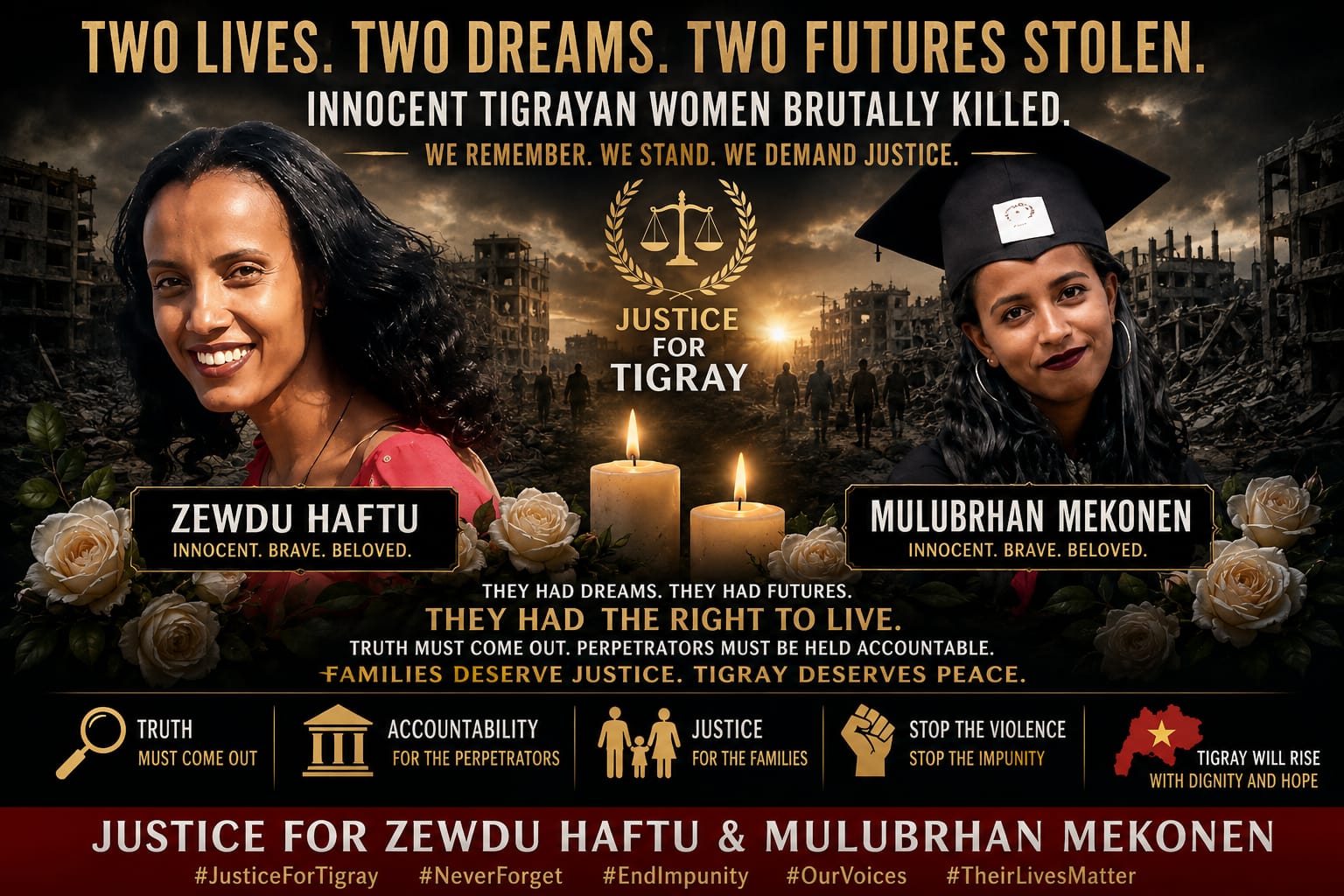
The August 4, 2026 acquittal of Yared Gebreselassie and Angesom Hailemariam convicted in the brutal August 2023 killing of Zewdu Haftu represents far more than a single miscarriage of justice. Evidence compiled by civil society organizations, family testimonies, and documented disappearances suggests a pattern of violence perpetrated by security sector operatives connected to Commander Gebreselassie Belay’s command structure, enabled by systematic judicial capture and institutional impunity.
This investigation documents three interconnected cases spanning 2018 through 2025: Zewdu Haftu (murdered August 2023; convicted July 2025; acquitted without evidence August 2026); Muluberhan Mekonnen Welegergis (murdered with institutional interference; connected to Yared Gebreselassie investigations); and Filmon Gebrehiwot (professional cameraman; abducted August 2025; remains missing amid institutional silence).
These cases spanning from 2018 through 2025 demonstrate a systematic pattern of violence by operatives within Tigray’s security apparatus, coupled with judicial mechanisms that have evolved to protect perpetrators rather than deliver accountability. The pattern indicates institutional capture has not simply failed to pursue justice; it has become an instrument enabling continued victimization. Each acquittal emboldens perpetrators. Each successful evasion of accountability narrows restraints on violence. The pattern indicates escalation.
Case 1: Zewdu Haftu Gendered Violence and Judicial Reversal
The Crime (August 19, 2023)
Zewdu Haftu, 32, was attacked while walking through Mekelle during the Ashenda festival. According to eyewitness testimony presented in court, she was ambushed by armed men traveling in an unmarked patrol vehicle. When she resisted an apparent sexual assault, the assailants subjected her to extreme violence: dragging her by her hair and deliberately crushing her beneath the vehicle.
The crime’s structural elements military transport, calculated brutality, public execution-style attack indicated perpetrators confident in immunity from prosecution. Sexual assault preceded murder. Violence was deliberate and witnessed. This was not impulsive crime; this was institutional violence executed with confidence in state protection.
The Conviction (July 2025)
Following sustained civil society pressure, the Mekelle Central Court convicted Yared Gebreselassie (son of Commander Gebreselassie Belay) and Angesom Hailemariam (driver of assault vehicle). Both were sentenced to life imprisonment with hard labor for extreme cruelty . The conviction appeared to vindicate post-conflict accountability mechanisms despite extraordinary obstacles: courtroom intimidation campaigns by defense affiliates; May 2025 storming of courts by relatives of the accused; direct threats against presiding judges and witnesses; temporary shutdown of all Mekelle courts due to security disruption.
The Acquittal (August 4, 2026)
The Mekelle City Middle-Level Court reversed both convictions without new exonerating evidence. The reversal ignored a higher court directive requiring independent digital evidence verification, offered no reasoned explanation for overturning eyewitness testimony, and coincided with political stabilization following the 2023 ceasefire. The decision demonstrated that proximity to military authority supersedes procedural law.
Institutional Assessment: The acquittal signals that Tigray’s formal justice system has been subordinated to security sector interests. Yared Gebreselassie as the son of a senior military commanderoperates with de facto immunity regardless of trial evidence or judicial procedure. This is not judicial error. This is institutional capture operationalized.
Case 2: Muluberhan Mekonnen Welegergis — Institutional Interference and Judicial Dysfunction
The Victim and Context
Muluberhan Mekonnen Welegergis was murdered over two years prior to trial documentation. Her death occurred within a timeframe consistent with post-2018 security sector operations in Tigray, when extrajudicial violence and political persecution were systematically deployed against perceived opponents of TPLF authority.
The Trial Proceedings and Institutional Interference
Northern District Court proceedings on the Muluberhan case document initial guilty pleas by accused parties, conviction on charges related to her murder, and systematic institutional interference disrupting normal judicial proceedings. Sentencing was inconsistent with the severity of the crime a pattern suggesting pressure on the judicial process.
Connection to Yared Gebreselassie
The critical detail linking this case to the broader pattern: Yared Gebreselassie appears as a charged party in the Muluberhan murder investigation, simultaneously while serving as an active security sector operative, accessing state protective mechanisms, and operating within command structures that shield him from prosecution.
This simultaneity operating as both alleged perpetrator and protected security operative demonstrates the permeability of judicial processes to security sector pressure. Gebreselassie was not isolated or suspended pending trial. He continued functioning within military structures while facing murder charges.
Institutional Implications
The Muluberhan case demonstrates that institutional failure predates the Zewdu Haftu acquittal. Rather than an isolated reversal, the pattern suggests systematic interference in cases involving security sector operatives, judicial processes that are disrupted or redirected based on perpetrator institutional affiliation, and a multi-year pattern in which murders connected to Yared Gebreselassie have been subjected to compromised judicial proceedings.
Case 3: Filmon Gebrehiwot — Political Abduction and Enforced Disappearance
The Victim: Professional Status and Threat Profile
Filmon Gebrehiwot is a professional Tigrayan cameraman and owner of Filari Production a media enterprise documenting social, political, and institutional developments in Tigray. His work positions him as an independent media operator, documentary producer with access to sensitive information, potential witness to security sector misconduct, and public commentator on institutional accountability.
The Abduction (August 10, 2025)
On August 10, 2025, Filmon was abducted while traveling home via local transport (Bajaj taxi) in Mekelle. Evidence of abduction includes: last confirmed contact while traveling; no voluntary departure from Tigray; no communication with family or colleagues since abduction; family reports filed with police producing no disclosure of location or status.
Institutional Non-Response
Despite documented reports to police, authorities have refused to confirm Filmon’s detention or location, offered no public statements regarding investigation status, implemented effective information blackout surrounding his whereabouts, and created conditions consistent with enforced disappearance rather than criminal detention. This is not mere investigative discretion. This is institutional silence in the face of documented disappearance.
Pattern Indication: Escalation and Sophistication
The Filmon abduction occurs in temporal proximity to the August 2026 acquittal of Zewdu Haftu’s killers, demonstrable impunity for Yared Gebreselassie, and proven failure of judicial mechanisms to constrain security sector violence. The abduction suggests escalation: when perpetrators achieve judicial acquittal, institutional confidence in impunity expands shifting from reactive violence against identified threats to proactive elimination of documentary evidence and potential witnesses.
The Pattern: Institutional Capture Enabling Serial Victimization
Defining Characteristics
The three cases share structural elements that establish a pattern rather than coincidental incidents. First: Security Sector Perpetrators. All cases involve operatives within Tigray’s armed forces or security apparatus operating with confidence in institutional protection. Command structure (Commander Gebreselassie Belay) provides patronage shielding.
Second: Judicial Capture. Cases are disrupted, redirected, or reversed based on perpetrator institutional affiliation. Formal legal procedures are subordinated to security sector interests. Judges and prosecutors operate under implicit or explicit pressure.
Third: Escalating Violence. 2018:
Murder with institutional interference. 2023: Public execution-style killing with initial conviction. 2025: Abduction and enforced disappearance with institutional silence. The escalation pattern indicates that each successful impunity episode emboldens security sector operatives and narrows institutional constraints on violence.
Fourth: Gendered and Targeted Dimensions. Sexual assault preceded Zewdu Haftu’s murder. Women and cultural figures are particular targets. Media professionals and potential witnesses face abduction. Pattern suggests systematic removal of voices documenting security sector misconduct.
Institutional Mechanism: From Capture to Operationalization
The pathway from judicial capture to continued violence operates through three stages. Stage 1—Compromised Justice (2024-2025): Initial trial procedures appear formal and legitimate. Evidence is presented; verdicts rendered. Civil society mobilizes; international attention focused.
Stage 2—Institutional Reversal (August 2026): Appellate courts overturn convictions without evidentiary basis. No accountability for judges who reverse verdicts. Perpetrators are released with institutional validation of innocence.
Stage 3—Escalated Impunity (August 2025-ongoing): Emboldened security operatives expand targeting. Abductions replace public killings (suggesting operational sophistication). Institutional silence replaces procedural disruption. Victims of enforced disappearance lose even the minimal protection formal detention offers.
Gender-Based Violence and Institutional Abandonment
Gendered Dimensions of Impunity
The targeting of Zewdu Haftu reflects institutionalized vulnerability of women in post-conflict Tigray. Sexual assault preceded her murder—not incidental but central to the crime’s character. Security sector operatives operate with confidence that sexual violence will not be prosecuted independently.
Even as formal judicial systems operate in Tigray, gender-based violence remains systematically unprosecuted when perpetrators maintain institutional connections. The acquittal of Zewdu Haftu’s killers signals institutional abandonment of women victims. The verdict operates as explicit institutional messaging: women who are assaulted by security sector operatives will not receive protection; formal legal systems will not sustain accountability; perpetrators connected to power structures operate with immunity.
Victimization and Family Trauma
Zewdu Haftu’s family—having pursued formal justice for three years—experienced what her sister characterized as a “second death” with the August 2026 acquittal. The psychological trauma of institutional betrayal compounds grief: initial formal validation of crime (conviction); subsequent institutional negation (acquittal); message that formal legal systems are unavailable to women victims; practical risk of perpetrator retaliation given judicial impunity.
International and Regional Implications
Institutional Legitimacy and Post-Conflict Reconstruction
Post-conflict Tigray’s stability depends on institutional credibility the belief that formal structures can deliver accountability. The pattern documented here demonstrates institutional capture has rendered this belief unjustified. Failed Reconstruction Objectives include: Rule of law undermined by judicial capture and arbitrary reversals; Gender justice abandoned through failure to sustain convictions for sexual violence and murder; Transitional justice compromised by security sector operatives operating with immunity; Victim support absent, with formal systems harming rather than protecting.
Regional Destabilization Risk
Institutionalized impunity for security sector violence creates conditions for continued predatory behavior by emboldened operatives, loss of institutional confidence among civilian population, increased appeal of extra-institutional accountability (vigilantism, armed opposition), and humanitarian deterioration as state protection mechanisms collapse.
International Accountability Mechanisms
The pattern documented here meets international legal standards for investigation under ICC Statute (systematic attacks on civilian population; gender-based violence, enforced disappearance), UN Principles on Enforced Disappearance (Filmon Gebrehiwot’s abduction and institutional non-response), and Convention Against Torture (deliberate violence by state agents operating with institutional protection).
Immediate Imperatives
For Civil Society Organizations
One: Witness Protection. Coordinate with international organizations to provide security for witnesses in Zewdu Haftu case and protection for family members. Two: Documentation. Systematize evidence of pattern across cases; compile testimonies; preserve evidence of judicial interference. Three: Victim Support. Establish direct assistance for families of deceased and disappeared victims. Four: Public Advocacy. Amplify messaging regarding judicial capture and security sector impunity.
For Tigray Regional Administration
One: Judicial Investigation. Independent inquiry into reversal of Zewdu Haftu convictions. Two: Missing Person Response. Immediate investigation into Filmon Gebrehiwot’s whereabouts; public disclosure of any detention or disappearance status. Three: Security Sector Accountability. Suspension of Yared Gebreselassie pending re-investigation; removal of judicial officers who participated in reversals. Four: Institutional Reform. Structural separation of security apparatus from judicial decision-making.
For International Community
One: Conditional Support. Link development assistance and institutional support for Tigray to demonstrable judicial independence and security sector reform. Two: Investigative Mechanisms. Support independent investigations by international human rights bodies into pattern of violence and judicial capture. Three: Victim Assistance. Direct humanitarian support to affected families. Four: Diplomatic Pressure. Condition normalized relations on accountability mechanisms.
Conclusion:
Institutional Capture as Systematic Victimization
The three cases examined here are not isolated incidents of judicial dysfunction. They constitute a pattern demonstrating that Tigray’s formal institutions have been captured by security sector interests and transformed into mechanisms enabling rather than constraining violence.
The pattern operates through stages: Perpetration (security sector operatives commit violent acts with confidence in institutional protection); Formal Procedures (initial trials proceed; convictions are rendered; system appears functional); Institutional Capture (appellate processes reverse convictions; judges operate under pressure; impunity is institutionally validated); Escalation (emboldened operatives expand violence; targeting becomes more sophisticated; enforced disappearance replaces public execution).
Each victim represents not merely a personal tragedy but evidence of institutional breakdown. The pattern indicates that Tigray’s post-conflict reconstruction has failed to create institutions capable of constraining security sector violence. Instead, formal mechanisms have been subordinated to security sector interests.
Justice for Zewdu Haftu is not a retrospective concern. Her acquittal is directly enabling ongoing violence against other victims. Filmon Gebrehiwot’s fate may well be determined by the institutional message conveyed by Yared Gebreselassie’s freedom.
Institutional accountability is therefore not a matter of individual justice. It is an urgent matter of preventing further victimization within a system that has been captured by those it was designed to constrain.
Until Tigray’s judicial system operates independent of security sector interference until perpetrators face consequences regardless of institutional affiliation the region faces continued deterioration of institutional legitimacy and escalating violence against vulnerable populations. The pursuit of justice is now inseparable from the question of institutional reconstruction. Without the former, the latter is impossible.