
Mekelle, Ethiopia — June 8, 2026 | Horn News Hub
Draft TPLF Law Would Apply Retroactively to Tigray War in Ti, Criminalizing Certain Speech, Media Activity, and Opposition to Mobilization
Proposed regulation extends jurisdiction beyond Tigray’s borders and reaches back to November 2020.
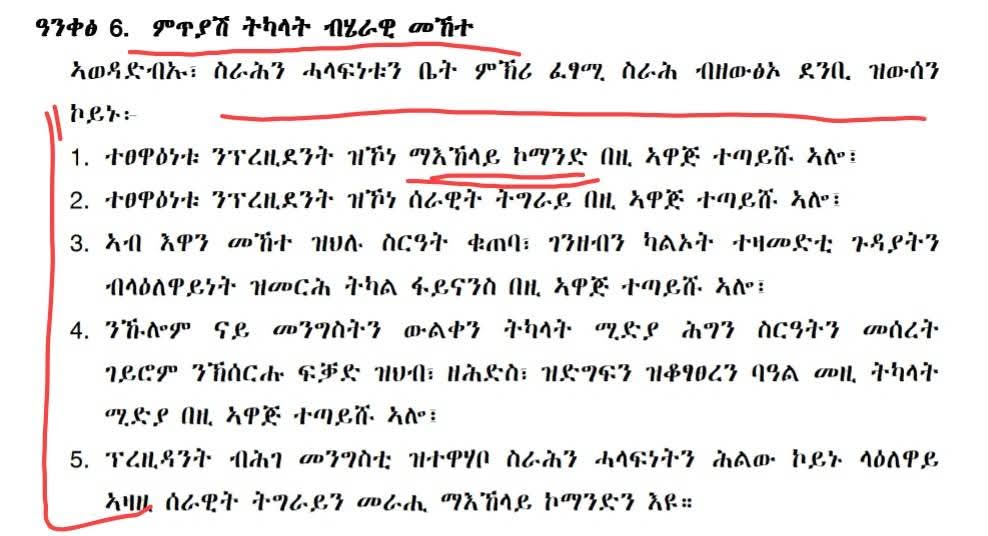
A draft proclamation attributed to the Tigray People’s Liberation Front (TPLF) is drawing attention for provisions that would impose severe criminal penalties on individuals and organizations accused of discouraging military participation, criticizing the armed struggle, or engaging in activities deemed to undermine Tigray’s defense effort.
The draft law contains some of the broadest provisions proposed in post-war Tigray, including prison sentences of up to 25 years, extraterritorial jurisdiction extending beyond Tigray’s borders, and retroactive enforcement dating back to the outbreak of the Tigray War on November 3, 2020.
Criminal Penalties for Opposition to Mobilization
Article 17 of the draft proclamation, titled “Obstructing the Defense Effort,” establishes a range of offenses related to military recruitment, desertion, and public opposition to participation in defense activities.
Among its most consequential provisions is Article 17(4), which states that any person who, through media or any other means, encourages individuals not to fight, resist, serve, or participate in military mobilization efforts may face five to fifteen years of rigorous imprisonment.
The provision applies not only to those who directly advocate against participation in military activities but also to individuals who are alleged to have organized, led, financed, raised funds for, distributed funds to support, or otherwise assisted such efforts.
In cases deemed particularly serious, the proposed punishment increases to fifteen to twenty-five years of imprisonment.
The language of the article is broad and could potentially encompass public campaigns, media commentary, political advocacy, fundraising efforts, online content, and other forms of communication interpreted as discouraging participation in military service or defense-related activities.
Media Organizations Could Face Closure
The draft law also imposes significant penalties on media institutions.
Under Article 17(5), if authorities determine that a media organization has committed offenses outlined in the proclamation, it may face financial penalties, suspension of operations, revocation of its license, and confiscation of assets.
The provision could expose newspapers, television stations, online media platforms, social media organizations, and other communications outlets to sanctions if their reporting or commentary is found to violate the law.
New Restrictions on Speech Concerning the Armed Struggle
Article 18 introduces additional offenses related to public expression and historical memory.
Under the draft law, individuals who are found to have diminished, insulted, or undermined the honor of Tigrayan fighters, the sacrifices made during armed struggles, or the families of fighters may face five to ten years of imprisonment and financial penalties.
If such acts are committed through media institutions or organized groups, the punishment could rise to ten to fifteen years of imprisonment, accompanied by substantially larger fines.
The article further criminalizes acts considered disrespectful toward Tigrayan mothers, the people of Tigray, the regional flag, the national anthem, historical struggles, and sacrifices associated with those struggles.
Violations may result in prison sentences of up to five years and additional monetary penalties.
Law Would Apply Beyond Tigray’s Borders
One of the most notable provisions in the draft proclamation is its assertion of extraterritorial jurisdiction.
The draft states that the law shall apply to any person who commits an offense prohibited by the proclamation, regardless of nationality, place of origin, or place of residence, whether the conduct occurs inside or outside Tigray.
The provision extends the law’s reach to members of the Tigrayan diaspora, foreign-based activists, journalists, academics, political commentators, media organizations, and advocacy groups operating outside the region.
Retroactive Enforcement Back to the Start of the War
Another provision of the draft law introduces retroactive criminal liability. According to the proclamation, offenses contained in Articles 35 through 48 would apply retroactively beginning on November 3, 2020, the date widely recognized as the start of the Tigray War.
This means that activities, statements, publications, fundraising efforts, organizational actions, or other conduct falling within the scope of those provisions could potentially be subject to prosecution even if they occurred years before the law’s enactment.
Depending on when the proclamation is adopted, the retroactive enforcement period could extend approximately six years into the past.
Retroactive criminal legislation is often controversial because it permits legal consequences for conduct that may not have been subject to the same criminal penalties at the time it occurred.
Potential Impact on Public Debate
Supporters of the draft regulation may argue that the provisions are necessary to protect Tigray’s security, preserve military readiness, safeguard national unity, and honor those who sacrificed during years of conflict.
Critics, however, are likely to raise concerns regarding freedom of expression, press freedom, political dissent, academic inquiry, and public discussion of wartime events.
The broad wording of several provisions could generate debate about where the line would be drawn between legitimate public discourse and conduct considered criminal under the proposed law.
Questions may also arise regarding the practical enforcement of extraterritorial provisions and the implications of applying criminal penalties retroactively to events dating back to the beginning of the war.
As of now, the document remains a draft proposal.
In recent months, a number of Tigrayan media organizations known for their criticism of political and military leaders’ management of post-war challenges and public affairs have moved their operations from Tigray to Addis Ababa.
Editor’s Disclaimer:
The views and opinions expressed in articles published by Horn News Hub are those of the authors and do not necessarily reflect the official position or editorial stance of Horn News Hub. Publication does not imply endorsement.