

Addis Ababa, Ethiopia — May 22, 2026 | Horn News Hub
The conclusion of the Dubai Chamber of Commerce trade mission in Addis Ababa marks more than a routine business delegation or ceremonial investment forum. It reflects a deeper shift in the evolving economic relationship between Ethiopia and the United Arab Emirates, particularly Dubai’s growing ambition to position itself as a central commercial gateway into Africa, while Ethiopia seeks new foreign investment partners capable of supporting its long-term economic transformation.
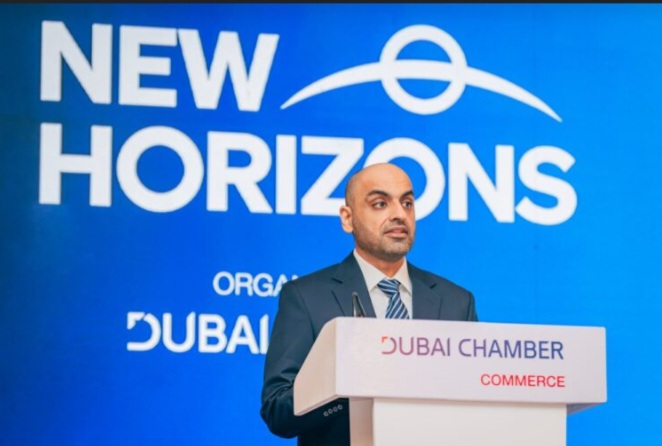
The “Dubai–Ethiopia Business Connect” forum brought together senior government officials, diplomats, and private sector representatives from both countries at a time when Ethiopia is actively pursuing economic recovery, foreign capital inflows, and international trade expansion. The participation of 21 Dubai-based companies across sectors ranging from construction and logistics to pharmaceuticals, manufacturing, and energy demonstrates the broad commercial interest emerging around Ethiopia’s market potential.
At the center of the discussions was the sharp rise in non-oil trade between Ethiopia and Dubai, which reached AED 22.3 billion in 2025, representing year-on-year growth of 236.6 percent. The scale of that increase signals that bilateral economic engagement is accelerating rapidly, even as Ethiopia continues to navigate domestic political and security challenges.
For Dubai, Ethiopia represents one of the largest untapped markets in East Africa. With a population exceeding 120 million, a strategic geographic position, and ongoing economic liberalization efforts, Ethiopia offers long-term opportunities in logistics, infrastructure, manufacturing, agriculture, aviation, tourism, and digital services.
Dubai’s interest is also tied to a broader geopolitical and commercial strategy. Over the past decade, the UAE has expanded its influence across the Horn of Africa through ports, logistics investments, energy projects, humanitarian engagement, and diplomatic partnerships. Ethiopia occupies a particularly important position in that strategy due to its economic size and political influence within Africa.
The forum also highlighted Dubai’s attempt to deepen institutional commercial connectivity with Ethiopian businesses. According to the Dubai Chamber of Commerce, 1,676 Ethiopian companies were registered as active chamber members by the end of the first quarter of 2026. This growing business presence suggests that Ethiopian firms are increasingly using Dubai not only as a trading partner, but also as a financial and logistical bridge to wider global markets.
Analysts say this reflects an emerging interdependence. Ethiopia benefits from Dubai’s advanced logistics infrastructure, international banking systems, free zone ecosystem, and global trade access. Dubai, meanwhile, benefits from Ethiopia’s expanding consumer market, labor force, industrial ambitions, and strategic position within the African Continental Free Trade Area (AfCFTA).
Still, despite the optimism surrounding the forum, major structural realities remain.
Ethiopia continues to face significant economic pressures, including foreign currency shortages, inflation, debt burdens, and investor concerns linked to political instability in several regions. While foreign investors increasingly view Ethiopia as a high-potential market, many remain cautious about operational risks, regulatory predictability, and long-term security conditions.
This creates a dual reality. Ethiopia is simultaneously one of Africa’s most promising emerging markets and one of its most complex investment environments.
The sectors represented during the trade mission reveal where both sides see immediate opportunity. Construction materials and engineering firms are likely responding to Ethiopia’s large-scale urban development and infrastructure agenda. FMCG and food companies are targeting Ethiopia’s expanding urban consumer base. Textile and garment companies see potential in Ethiopia’s low-cost manufacturing sector, while pharmaceutical and biotechnology firms are exploring growing healthcare demand.
The UAE’s logistical expertise also aligns closely with Ethiopia’s ambitions to become a regional trade and aviation hub. Addis Ababa already hosts one of Africa’s largest airlines and occupies a strategic position connecting East Africa to the Middle East and Asia. Greater commercial integration with Dubai could strengthen Ethiopia’s role in regional supply chains.
Diplomatically, the event reflects increasingly close political relations between Addis Ababa and Abu Dhabi. Ethiopian officials repeatedly emphasized the strategic nature of the partnership, while UAE representatives framed Ethiopia as a priority economic partner in Africa.
Ambassador Dr. Jemal Beker’s remarks about Ethiopia learning from Dubai’s economic transformation were particularly notable. Dubai’s rise from a regional trading center into a global logistics and financial hub is often viewed by policymakers in developing economies as a model for rapid modernization driven by infrastructure, trade openness, and international investment attraction.
However, Ethiopia’s circumstances differ significantly. Dubai’s transformation was supported by political stability, centralized governance, and a globally integrated financial system. Ethiopia’s development path is unfolding within a far more complex domestic political environment shaped by ethnic federalism, conflict recovery, and economic restructuring.
As a result, the long-term success of this growing partnership will depend not only on investment pledges or trade statistics, but also on Ethiopia’s ability to create a more stable and predictable business climate.
The forum nevertheless demonstrated that international interest in Ethiopia remains strong despite ongoing challenges. Rather than disengaging, Gulf countries appear to be deepening their economic footprint across the Horn of Africa, viewing the region as strategically important for trade routes, food security, energy access, and geopolitical influence.
For Ethiopia, the relationship offers opportunities for capital, market access, infrastructure cooperation, and economic diversification. For Dubai and the UAE, Ethiopia represents both a commercial opportunity and a strategic anchor within East Africa.
The Addis Ababa meetings may therefore be remembered less as a single business forum and more as part of a broader realignment in Horn of Africa economics, where Gulf investment, African markets, and geopolitical strategy are becoming increasingly interconnected.
Editor’s Disclaimer:
The views and opinions expressed in articles published by Horn News Hub are those of the authors and do not necessarily reflect the official position or editorial stance of Horn News Hub. Publication does not imply endorsement.