
The Unresolved Paradox at the Heart of the Eritrean State
“A house divided against itself cannot stand.”
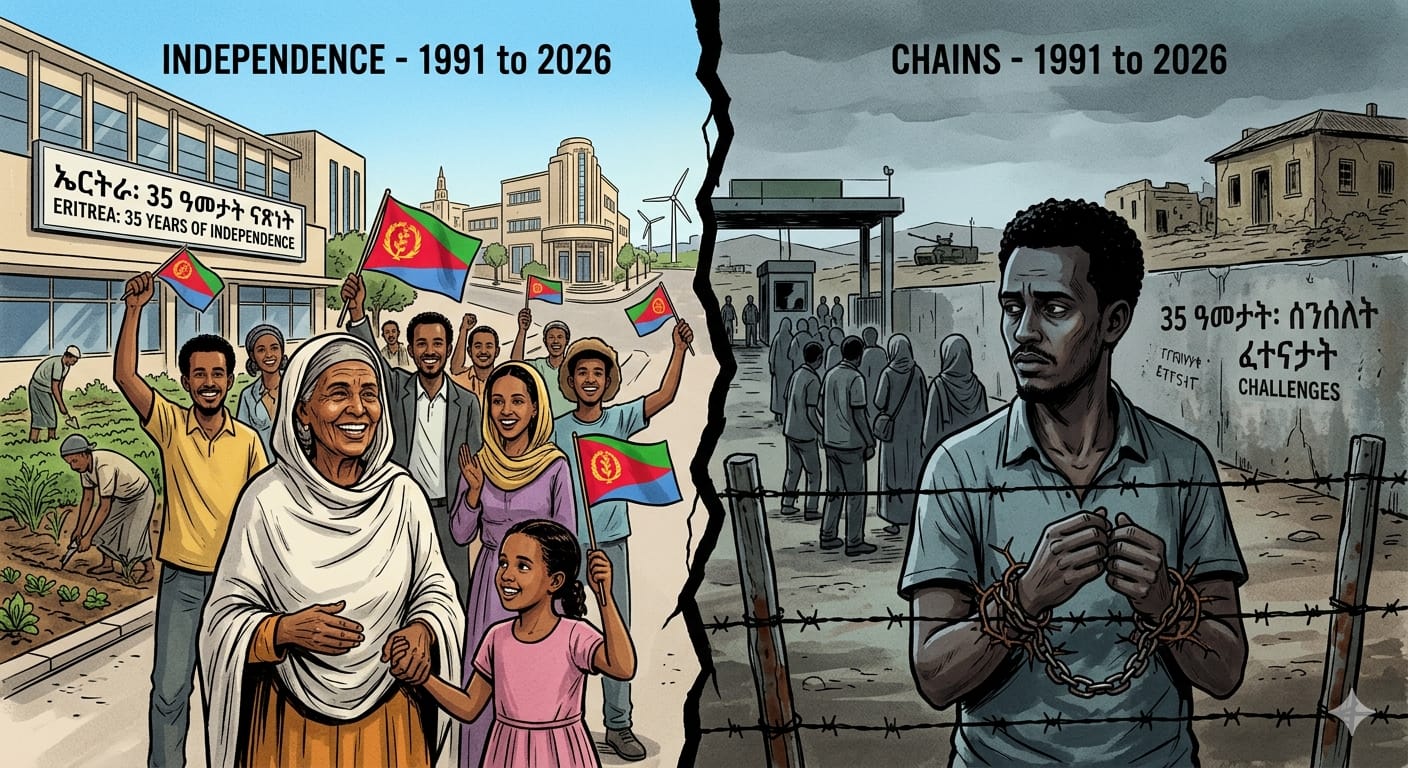
Where liberation becomes the language of oppression, independence ceases to represent freedom and instead reflects a transfer of power from one ruling structure to another.
By HAGR Editorial and Strategic Analysis Desk
Addis Ababa, Ethiopia — May 24, 2026 | Horn of Africa Geopolitical Review (HAGR)
Thirty five years after Eritrea achieved independence, the country remains one of the most politically isolated and heavily militarized states in the world. What was once celebrated across Africa as a historic victory for self determination has increasingly become the subject of regional and international scrutiny over governance, militarization, human rights, and long term regional instability.
On May 24, 1991, Eritrean fighters entered Asmara after a thirty year armed struggle against successive Ethiopian governments. The victory was viewed as one of Africa’s most remarkable liberation movements. Eritrea later formalized its independence through a referendum in 1993, gaining international recognition and membership in major international institutions.
Yet despite the symbolism of sovereignty, Eritrea today continues to experience one of the world’s largest refugee outflows per capita. Thousands of Eritreans continue to flee the country annually, with many undertaking dangerous migration routes through Sudan, Libya, and the Mediterranean Sea toward Europe.
This contradiction lies at the center of Eritrea’s modern political reality: a state that secured territorial independence while facing persistent accusations of internal repression and indefinite militarization.
The State Built Around Permanent Threat
Analysts of the Horn of Africa argue that Eritrea’s political system has been shaped by a continuous security doctrine centered on external threats and regional confrontation.
Under President Isaias Afwerki, Eritrea has experienced military conflict, diplomatic rupture, or prolonged hostility with nearly every neighboring country since independence.
The most defining confrontation was the 1998 to 2000 border war with Ethiopia over the disputed town of Badme. The war resulted in tens of thousands of deaths and created a prolonged “no war, no peace” situation that lasted nearly two decades. Although international arbitration later ruled on the border dispute, implementation became a major source of tension between Addis Ababa and Asmara.
The 2018 rapprochement between Eritrea and Ethiopia, led by Prime Minister Abiy Ahmed and Isaias Afwerki, initially generated optimism across the region and contributed to Abiy Ahmed receiving the Nobel Peace Prize. However, relations later deteriorated again amid the conflict in Tigray and growing disputes linked to post Pretoria political tensions and Red Sea access debates.
Eritrea’s relations with Djibouti also deteriorated during border clashes around Ras Doumeira in 1996 and 2008. Those incidents contributed to diplomatic isolation and eventually to United Nations sanctions imposed on Eritrea in 2009.
Relations with Sudan have similarly fluctuated between cooperation and proxy confrontation, with both governments historically accusing each other of supporting armed groups operating along border regions.
Eritrea also became involved in disputes connected to Yemen and the strategically important Red Sea corridor, particularly around the Hanish Islands in the mid 1990s. Regional intelligence reports over the years have additionally linked Eritrea to broader geopolitical rivalries involving Gulf states, Iran, and armed actors operating in Yemen.
In Somalia, Eritrea faced repeated accusations from international monitoring groups alleging support for armed Islamist factions during the 2000s. Western and regional analysts often interpreted these policies as part of Eritrea’s broader strategy of countering Ethiopian influence across the Horn of Africa.
Regional observers argue that the Eritrean state has historically relied on external confrontation as a mechanism for maintaining domestic political cohesion and justifying prolonged militarization.
Indefinite National Service and Human Rights Concerns
Inside Eritrea, the most controversial pillar of the state remains the indefinite national service system.
Originally introduced as a limited national defense program, the system evolved into an open ended structure requiring Eritrean citizens to serve in military or state assigned civilian roles for years, and in some cases decades. Human rights organizations and United Nations investigations have repeatedly characterized the system as a form of forced labor.
The United Nations Human Rights Council and multiple international organizations have documented allegations involving arbitrary detention, restrictions on freedom of expression, lack of judicial independence, and the absence of national elections.
Eritrea has not implemented the constitution drafted in 1997, and the country continues to operate without national electoral processes, independent media institutions, or legal opposition parties.
Journalists arrested during political crackdowns in 2001 remain among the longest detained media figures in the world, with many never publicly accounted for.
Religious groups outside officially recognized institutions have also reported surveillance, detention, and restrictions.
The Eritrean government has consistently rejected accusations of systematic abuse, arguing that international criticism is politically motivated and ignores the country’s security realities and sovereignty concerns.
Refugees and the Human Cost of Militarization
The human consequences of Eritrea’s political structure are visible across migration routes stretching from East Africa to Europe.
Eritreans continue to rank among the largest groups seeking asylum in Europe relative to population size. International refugee agencies report that many young Eritreans cite indefinite military service, political restrictions, and limited economic opportunity as major reasons for leaving the country.
The exodus has deeply affected Eritrean society, creating large diaspora communities across Europe, North America, and neighboring African countries.
Critics argue that this migration trend reflects a deeper crisis within the Eritrean state, where large sections of the younger generation no longer view their future as possible inside the country itself.
Eritrea’s Role in Regional Instability
Across the Horn of Africa, Eritrea’s role remains one of the most divisive geopolitical questions.
Several regional analysts and international policymakers have described Eritrea as a destabilizing actor in regional peace processes. During negotiations leading to the 2022 Pretoria Agreement that formally ended the Tigray war, Eritrea was largely sidelined from central mediation efforts despite its military involvement in the conflict.
At the same time, Eritrea’s strategic geographic position along the Red Sea has made it increasingly important in wider international competition involving Gulf powers, maritime security, and trade corridors.
The combination of unresolved historical grievances, border tensions, military distrust, and regional power competition continues to place the relationship between Eritrea and Ethiopia among the most sensitive security issues in Africa.
The Constitutional and Legal Debate
Beyond military and political tensions, Eritrea’s independence process itself continues to generate legal and constitutional debate in some academic and political circles.
While Eritrea’s referendum is internationally recognized as legitimate under international law, some Ethiopian scholars, political commentators, and constitutional critics argue that the process was conducted without the direct participation or broader national consent of the Ethiopian people as a whole. They contend that the transitional government in Ethiopia, which formally accepted Eritrea’s independence, lacked an elected constitutional mandate to make permanent territorial decisions on behalf of the Ethiopian state.
Although the issue remains highly sensitive and is rarely addressed openly by officials in either Eritrea or Ethiopia, analysts note that differing historical interpretations of the referendum and separation process continue to shape nationalist narratives, political grievances, and long standing mistrust between the two countries.
The Legacy of Liberation
For many Eritreans, independence represented not only territorial liberation but also a broader hope for political dignity, institutional development, and social transformation.
Critics argue that the greatest tragedy of modern Eritrea is not the achievement of independence itself, but the belief that the promises of liberation were never fully realized for ordinary citizens.
Conclusion
As Eritrea marks the 35th anniversary of independence, the country stands at a difficult historical crossroads.
Formally, Eritrea possesses all the characteristics of sovereign statehood: internationally recognized borders, membership in continental and global institutions, and full diplomatic recognition.
Yet the debate surrounding Eritrea increasingly centers not on sovereignty itself, but on governance, citizenship, freedom, and the meaning of liberation after independence.
For supporters of the government, Eritrea represents a nation that defended its sovereignty against overwhelming external pressure and refused foreign interference.
For critics, the country has evolved into one of the Horn of Africa’s most restrictive political systems, where national security has become the central justification for indefinite militarization and political control.
Thirty five years after independence, Eritrea remains both a symbol of successful liberation and a case study in the unresolved tensions between state sovereignty and individual freedom.
Whether the next chapter of Eritrean history moves toward reform, reconciliation, and regional reintegration or toward deeper isolation and confrontation may shape not only Eritrea’s future, but also the future stability of the entire Horn of Africa region.
HORN OF AFRICA GEOPOLITICAL REVIEW (HAGR)
Special Edition — 35th Anniversary of Eritrean Independence.