
The historical trajectory of the people of Tigray has been defined by a prolonged and complex interaction between war and peace, both in relation to external forces and internal political dynamics. This trajectory reflects cycles of division and unity, struggle and achievement, marked by profound sacrifices and resilience. It is through these cumulative experiences that Tigray has reached its present juncture.
Over the course of five to six generations, it is difficult to identify a single generation in Tigray that has experienced sustained peace. This pattern underscores a structural failure to translate past sacrifices into lasting stability. We currently persist without a definitive strategy or a coherent practical movement capable of liberating our society from this recurring historical cycle of devastation.
The Tigray People’s Liberation Front (TPLF) historically served as a transformative force, dismantling an oppressive system and leading a seventeen-year struggle to a successful conclusion through unparalleled sacrifice.
This organization succeeded in forging a unified populace dedicated to the preservation of identity and dignity. Over the subsequent twenty-seven years, it acted as a catalyst for fundamental socio-economic and political shifts, fostering human capital and professional development while encouraging a citizenry that demands active participation. By accurately interpreting national, regional, and global geopolitics, the organization facilitated the most prolonged period of peace and development in Ethiopian history, driven by a strategic leadership that was once characterized by wisdom, adaptability, and unwavering commitment.
However, the past decade has been characterized by a sustained decline. Tigray has experienced a progressive erosion of its political position within the Ethiopian state, culminating in its effective isolation. The consequences have been severe: a devastating war marked by widespread atrocities, the loss of constitutionally recognized territories, large-scale displacement, and a humanitarian crisis of unprecedented scale. Despite our profound sacrifices and our consistent advocacy for the supremacy of the Constitution, that legal framework ultimately failed to provide security. The Pretoria Agreement, reached at considerable cost, remains only partially implemented, leaving the region in a condition of fragile and uncertain peace.
We now find ourselves in the precarious aftermath of war, where the Pretoria Agreement attained at a staggering cost remains largely unimplemented. We are currently traversing a narrow path between a fragile peace and the immediate threat of renewed conflict. The persistent threat of war looms large, and the risk of sliding back into active combat is high. We are facing a peril that is unprecedented in its nature and potential for catastrophe.
The source of our current malaise is rooted in leadership. There is a demonstrable failure to evaluate the present with maturity or to envision sustainable solutions for the future. Instead of inclusive strategic planning, we observe the suppression of divergent views and the prioritization of tactical maneuvering over long-term stability. The current political environment in Tigray has devolved into a culture of defamation and labels, where energy is spent on internal friction rather than on mobilizing the intellectual and moral resources of the people. This trajectory toward failure is no longer a hidden reality. A solution to this crisis cannot be found within the confines of a single political organization or the dictates of an individual; it requires a collective effort that transcends current power structures.
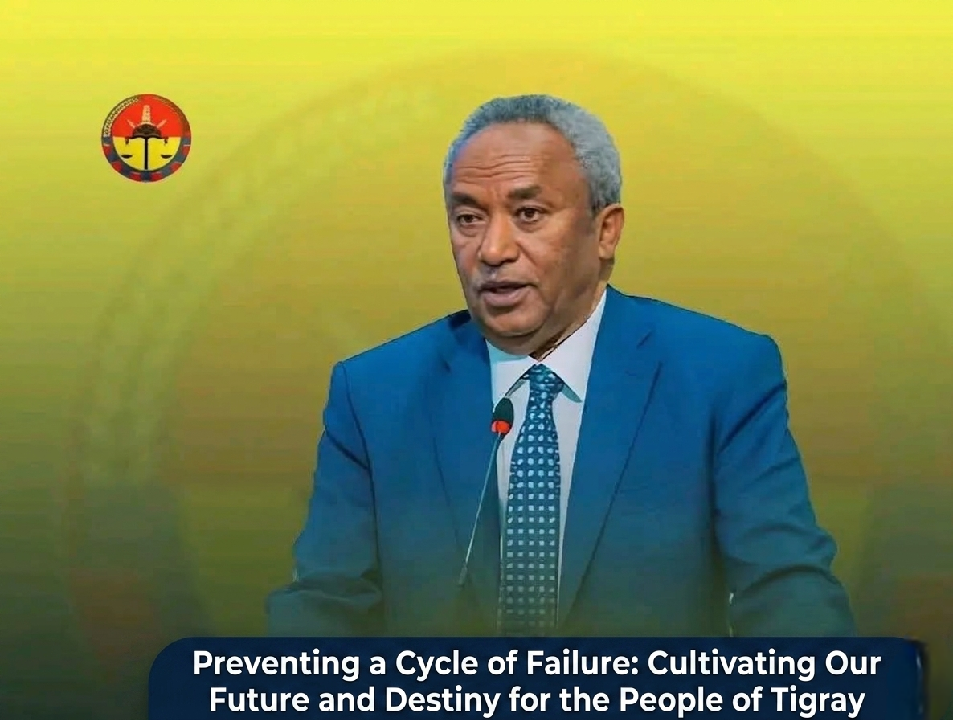
It is imperative that Tigray does not succumb to another cycle of collapse. There is a significant opportunity for unity if we embrace the diverse perspectives of Tigrayans who are eager to contribute solutions. To ignore these voices in favor of an exclusionary “my way only” approach will inevitably lead to further disaster. Attempting to enforce decisions through coercion rather than dialogue will only expedite our collective downfall.
I therefore call upon the people of Tigray specifically the youth and womens who bear the greatest burden of these crises to intervene. We must halt this unwise handling of our shared destiny before we reach a point of total disintegration. It is essential to establish a platform for genuine dialogue during this transitional period to ensure that refined, collective wisdom guides our path forward.
The safeguarding of Tigray’s future depends on the ability of its people to engage collectively, think critically, and act decisively.
Lieutenant General Tadesse Werede Tesfay
Interim President of the Tigray Region
May 4, 2026
Mekelle,Tigray