
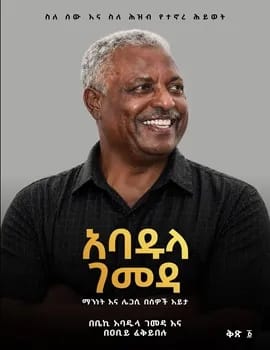
The Extraordinary Life, Leadership, and Enduring Legacy of General Abadula Gemeda፡A Strategic Editorial Reflection on Leadership, Institutional Transformation, and Modern Ethiopian Political History
Author: Dr. Dawit Tesfay
Post-War Military, Security & Transitional Justice Affairs Researcher
Analytical Leadership Expert
PREFACE: THE POWER OF ENDURANCE
Few political figures in modern Ethiopian history have followed a trajectory as remarkable, complex, and consequential as that of General Abadula Gemeda.
His journey from rebel commander to military general, from national defense leadership to regional governance, from Speaker of the House of Peoples’ Representatives to elder statesman, reflects some of the most transformative chapters in Ethiopia’s contemporary history. It is a story of perseverance, institutional experience, political resilience, and sustained commitment to public service across multiple phases of state-building.
General Abadula Gemeda belongs to a rare category of leaders whose influence cannot be measured solely by the offices they held. His significance lies equally in the institutions he helped shape, the political transitions he influenced, and the strategic decisions he made during periods of national uncertainty.
For more than three decades, he operated at the intersection of military affairs, national security, regional governance, parliamentary leadership, diplomacy, and political reform. Few Ethiopian leaders have accumulated such breadth of experience across so many dimensions of statecraft.
This is not merely the story of a soldier who became a politician. Nor is it simply the story of a politician who rose through government ranks.
It is the story of a man who participated in the construction of modern Ethiopia’s political architecture while also helping reshape the political consciousness of the country’s largest regional state.
His life offers an important lesson about leadership: meaningful influence is rarely built through dramatic declarations. More often, it is forged through patience, strategic judgment, institutional discipline, and the willingness to work within difficult systems while seeking opportunities to improve them.
THE FOUNDING OF OPDO AND THE ARCHITECTURE OF A POLITICAL MOVEMENT
The formation of the Oromo People’s Democratic Organization (OPDO) in the early 1990s remains one of the most debated developments in Ethiopian political history. At the time, Ethiopia was emerging from years of armed conflict and revolutionary transformation. The collapse of the Derg regime created a historic political opening, but it also raised fundamental questions about representation, federalism, national unity, and the future role of Ethiopia’s diverse communities within the state.
Among the leaders who would shape this new political landscape, Abadula Gemeda emerged as one of the most influential. As a founding leader of the OPDO, he became part of a generation tasked with translating Oromo political aspirations into institutional reality. The challenges were substantial. The organization faced skepticism, political pressure, and questions about legitimacy. Yet over time, the OPDO evolved from a relatively weak political structure into one of the most influential forces in Ethiopian politics.
Many of the transformations that later reshaped Ethiopia’s political order can be traced to internal reform efforts undertaken within the OPDO over several decades. Abadula Gemeda was not merely a participant in this process. He was one of its principal architects.
His contribution was defined not by rhetoric alone, but by organizational discipline, institution-building, and the cultivation of a new generation of political leadership. History often remembers political movements through their most visible moments. Yet lasting transformation usually occurs through quieter wor through the patient construction of institutions capable of enduring beyond individual leaders.
This was one of Abadula Gemeda’s most significant political contributions.
THE SOLDIER, THE GENERAL, AND THE BUILDER OF INSTITUTIONS
Before becoming one of Ethiopia’s most recognizable political leaders, Abadula Gemeda established himself within the country’s military establishment.
Following the political transition of 1991, he assumed major responsibilities in the restructuring of the Ethiopian National Defense Force (ENDF), contributing to the difficult process of building a unified national military institution in a post-conflict environment.
The challenge facing Ethiopia at the time was extraordinary. A new state required a new military doctrine, new command structures, and a professional force capable of protecting national sovereignty while adapting to rapidly changing political realities.
Abadula Gemeda played a central role in this effort. Over time, he served in several strategic military and security positions, including operational command responsibilities, intelligence leadership, and senior military administration, before attaining the rank of Major General.
His military career provided him with something many politicians never acquire: a deep understanding of how institutions function under pressure.
That experience would later shape his approach to governance, administration, and political leadership. Throughout his public life, he consistently demonstrated an appreciation for organizational stability, institutional continuity, and long-term strategic thinking. These qualities became defining characteristics of his leadership.
DEFENSE MINISTER, REGIONAL PRESIDENT, AND NATIONAL STATESMAN
Abadula Gemeda’s transition from military leadership to civilian governance marked another significant chapter in his career. As Minister of National Defense, he served during a period when Ethiopia was confronting the difficult realities of post-war reconstruction, military reform, and national security restructuring.
His tenure reflected the challenges faced by many post-conflict societies: balancing security requirements while strengthening state institutions capable of supporting long-term stability.
Later, as President of the Oromia Regional State, he became one of the most influential regional leaders in Ethiopia.
His administration coincided with a period of expanding regional institutional capacity, growing cultural self-confidence, and increasing public engagement in regional governance.
Supporters often regard this period as one of the most important phases in the political evolution of modern Oromia.
His reputation as a decisive administrator earned him the nickname “Bulldozer”a reflection of his determination, persistence, and willingness to confront bureaucratic obstacles directly. Whether one agrees with all of his policies or not, few observers dispute his impact on the political development of Oromia and the broader federal system.
THE SPEAKER WHO SHOOK THE ESTABLISHMENT
Perhaps one of the most consequential moments of Abadula Gemeda’s political career came during his tenure as Speaker of the House of Peoples’ Representatives. At a time of mounting political tensions, rising public dissatisfaction, and growing demands for reform, his resignation sent shockwaves throughout Ethiopia’s political establishment. For many Ethiopians, the resignation represented far more than the departure of a senior government official. It was interpreted as a public signal that serious fractures had emerged within the ruling coalition itself. Political observers continue to debate the long-term significance of that decision. Yet there is broad agreement on one point: the resignation altered the political landscape.
Many analysts regard it as one of the defining moments that accelerated the internal realignments which ultimately transformed Ethiopian politics and contributed to the emergence of a new political era.
For supporters, it represented a strategic form of resistance an effort to challenge entrenched power structures from within rather than through confrontation outside the system.
Whether viewed through a political, institutional, or historical lens, the decision remains one of the most important acts of Abadula Gemeda’s public career.
THE DIPLOMAT AND ADVOCATE OF ETHIOPIA’S NATIONAL INTERESTS
Abadula Gemeda’s influence extended beyond military and domestic political affairs. In December 2014, he led one of Ethiopia’s most significant public diplomacy missions to Egypt.
As head of a delegation of more than seventy Ethiopian public diplomacy representatives, he participated in a landmark effort aimed at strengthening people-to-people relations between Ethiopia and Egypt while addressing misunderstandings surrounding the Grand Ethiopian Renaissance Dam (GERD).
The initiative reflected an important principle of diplomacy: national interests are advanced not only through government negotiations, but also through direct engagement between societies. His observations regarding the Nile, regional geopolitics, and Ethiopia’s strategic interests continue to generate debate. Whether one agrees with every conclusion or not, his interventions have consistently been framed around a central concern: safeguarding Ethiopia’s long-term national interests while promoting peaceful regional engagement.
This combination of strategic realism and diplomatic engagement has become one of the defining features of his public legacy.
MORE THAN AN INTERVIEW: A STATESMAN’S REFLECTION
Recent public interviews given by General Abadula Gemeda have attracted renewed attention from Ethiopians across political, generational, and regional lines.
What makes these interviews noteworthy is not merely the status of the speaker, but the substance of the message. His reflections frequently emphasize reconciliation, national unity, institutional reform, and the importance of overcoming historical grievances.
One statement, in particular, stands out:
“We must break down the walls of hatred and build bridges of love, solidarity, and unity.” In a political environment often characterized by polarization and mistrust, such a message carries particular significance.
These interviews are not simply recollections of past events.
They are reflections from a leader who has witnessed Ethiopia’s modern political evolution from multiple vantage points as a commander, administrator, minister, diplomat, regional president, parliamentary leader, and elder statesman.
For that reason alone, they deserve careful attention from anyone interested in Ethiopia’s future.
The relatively modest viewership of some of these discussions stands in contrast to the importance of the issues being raised. The questions addressed are not merely historical. They concern Ethiopia’s future direction, national cohesion, regional security, and the responsibilities of leadership in times of profound change. In that sense, these conversations deserve a far wider audience than they have thus far received.
A LASTING LEGACY BEYOND POLITICS
Perhaps the most revealing chapter of Abadula Gemeda’s public life is not found in military command, government office, or political influence.
It is found in service. Through the Deborah Foundation, inspired by his daughter Deborah, he has dedicated significant effort to supporting children with Down syndrome and intellectual disabilities.The Foundation represents a different kind of leadership one measured not by power, but by compassion.
Its work reflects a simple but profound belief: that every child deserves dignity, opportunity, inclusion, and hope.
In a world where many public figures spend their retirement protecting their legacy, Abadula Gemeda chose to invest in improving the lives of some of Ethiopia’s most vulnerable citizens.
That decision may ultimately become one of the most enduring parts of his legacy.
Because institutions matter.
Politics matters.
History matters.
But humanity matters most.
And the leaders remembered longest are often those who use influence not only to govern society, but also to serve it.
THE MAN WHO CHOSE INSTITUTIONS OVER POWER FORTY YEARS OF SERVICE: Military Leadership, Political Reform, and National Transformation
Suggested HAGR Special Editorial
Dedication
In Honor of the Deborah Foundation
A Beacon of Inclusion, Dignity, and Hope in Ethiopia,this Special Editorial Edition dedicated to the humanitarian mission of the Deborah Foundation. Inspired by compassion and guided by the principle that every human being deserves dignity and opportunity, the Foundation represents the highest ideals of public service beyond politics and beyond power.
This analytical reflection is published in recognition of the Foundation’s contribution to inclusive education, healthcare advocacy, social protection, and the advancement of children with Down syndrome and intellectual disabilities across Ethiopia.
We expresses its solidarity with this noble cause and commends all individuals and institutions working to build a more compassionate, inclusive, and humane society for future generations.