
Sudan, Eritrea, and the Strategic Depth of Iran’s Houthi Resupply
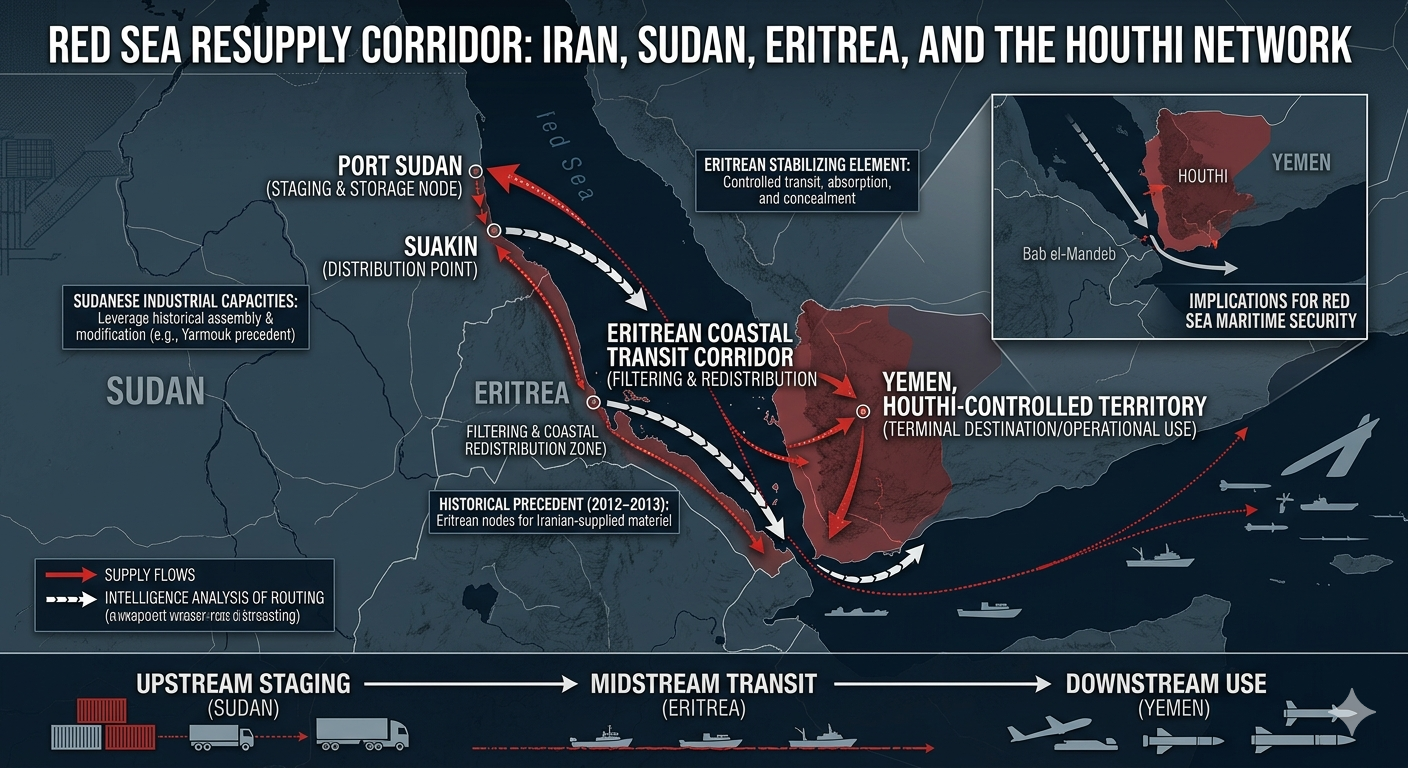
The latest intelligence indicating that the Houthi movement in Yemen is being supplied with weapons and logistical support from bases near Port Sudan and Suakin, routed through Eritrea, reflects the reactivation and evolution of a transregional network connecting the Horn of Africa to the Arabian Peninsula. This network demonstrates operational continuity, infrastructural adaptation, and strategic foresight, enabling sustained operations across multiple theaters under conditions of constrained visibility and scrutiny. The combination of Sudanese staging points, Eritrean transit corridors, and historical industrial capacities illustrates a deliberate, layered architecture designed for both resilience and deniability.
The operational logic of this system is anchored in precedent. During 2012–2013, Eritrean coastal facilities were already implicated in the discreet transshipment of Iranian-supplied materiel to the Houthis, establishing a framework that prioritized indirect routing, compartmentalization, and the exploitation of peripheral geographies to mitigate exposure. The present configuration builds upon this foundation, incorporating Sudanese Red Sea ports as upstream staging nodes. Port Sudan and Suakin provide throughput capacity, storage, and redistribution capabilities that expand operational flexibility while maintaining plausible deniability. The network thus exhibits both spatial and functional dispersion, reducing vulnerability and complicating attribution.
Sudan’s role is further reinforced by its historical industrial and technical collaboration with Iran. The Yarmouk Military Industrial Complex previously functioned as a locus for assembly, modification, and limited production of advanced weaponry under Iranian guidance. While the facility’s operational status may have fluctuated, its existence established a precedent for the transformation of raw materiel into operationally usable form within Sudan. The reactivation of Sudanese nodes suggests that residual or repurposed capacities may now be leveraged to sustain supply flows, forming a continuous logistical continuum from industrial preparation to staging and onward distribution.
Eritrea remains a central, stabilizing element of the network. Its elongated coastline and centralized governance permit tightly controlled transit operations, enabling the absorption, redirection, and concealment of flows in ways that maintain continuity while limiting external visibility. Eritrea’s recurrence in both historical and contemporary supply configurations signals durable integration within the system, rather than opportunistic engagement. It functions as a filtering and redistribution node, preserving operational coherence while mitigating risk at each transfer point.
The network’s design demonstrates structural resilience. By distributing functions across Sudanese staging areas, Eritrean transit nodes, and Yemeni end-use destinations, the system mitigates the impact of potential disruption at any single point. Its distributed architecture leverages the fragmented governance of the Horn of Africa, embedding logistical activity within territories where monitoring and interdiction capacities are limited. The result is a robust, adaptive flow capable of sustaining operational tempo in Yemen despite intensified scrutiny along traditional supply routes.
Strategically, the corridor linking Sudan and Eritrea to Yemen extends the operational depth of actors aligned with Tehran and embeds the Horn of Africa more deeply into a transregional conflict system. Sudan operates simultaneously as a staging ground, a contested terrain, and a site with latent industrial capacity, while Eritrea functions as a resilient hinge that maintains continuity, operational security, and deniability. The Houthi movement, as the terminal node, converts these flows into operational capability, with direct implications for Red Sea maritime security and the strategic dynamics of the Bab el-Mandeb chokepoint.
This system reflects a broader pattern of spatial and operational integration. Historical precedent in Eritrea, combined with Sudanese industrial and logistical capacities, demonstrates a continuity of strategic design that has evolved and intensified over time. The network transforms geographic space into operational advantage, embedding supply chains within contested and peripheral territories to maximize resilience while minimizing exposure. It represents not merely the movement of weapons, but the deliberate structuring of regional operational space to sustain influence and projection across multiple theaters.
The emerging intelligence should thus be interpreted as evidence of systemic consolidation rather than isolated operational improvisation. The Horn of Africa is no longer a peripheral theater; it is an integrated component of a wider strategic geometry, in which historical precedent, logistical sophistication, and operational discretion converge. Sudan and Eritrea are operationally embedded within this architecture, while the Houthi movement constitutes the terminal node where these capabilities are realized. The implications are profound, redefining the operational contours of the Red Sea basin and positioning the Horn of Africa as a durable and indispensable node within transregional conflict networks.
Source፡ Horn Review
Editor’s Disclaimer:
The views and opinions expressed in articles published by Horn News Hub are those of the authors and do not necessarily reflect the official position or editorial stance of Horn News Hub. Publication does not imply endorsement.