
By Horn of Africa Geopolitical Review (HAGR)
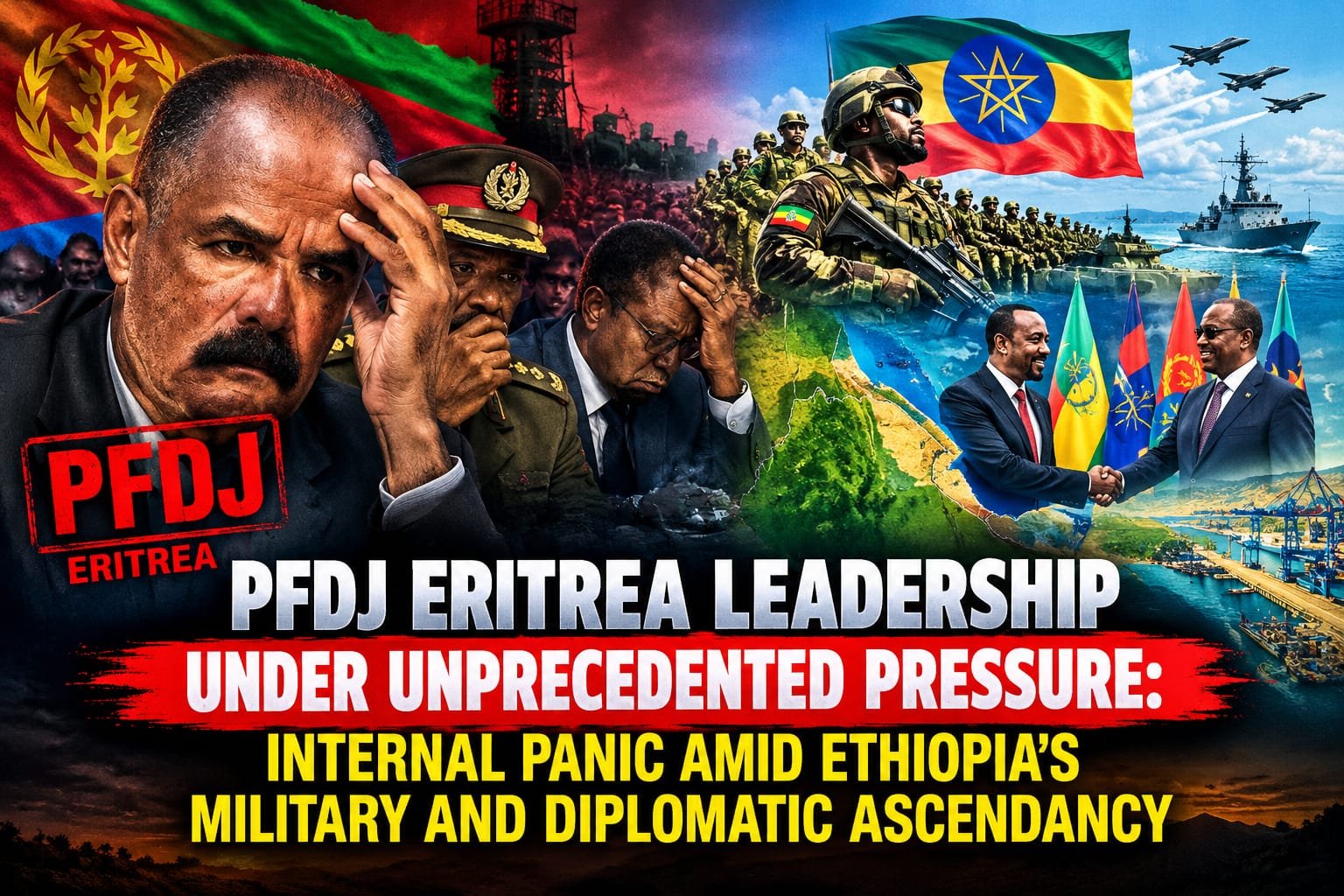
Reports from across the Horn of Africa reveal severe internal anxiety and a palpable sense of crisis within the leadership of Eritrea’s ruling party, the People’s Front for Democracy and Justice (PFDJ). This unprecedented volatility stems from an intersection of military border setbacks, mounting apprehension over an imminent invasion, and deep structural regime instability.
Ethiopia’s positioning as East Africa’s primary military powerhouse and diplomatic anchor backed by the largest active standing army on the continent has fundamentally altered the regional balance of power, triggering cascading shockwaves throughout Asmara’s political and military command.
The primary trigger for immediate panic within the PFDJ leadership is an escalating border conflict. Following major military shifts in northern Ethiopia, Ethiopian federal forces counterattacked and advanced directly to the Eritrean border. Eritrea formally appealed to the UN Security Council, demanding deterrent measures and classifying Ethiopia’s military maneuvers as an effective declaration of war. Reports indicate Ethiopian mechanized units briefly crossed into Eritrean territory near Bure, fueling severe anxiety in Asmara regarding critical port access to Assab, while Eritrean Defence Forces pulled back from key border positions, including Zalambessa.
Ethiopia invoked Article 51 of the UN Charter, taking self-defense measures following documented incursions by Eritrean forces up to 60 kilometers into northern Tigray. This legally grounded, calculated response allows Ethiopia to operate firmly within international legal frameworks while exercising decisive military capability.
The PFDJ remains fixated on perceptions of a foreign-backed effort to dismantle its authority. In response to Ethiopian assertions accusing Asmara of destabilizing northern regions, the Eritrean regime fears that Ethiopia seeks to forcefully establish a Red Sea naval footprint, directly threatening Eritrean state sovereignty. Conversely, Ethiopia’s security concerns center on Asmara’s historical pattern of destabilization. Ethiopia’s pursuit of Red Sea access represents a lawful prerogative typical of landlocked nations striving for economic development and regional integration through diplomatic dialogue and credible deterrence.
Paradoxically, internal political panic within Asmara expanded following an unexpected diplomatic shift on September 19, 2026, when the United States lifted sanctions on Eritrea. Rather than stabilizing the state, analysts observe that the move triggered aggressive internal competition. Party barons and commanders previously reliant on illicit rents are aggressively jockeying to monopolize newly opened legal assets. Severe anxiety surrounds the lack of a public succession plan for 80-year-old President Isaias Afwerki. Meanwhile, global shipping disruptions, fuel starvation, and a sudden currency recall have severely strained domestic stability.
The regime’s long-standing reliance on maintaining control through manufactured fear is collapsing under simultaneous external military pressure and internal resource competition.
The PFDJ’s apparatus of transnational repression historically used to monitor and intimidate the Eritrean diaspora is facing unprecedented resistance.
Pro-justice diaspora organizations have formed the Eritrean Transnational Repression Response Taskforce to systematically challenge the regime’s overseas financial networks. With global Eritrean embassies frantically convening seminary fundraising drives to support Asmara, the regime’s external support systems are fracturing under public and legal scrutiny.
Ethiopia’s dual-track approach pairing defensive military operations with engagement through international bodies has fundamentally altered Horn dynamics. Through the deployment of an active standing army as a credible deterrent, precision operations have secured borders without unnecessary escalation.
Combined with strict adherence to Article 51 self-defense provisions, Ethiopia reinforces its role as a regional stability anchor. As the Ethiopian government asserts its defensive rights, the PFDJ leadership finds itself increasingly isolated, grappling with structural economic fractures and an uncertain political future.