

A Special Geopolitical Analysis
By Chekole Alemu
In the contemporary geopolitical landscape of the Horn of Africa and the Mediterranean basin, water security and food self-sufficiency are no longer mere agrarian targets; they are foundational pillars of national security and strategic autonomy. Recent geospatial data and state infrastructure portfolios reveal that Egypt a nation where nearly 90% of the terrain is hyper-arid desert is executing an unprecedented, capital-intensive domestic campaign to achieve food sovereignty. Conversely, Ethiopia, naturally endowed with highly fertile arable land and vast hydrological basins, stands at a critical juncture where its immense agricultural potential must be fully translated into absolute food security.
- Egypt’s Multi-Billion Dollar Arid-Zone Gambit
Faced with a rapidly expanding demographic curve and the structural vulnerabilities of global wheat supply chains, Cairo has pivotally redirected its state apparatus toward massive desert reclamation projects in its Western Desert. This transition, however, is being achieved through staggering financial and technological trade-offs:
The High Capital Threshold of Reclamation: Empirical data indicates that reclaiming a single hectare of hyper-arid desert land for sustainable cultivation demands an initial capital expenditure of at least $335,000 USD. For a developing economy, this represents a monumental reallocation of sovereign resources.
The “New Delta” Mega-Project:
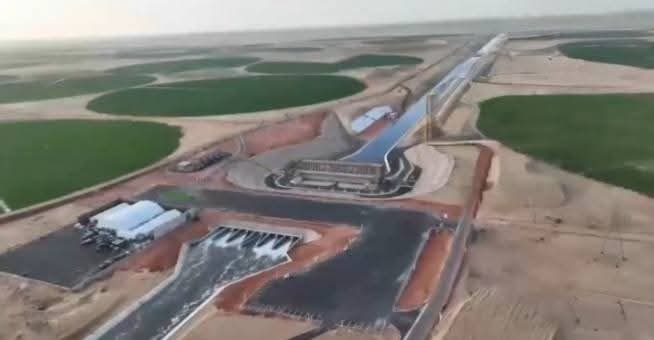
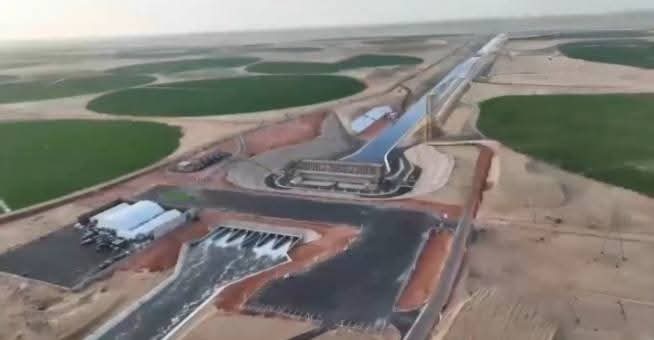
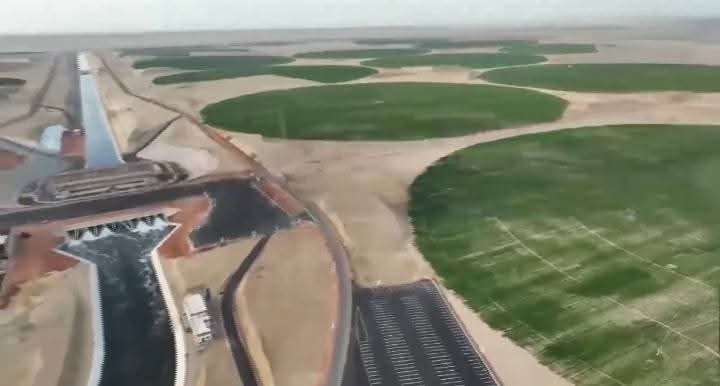
Cairo has allocated upwards of 800 billion Egyptian Pounds ($15.1 billion USD) to construct an artificial river network extending approximately 170 kilometers from the Nile basin into the Western Desert. This infrastructure, coupled with advanced center-pivot irrigation systems, has forced the arid landscape into productivity. From an aerial perspective, the stark contrast between the lush, circular green agricultural hubs and the surrounding ash-colored desert sands perfectly illustrates Egypt’s existential campaign to conquer geographic limitations through sheer fiscal and technological willpower.
- The Ethiopian Paradox: Natural Endowments vs. Utilization Gaps
In sharp contrast to Egypt’s hyper-arid constraints, Ethiopia possesses an entirely inverse geographical reality.
Renowned as the “Water Tower of East Africa,” Ethiopia is blessed with rich volcanic topsoils, highly favorable microclimates, and a network of perennial transboundary rivers.
Unlike Egypt’s capital-intensive reclamation model, Ethiopia’s soil requires no multi-billion-dollar chemical or physical conditioning to become viable; it possesses an inherent, natural readiness for high-yield cultivation.
However, historical patterns reveal a persistent gap between this natural endowment and the realization of comprehensive food security. The state has traditionally remained vulnerable to rain-fed subsistence cycles, institutional lags in large-scale irrigation deployment, and rural logistical bottlenecks. While recent initiatives in off-season wheat production mark a commendable paradigm shift toward macro-irrigation, the volume of output relative to the country’s latent, unexploited capacity indicates that Ethiopia has only scratched the surface of its agrarian power.
- Strategic Blueprints: What Ethiopia Must Synthesize from Cairo
Egypt’s aggressive infrastructure spending offers critical, high-stakes lessons for Ethiopian policymakers and regional strategists: The Securitization of Agriculture: Cairo treats food production as a zero-sum element of national defense and sovereign survival. Ethiopia must similarly elevate its agricultural strategy beyond standard poverty-reduction frameworks, treating it as a core metric of geopolitical leverage and independence.
The Institutional Shift to Macro-Irrigation:
The state must decisively transition from a reliance on unpredictable meteorological patterns to the systematic exploitation of its primary river basins (the Abbay, Awash, Omo, and Wabi Shebelle) via localized and grand-scale technological irrigation grids.
Resource Preservation and Efficiency:
While Egypt spends billions to synthetically replicate arable conditions, Ethiopia loses millions of tons of pristine topsoil annually to preventable soil erosion and downstream siltation. Enhancing watershed management and soil conservation is therefore a low-cost, high-return geopolitical imperative.
Conclusion: Beyond Political Correctness-The GERD and the Survival of 150 Million
Ultimately, Egypt’s engineered agricultural transformation underscores a profound geopolitical truth: modern agricultural dominance is a function of strategy and technology, not mere geography. Ethiopia holds in its hands the very soil and water assets that Egypt spends billions to synthetically simulate. If left unexploited, however, natural abundance yields no geopolitical dividend.
It is within this context that Ethiopia must shed traditional diplomatic hesitation often maintained for regional “political correctness” and state its sovereign objectives with absolute clarity on the global stage. The construction of the Grand Ethiopian Renaissance Dam (GERD) must no longer be framed solely through the narrow lens of hydroelectric generation.
The GERD is fundamentally a strategic hydrological regulator, vital for securing the steady water volumes required to fuel long-term domestic irrigation and downstream agricultural predictability.
With Ethiopia’s population projected to converge toward 150 million in the immediate future, food security transcends economic planning it becomes an existential matter of national survival.
To feed a demographic mass of this magnitude and sustain domestic stability, Addis Ababa possesses not only the sovereign right but the fundamental state obligation to utilize its transboundary water resources, including the Nile basin, for comprehensive irrigation frameworks.
By internalizing Egypt’s hyper-expensive mobilization as a strategic wake-up call, Ethiopia can systematically leverage its water and soil assets. Doing so will not only permanently sever the country from foreign food aid dependencies but will decisively cement its position as the anchor state of East Africa, guaranteeing its strategic autonomy for generations to come.
Editor’s Disclaimer:
The views and opinions expressed in articles published by Horn News Hub are those of the authors and do not necessarily reflect the official position or editorial stance of Horn News Hub. Publication does not imply endorsement.