

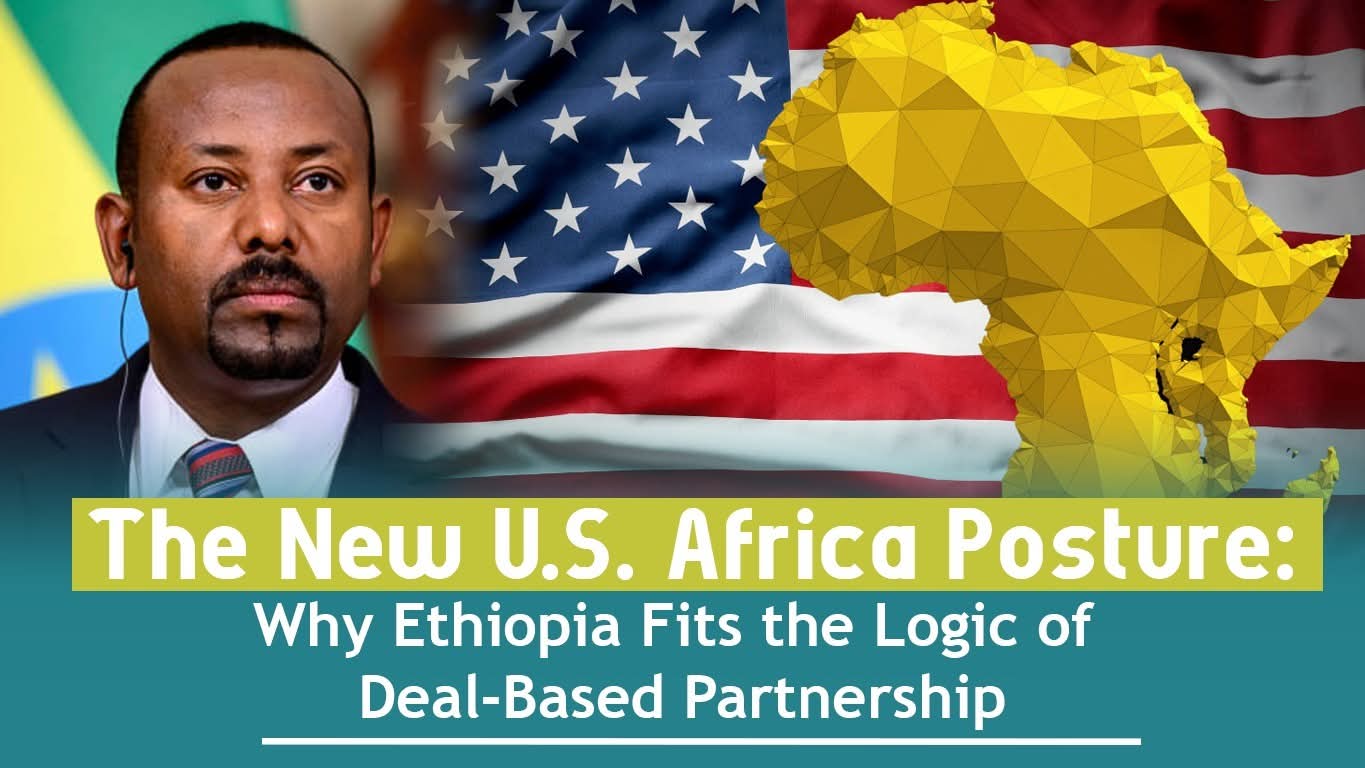
The New U.S. Africa Posture: Why Ethiopia Fits the Logic of Deal-Based Partnership
Much of the early reaction to the Trump administration’s new Africa posture has fallen into a familiar binary. Some see it as a retreat from Africa wrapped in harder language. Others present it as a welcome correction to an aid-heavy model that too often treated African states as recipients rather than strategic counterparts. Neither reading fully captures what is taking shape. What Washington appears to be signaling is not a simple disengagement, but a narrower and more openly interest-based framework: one that places commercial reciprocity, strategic utility, infrastructure, energy, and supply-chain resilience closer to the center of policy. In that setting, Ethiopia stands out as one of the African countries best positioned to fit the logic of deal-based partnership.[1]
A Diplomatic Language Ethiopia Already Understands
That fit begins with diplomatic style. Ethiopia has long approached external relations through the language of sovereignty, reciprocity, and practical advantage. It has generally preferred relationships defined by negotiated interests and mutual gain rather than donor hierarchies or externally scripted political frameworks. That instinct now sits more comfortably with the tone coming from Washington. In remarks published under the title “America First in Africa,” Senior Bureau Official Nick Checker described a U.S. reset based on “mutually beneficial partnerships rather than aid, dependency,” a formulation that matters because it reframes the relationship away from development paternalism and toward reciprocal bargaining. Even in snippet form, the line is revealing. It tells African capitals that Washington wants tangible returns and partners that can operate as strategic actors in their own right.[1]
The Powering Africa Summit and the New U.S. Signal
The setting of those remarks is important. Checker delivered them in connection with the Powering Africa Summit, a recurring U.S.-Africa energy and investment forum that brings together government officials, financiers, infrastructure players, development agencies, and private firms around bankable deals in power, transmission, critical minerals, and related infrastructure. The 2026 agenda made the direction of travel especially plain. One featured session, “Powering the Future of the U.S.-Africa Energy Partnership,” was explicitly framed around what had been achieved since the previous summit, how U.S. foreign policy had shifted under the current administration, and how a more profit-driven, investment-led commercial diplomacy was shaping reciprocal partnerships in energy and infrastructure. The summit’s own language emphasized capital deployment, commercial execution, critical minerals, and infrastructure strategy rather than the older vocabulary of assistance.[2]
Why Ethiopia Stands Out
That context makes Ethiopia particularly relevant. Ethiopia can offer something the new U.S. approach appears to value: scale, reform momentum, market size, strategic location, and a state narrative centered on production rather than dependence. It is one of the few countries in the region that can plausibly present itself at once as a large consumer market, a future industrial platform, a major infrastructure story, and a consequential security actor. In a period when Washington seems increasingly inclined to ask what concrete strategic value a partner brings, Ethiopia can answer with more than diplomatic goodwill. It can point to growth potential, regional relevance, and sectors that align directly with current U.S. priorities.
Reform Momentum and Economic Credibility
The economic side of that case has become stronger over the past two years. The IMF said in January that Ethiopia’s reform program was yielding “better-than-anticipated macroeconomic outcomes,” citing strong growth, exports, revenue mobilization, reserves accumulation, and declining inflation. The Fund also linked the reform path to the broader aim of restoring macroeconomic stability and laying the foundations for high, private sector-led growth. The World Bank has reinforced that direction, backing Ethiopia’s transition toward a more inclusive and private sector-led growth model through a $1 billion development policy operation. These are not small markers. They suggest that Ethiopia’s economic reform agenda is no longer being read merely as an aspiration, but increasingly as a process generating visible progress.[3]
That progress should be discussed with appreciation and sobriety. Ethiopia still faces real pressures, but the recent trajectory matters. It has worked to modernize the foreign-exchange regime, strengthen revenue mobilization, improve macroeconomic management, and widen the space for private-sector activity. The significance of these steps goes beyond technical reform. In the emerging U.S. framework, countries will likely be judged less by need and more by whether they can absorb investment, sustain commercial engagement, and support long-term strategic projects. Ethiopia’s reform record gives it a stronger platform from which to make that case.[4]
Food Sovereignty as Strategic Capacity
Agriculture adds another layer to Ethiopia’s strategic fit. Ethiopia’s food-sovereignty drive, particularly around wheat, has become one of the clearest expressions of a broader national ambition: to reduce structural dependence and expand productive self-reliance. Official Ethiopian materials describe major gains in wheat production and present those gains as part of a wider effort to strengthen food security, reduce imports, and deepen the domestic agricultural value chain. For Washington, this is relevant not only because food systems matter in themselves, but because they signal something larger about state capability. A country that can organize policy around import substitution, rural production, and value-chain development appears less as a perpetual humanitarian file and more as an economy trying to build resilience from within. That is exactly the kind of signal that resonates in a more transactional external environment.[5]
Untapped Minerals and a New Geoeconomic Relevance
Mining and strategic minerals present a further opening. As global competition intensifies around critical minerals and diversified supply chains, countries with untapped mineral potential have begun to acquire new strategic visibility. Ethiopia is increasingly presenting itself in those terms. Investment-facing Ethiopian materials highlight mining among the country’s priority sectors and emphasize untapped potential, including in minerals relevant to future industrial and technological supply chains. In that context, Ethiopia’s untapped rare earth potential can be understood not as a marginal talking point but as part of a broader geoeconomic story. A United States that is more focused on supply-chain resilience, industrial competitiveness, and trusted sourcing will naturally look with greater interest at African states able to position themselves within that landscape. Ethiopia has a credible basis for doing so.[6]
Energy, Infrastructure, and the Logic of Bankable Partnership
Energy and infrastructure strengthen that case even further. The Powering Africa Summit was not simply a conference backdrop for a policy speech. It was a useful window into how Washington increasingly wants to think about the continent: through investable projects, commercial diplomacy, bankable infrastructure, and long-horizon strategic sectors. Ethiopia fits that logic because its development story is inseparable from energy expansion, logistics, transport corridors, industrial parks, and rising demand for modern infrastructure. It is exactly the kind of economy that can engage a deal-based U.S. policy not as a passive recipient but as a negotiating partner seeking capital, technology, market access, and industrial spillovers.[2]
Security Weight and Regional Relevance
Security is the second major area of alignment. Whatever new language Washington uses, Africa policy still turns on familiar strategic questions: stability, maritime access, trade corridors, counterterrorism, and the containment of regional disorder. Ethiopia remains central to all of these in the Horn and the wider Red Sea-connected space. By population, military weight, geography, and political influence, it is too large and too central to be treated as peripheral. If the United States wants durable partners in eastern Africa who matter to corridor security and regional stability, Ethiopia will inevitably rank high in that calculation. That does not mean Washington and Addis Ababa will agree on every issue. It does mean that Ethiopia enters this moment with structural relevance that few states can match.
How Ethiopia Should Approach the Opening
The diplomatic opportunity, then, is real. But it will reward discipline. Ethiopia should approach this opening with a clear sense of what it wants to secure. It should present itself not as a country asking for accommodation, but as a strategic platform offering reform momentum, productive capacity, market scale, infrastructure need, and regional relevance. It should focus U.S. engagement around a few high-value sectors where interests clearly converge: energy systems, agro-processing, logistics, digital infrastructure, and minerals. It should seek not only capital, but also technology transfer, skills development, and value addition inside Ethiopia. In a deal-based environment, the quality of the bargain matters as much as access to the table.[1][2]
From Reform Narrative to Strategic Proposition
Just as importantly, Ethiopia should translate reform momentum into administrative confidence. External investors and policymakers will respond not only to growth numbers or positive narratives, but to clarity in licensing, contract enforcement, foreign-exchange rules, taxation, and the practical ease of doing business. The more predictable Ethiopia becomes, the more powerful its strategic story will be. This is where macroeconomic reform, food-sovereignty gains, investment promotion, and the country’s untapped rare earth potential can be woven together into a coherent national proposition: Ethiopia as a sovereign partner open to serious deals that serve both its own transformation and the commercial priorities of major powers.[4][5][6]
An Opening Suited to Ethiopia’s Diplomatic Instinct
What is emerging from Washington, then, is not simply a harder slogan. It is a narrower geopolitical offer: partnership based on tangible return. For Ethiopia, that may prove less constraining than older aid-centered approaches because it aligns more closely with Addis Ababa’s own preference for reciprocal, interest-based statecraft. The opportunity is not automatic, and it should not be romanticized. But it is significant. A country with reform momentum, food-production gains, untapped mineral potential, regional weight, and a strong instinct for sovereign bargaining is well positioned for a moment in which the United States appears to value deals more than declarations. If Ethiopia moves with clarity and confidence, it may find that the new U.S. Africa posture is not a narrowing of possibility, but an opening tailored to the logic it understands best.[1][3][5][6]
Footnotes
[1] U.S. Department of State, “America First in Africa,” remarks by Senior Bureau Official Nick Checker.
Source፡ IFA
Editor’s Disclaimer:
The views and opinions expressed in articles published by Horn News Hub are those of the authors and do not necessarily reflect the official position or editorial stance of Horn News Hub. Publication does not imply endorsement.