

Mekelle/Tel Aviv/Nairobi/Pretoria/London
Refugee Response in Ethiopia Nears Crisis as Funding Shortfalls Threaten 1.1 Million Lives
Addis Ababa, December 19, 2025 — Ethiopia’s refugee response is facing a severe crisis, with humanitarian agencies warning that life-saving services for more than 1.1 million refugees could halt within weeks due to critical funding gaps.
In a joint statement, the Government of Ethiopia’s Refugees and Returnees Service (RRS), the UN Refugee Agency (UNHCR), and the World Food Programme (WFP) said the refugee system is approaching a breaking point as resources dry up amid rising needs.
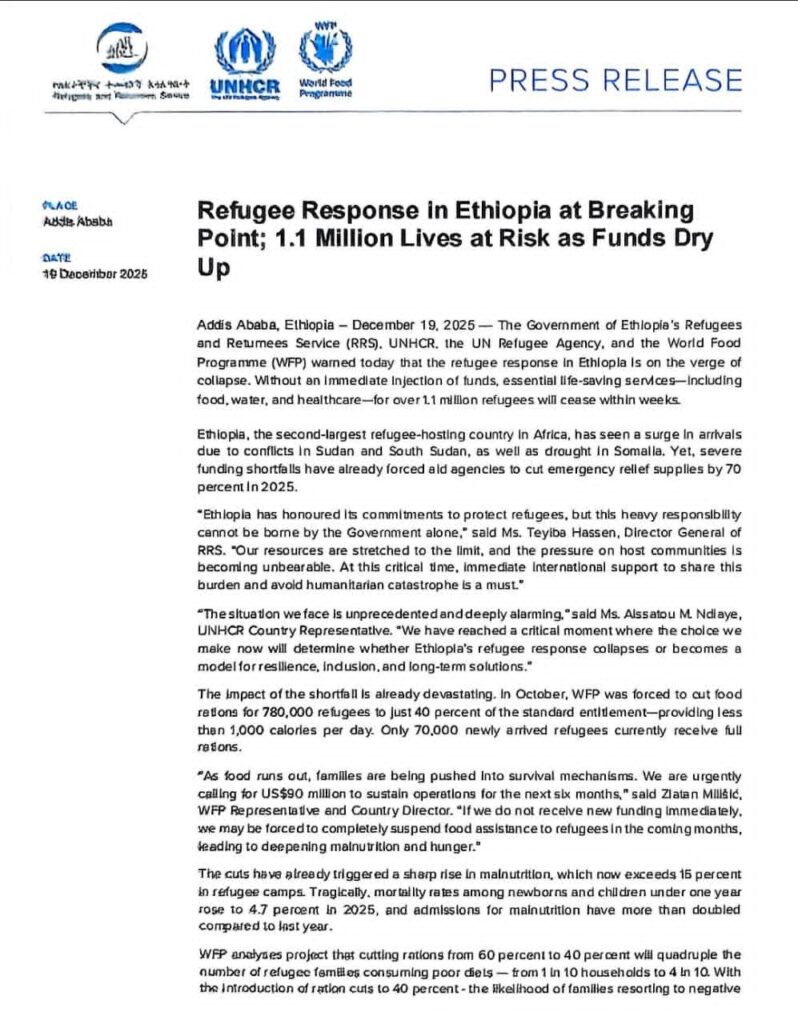
Ethiopia is currently the second-largest refugee-hosting country in Africa, sheltering people displaced by conflict in Sudan and South Sudan, as well as drought and instability in Somalia. Despite the growing caseload, humanitarian funding has fallen sharply, forcing agencies to cut emergency assistance by about 70 percent in 2025.
Officials say the strain is already evident. In October, WFP reduced food rations for roughly 780,000 refugees to 40 percent of the standard entitlement, providing less than 1,000 calories per person per day. Only about 70,000 newly arrived refugees are receiving full food assistance.
WFP has warned that without an additional US$90 million to sustain operations over the next six months, food assistance could be suspended entirely in the coming months. Such a move, the agency says, would significantly worsen hunger and malnutrition across refugee settlements.
Health indicators are also deteriorating. Malnutrition rates in refugee camps have surpassed 15 percent, while mortality among newborns and children under one year reached 4.7 percent in 2025. Admissions for malnutrition treatment have more than doubled compared to the previous year.
According to WFP analysis, reducing food rations from 60 percent to 40 percent is expected to quadruple the number of refugee households consuming poor diets, rising from one in ten to four in ten families. Aid agencies report that many households are increasingly resorting to negative coping mechanisms, including skipping meals, reducing children’s food portions, selling remaining assets, and sending children into labor or early marriage.
The funding shortfall is also affecting water and education services. Refugees now receive an average of 12 to 14 liters of water per person per day, with some areas dropping to as low as five liters—well below the international emergency standard of 15 liters. At the same time, funding for 57 primary schools serving approximately 110,000 refugee children has been exhausted. These schools are scheduled to close at the end of December 2025.
Humanitarian agencies stress that schools play a critical protective role beyond education. Their closure, they warn, could expose tens of thousands of children to heightened risks of exploitation, including child labor, trafficking, and early marriage.
The Government of Ethiopia, UNHCR, and WFP have urged international donors to step up support, emphasizing that Ethiopia has continued to host refugees despite mounting economic and social pressures.
Aid agencies caution that without immediate and sustained financial assistance, the humanitarian situation could deteriorate rapidly, reversing years of progress and placing an already vulnerable population at further risk.
Editor’s Disclaimer:
The views and opinions expressed in articles published by Horn News Hub are those of the authors and do not necessarily reflect the official position or editorial stance of Horn News Hub. Publication does not imply endorsement.