
Opinion: From Pretoria to Tsimdo: Tigray’s constitutional integrity, limits of external patronage
Addis Abeba — The question of Tigray’s constitutional territorial integrity and the right to self-determination lies at the heart of Ethiopia’s ongoing political crisis. These are legal, political, and moral claims anchored in the 1995 Ethiopian Constitution and in the lived realities of the Tigrayan people. Addressing them requires seriousness, clarity, negotiation, and respect for law not external interference or proxy strategies that undermine the very goals they purport to serve.
Historical experience shows that foreign involvement in Ethiopia’s internal disputes, especially military intervention, almost invariably results in catastrophic humanitarian consequences and deeper political fragmentation. Any credible political process must therefore be rooted in domestic constitutional mechanisms and internal negotiation.
Constitutional legitimacy of self-determination
Tigray’s claims to territorial integrity, political autonomy, and meaningful self-determination derive their legitimacy from Ethiopia’s constitutional framework. Article 39 of the 1995 Constitution explicitly recognizes the right of nations, nationalities, and peoples to self-determination, including the right to secession through legal procedures involving regional council approval and a referendum organized by the federal government.
Recommended News


This constitutional pathway demonstrates that genuine self-determination is not a matter for foreign sponsors to decide; it is a legal right exercised by the people it affects. When these claims are advanced through foreign alliances that serve external agendas, they lose moral and political legitimacy and invite a host of unintended and often deadly consequences.
The Pretoria Peace Agreement, signed on 2 November 2022 between Ethiopia’s federal government and the former Tigray People’s Liberation Front (TPLF) under international auspices, represents a legitimate framework for ending hostilities and restoring constitutional governance in Tigray.
The Agreement reaffirmed Ethiopia’s sovereignty and territorial integrity, committed to the withdrawal of all foreign and non-Ethiopian National Defense Force (ENDF) forces from Tigray, and designated the ENDF as the sole military authority responsible for securing federal and regional borders. It also outlined mechanisms for disarmament, demobilization, and reintegration (DDR), and for restoring essential services.
However, implementation of the agreement has been uneven, and continuing challenges include incomplete withdrawal of irregular forces and gaps in transitional justice. These implementation deficits weaken confidence in constitutionally grounded processes and embolden spoilers both inside and outside Tigray.
Tragedy of external militarization
One of the most troubling elements in the trajectory of the war in Tigray has been the active participation of the Eritrean regime alongside Ethiopian federal forces. Multiple international investigations, including reporting by independent media, human rights organizations, and U.S. government assessments, have documented credible allegations of mass extrajudicial killings, sexual violence, and actions that may amount to crimes against humanity or even genocide in Tigray by Eritrean forces.
Communities across Tigray reported systematic slaughter in towns such as Axum and widespread abuses in rural areas, with credible testimony pointing to the active involvement of Eritrean troops. These acts have left deep psychological and social scars and continue to fuel mistrust toward Eritrean actors.
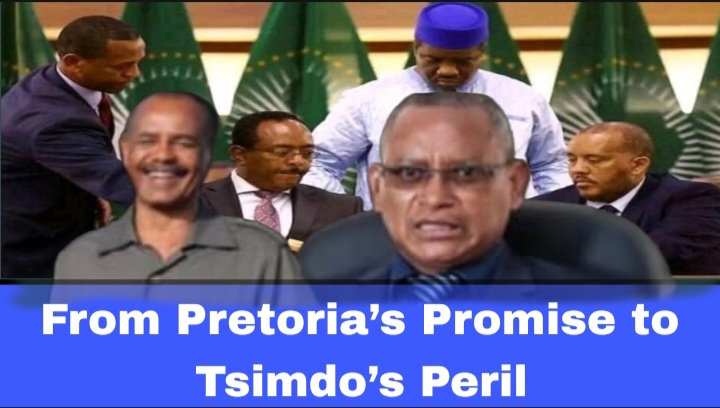
Given this background, the tactical alliance known colloquially as “Tsimdo”referring to the cooperation between certain TPLF factions and the Eritrean government is profoundly ironic and deeply concerning. To seek assistance from a regime complicit in atrocities that devastated the region is not only morally fraught; it undermines the very legitimacy of the struggle for self-determination.
Alliances with actors implicated in grave abuses erode Tigray’s claims to justice, tarnish political credibility, and make reconciliation with other Ethiopian communities far more difficult. Moreover, they contravene the principle of non-complicity in international law, which prohibits benefitting from the wrongful acts of others.
In effect, Tsimdo transforms what should be a constitutional and political struggle into a form of proxy warfare with actors whose interests may run counter to Tigray’s long-term stability and dignity. It perpetuates cycles of violence and replicates the same external dependency that Ethiopians have historically resisted.
Self-determination vs. proxy warfare
A fundamental distinction must be made between self-determination as a constitutional right and destabilization as a political strategy. True self-determination seeks security, justice, and political agency through lawful channels. Proxy warfare especially when it invites actors previously implicated in atrocities transforms legitimate claims into instruments of external power struggles that derail political solutions.
No credible scenario exists in which alliances with external actors that benefit from Ethiopia’s fragmentation can deliver durable self-determination for Tigray. Agreements produced amid externally induced instability tend to be temporary, contested, and reversible.
The reliance on destabilizing external actors carries profound moral and strategic costs. Constitutional struggles become regional bargaining chips, sympathy for legitimate claims erodes, and opposition hardens across Ethiopia.
Civilians the very people whom the struggle seeks to protect pay the greatest price. Reducing Tigray’s quest for justice to a geopolitical contest diminishes its moral weight and threatens long-term stability. It alienates potential domestic allies and reinforces narratives used by opponents to delegitimize Tigray’s constitutional claims.
Path Forward: Internal negotiation over external interference
A durable resolution to Tigray’s territorial integrity and political status can only emerge from processes that are internal, negotiated, and insulated from foreign coercion and militarization. This does not mean abandonment of legitimate claims but rather insisting that they be addressed within Ethiopia’s constitutional framework and through full implementation of agreements like Pretoria.
This approach requires political courage, patience, and a willingness to compromise. It calls for the full implementation of the Pretoria Agreement, including the withdrawal of non-ENDF forces and the restoration of constitutional governance. It necessitates the establishment of credible transitional justice mechanisms to address wartime atrocities without external interference. It demands inclusive dialogue among Ethiopian communities to resolve legitimate grievances while upholding the constitutional order. Finally, it requires the rejection of alliances with actors implicated in crimes, including the categorical severing of ties that compromise moral and legal legitimacy.
In conclusion, there is no sustainable exit from Ethiopia’s crisis through destabilization neither for the country as a whole nor for Tigray in particular. The pursuit of self-determination through alliances that profit from chaos undermines the very objectives it claims to serve. Tigray’s future, like Ethiopia’s, cannot be secured through actors whose power depends on its vulnerability or chaos. It must be forged through internal legitimacy, constitutional struggle, and political agency rooted in the will of the people, not the calculations of external patrons.
Durable autonomy lies in honoring and implementing the Pretoria Agreement, rejecting foreign militarization, including the tactics behind Tsimdo, and pursuing self-determination through internal, constitutional, and negotiated mechanisms. Tigray’s stability, sovereignty, and dignity depend not on foreign patrons but on the principled, lawful exercise of political authority by Tigrayans themselves in partnership with the Ethiopian state and its constitutional framework.
Editor’s Note: Dr. Tsegazeab Kahsu, MD, MPH, is a physician and public health professional with extensive experience in both clinical care and public health practice. He previously served as Chairman and as a member of the National Congress of Great Tigray (Baytona), where he actively participated in policy discussions and political advocacy. Dr. Kahsu can be reached at tkahsu@gmail.com.