

Mekelle/Tel Aviv/Nairobi/Pretoria/London
Ethiopia’s Central Bank Holds Policy Rate at 15 Percent, Tightens Liquidity Controls
Addis Ababa, December 30, 2025
The National Bank of Ethiopia has decided to maintain a tight monetary policy stance as inflation continues to ease but remains above the central bank’s single digit target.
The decision was announced following the fifth meeting of the Monetary Policy Committee, held on December 22, 2025, and formally approved by the NBE Board, according to a statement released on Tuesday.
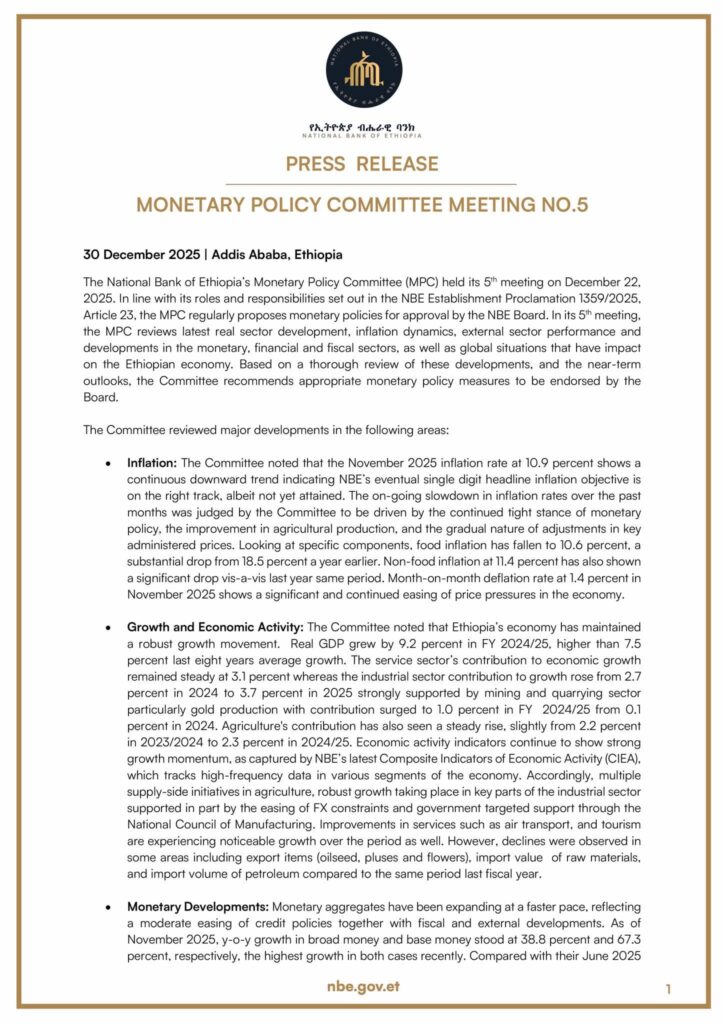
The Committee reported that headline inflation declined to 10.9 percent in November 2025, extending a downward trend seen over recent months. Food inflation fell sharply to 10.6 percent from 18.5 percent a year earlier, while non food inflation declined to 11.4 percent. Month on month prices contracted by 1.4 percent in November, which the central bank said reflects easing price pressures across the economy.
Despite the progress, the Committee said inflation has not yet reached the desired single digit level and stressed that maintaining a tight policy stance remains necessary.
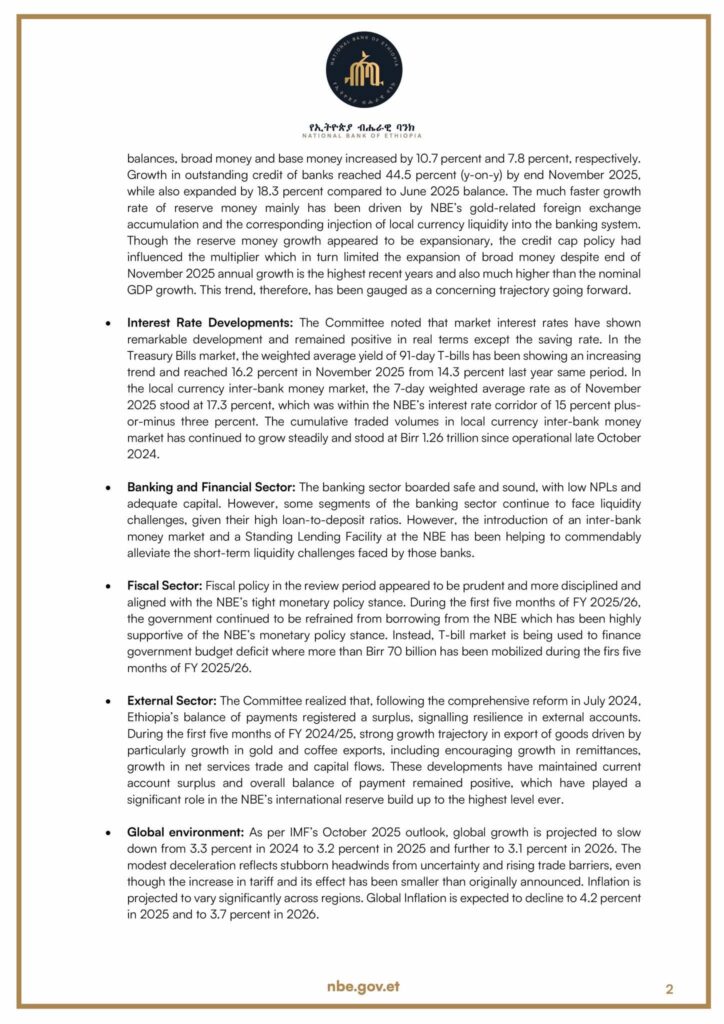
On growth, the NBE said Ethiopia’s economy continued to expand strongly, with real GDP growth reaching 9.2 percent in the 2024/25 fiscal year, well above the eight year average of 7.5 percent. The industrial sector recorded a notable improvement, supported largely by increased gold production, while agriculture and services also posted steady gains. However, the central bank noted declines in some export items and reduced imports of raw materials and petroleum compared to the previous fiscal year.
Monetary conditions showed rapid expansion, with broad money growing by 38.8 percent year on year and reserve money by 67.3 percent as of November 2025. Bank credit expanded by 44.5 percent, the highest level recorded in recent years. The NBE attributed the surge in reserve money mainly to gold related foreign exchange accumulation, which injected liquidity into the banking system. While credit caps helped limit the broader impact, the Committee warned that current trends pose risks if left unchecked.
Interest rates in money markets remained positive in real terms, except for savings deposits. The yield on 91 day Treasury bills rose to 16.2 percent in November, while the interbank money market rate stood at 17.3 percent, within the NBE’s policy corridor. Trading volumes in the interbank market continued to grow, reaching 1.26 trillion birr since its launch in late 2024.
The banking sector was described as generally stable, with low non performing loans and adequate capital levels, though some banks continue to face liquidity pressures. The central bank said new facilities, including the interbank market and standing lending facility, have helped ease short term liquidity constraints.
On fiscal policy, the Committee said government spending remained disciplined and aligned with the central bank’s monetary stance. During the first five months of the 2025/26 fiscal year, the government refrained from borrowing from the NBE and instead raised more than 70 billion birr through Treasury bills to finance the budget deficit.
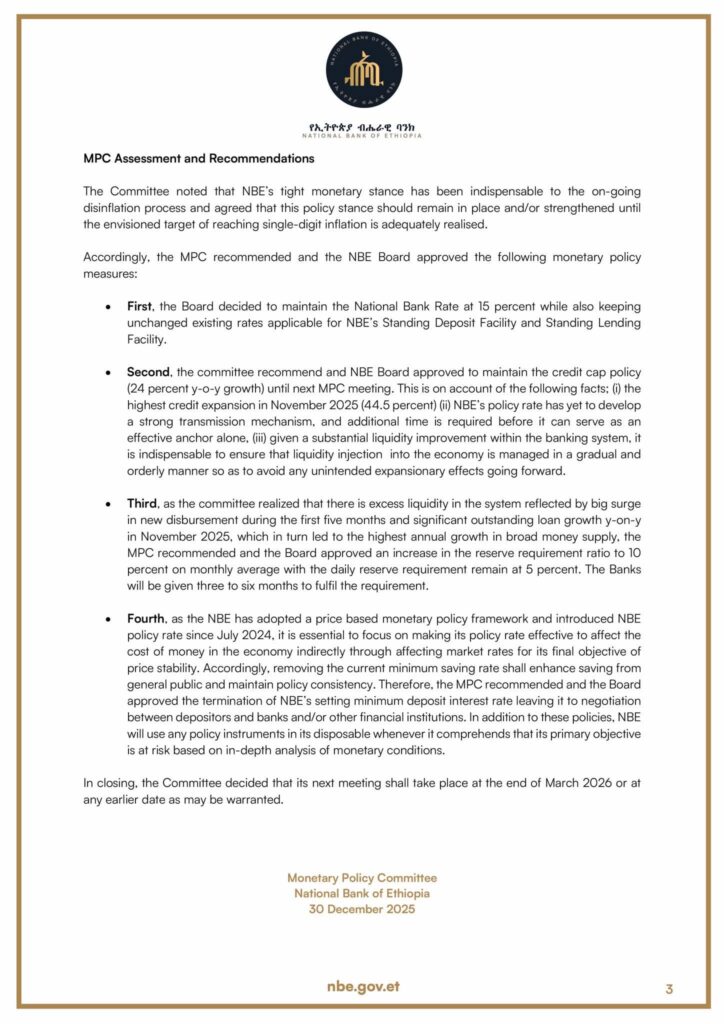
External sector performance also improved. Following reforms introduced in July 2024, Ethiopia recorded a balance of payments surplus, supported by rising gold and coffee exports, stronger remittance inflows and improved services trade. These developments contributed to the build up of international reserves to what the NBE described as a record high level.
Globally, the Committee cited IMF projections showing modest slowing in global growth over the next two years, alongside a gradual decline in global inflation.
Based on its assessment, the Monetary Policy Committee recommended several measures, all approved by the NBE Board. The central bank kept its policy rate at 15 percent and maintained existing standing facility rates. It also extended the credit cap of 24 percent annual growth until the next MPC meeting, citing high credit expansion and the need for better policy transmission.
To address excess liquidity, the NBE raised the reserve requirement ratio to 10 percent on a monthly average basis, while keeping the daily requirement at 5 percent. Banks will have between three and six months to comply.
In a significant policy shift, the central bank also removed the minimum savings deposit rate, allowing banks and depositors to negotiate rates freely. The NBE said the move is intended to strengthen the effectiveness of its price based monetary policy framework and encourage savings.
The Committee said it stands ready to use additional policy tools if price stability comes under threat. The next MPC meeting is scheduled for the end of March 2026, or earlier if conditions require.
Editor’s Disclaimer:
The views and opinions expressed in articles published by Horn News Hub are those of the authors and do not necessarily reflect the official position or editorial stance of Horn News Hub. Publication does not imply endorsement.