
Mekelle/Tel Aviv/Nairobi/Pretoria/London
Isaias Afwerki’s Rhetoric Signals Anxiety Amid Shifting Power Dynamics in the Horn of Africa
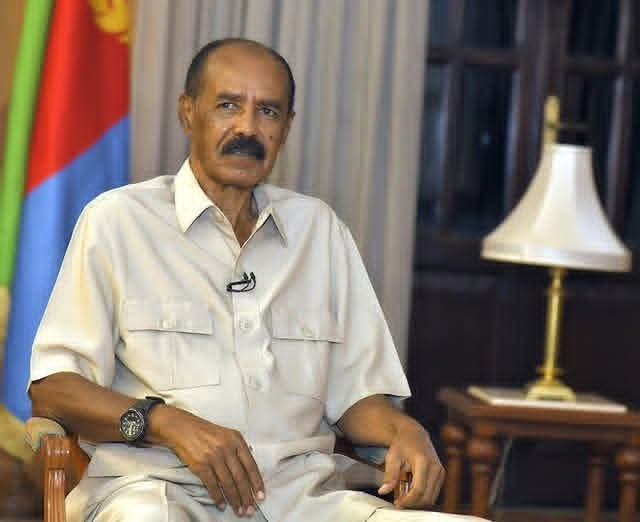
Recent public remarks by Eritrean President Isaias Afwerki have drawn regional attention for their unusually harsh tone toward the Ethiopian government. In a series of interviews, Afwerki described Ethiopia’s leadership using language that included accusations of laziness, greed, weakness, and incompetence. Observers note that this marks a departure from his historically opaque and cautious communication style, raising questions about the political context behind the shift.
Political analysts argue that such rhetoric reflects strain rather than confidence. In authoritarian systems, sharp verbal attacks are often interpreted as indicators of strategic anxiety, particularly when leaders face diminishing leverage or rapidly changing regional realities.
Contradictions at the Core of Power
Afwerki has governed Eritrea for more than three decades without a ratified constitution, national elections, or an operational parliament. Against this backdrop, his public criticism of other governments for alleged power obsession has been widely described as contradictory. Scholars of political behavior point out that projection is a common phenomenon among long serving leaders facing legitimacy erosion, especially when institutional accountability is absent at home.
Rhetoric as a Measure of Strategic Constraint
The use of personal insults in political discourse is frequently viewed by analysts as a sign of narrowing options. Diplomatic language tends to harden when leaders perceive declining influence or lack effective policy responses. In Eritrea’s case, the country remains diplomatically isolated, shaped by the legacy of international sanctions and ongoing allegations of war crimes and crimes against humanity linked to the northern Ethiopia conflict.
These conditions have limited Eritrea’s room for maneuver in regional diplomacy, a reality that regional observers say is increasingly evident in the tone of its leadership.
An Aging Leadership and Heightened Political Pressure
At over eighty years old, Afwerki presides over a state confronting both internal fatigue and external pressure. Political psychologists note that prolonged rule under constant security stress often results in more confrontational behavior, particularly when long standing strategies begin to unravel.
Two developments are frequently cited as especially destabilizing for Asmara. First is the rejection by large segments of the Tigrayan population of coercive political alliances and militarized governance models that have imposed significant civilian costs. Second is the weakening of Fano, an armed militia in Ethiopia that analysts describe as having previously served as a disruptive force within Ethiopia’s internal security landscape.
The decline of these actors has reduced Eritrea’s indirect influence in Ethiopian affairs.
Diminishing Proxy Leverage
With both the TPLF and Fano no longer functioning as effective instruments of pressure, Eritrea’s strategic position has narrowed considerably. Security analysts note that without proxy forces acting as buffers, Eritrea faces increased exposure in the event of heightened interstate confrontation. This vulnerability has become a central feature of current assessments of Eritrea’s security posture.
A Technological Gap in Military Capabilities
The regional military balance has also shifted. Ethiopia has invested heavily in modernizing its armed forces, including domestic drone manufacturing, artificial intelligence supported systems, cyber capabilities, and integrated air power. This modernization has reportedly been complemented by advanced platforms sourced from multiple international partners.
By contrast, Eritrea’s military structure remains rooted in a liberation era doctrine that emphasizes manpower over technology. Analysts describe the resulting capability gap as structural and widening, with long term implications for deterrence and defense planning in the Horn of Africa.
Maritime Strategy and Regional Realignments
Ethiopia’s pursuit of sovereign access to the Red Sea has further altered regional calculations. Officials in Addis Ababa have framed this ambition as an economic and strategic necessity rather than a territorial claim. At the regional level, new alignments involving Gulf states, Somaliland, and Israel have reshaped maritime security discussions.
For Eritrea, these developments threaten to weaken its traditional leverage over regional trade routes, potentially exposing the country to increased economic and political pressure.
Legal and Diplomatic Exposure
Eritrea’s legal position has also come under renewed scrutiny. While Eritrean officials have argued that the Algiers Agreement has lost validity, international legal assessments point instead to Eritrea’s own violations. Reports from late 2024 and early 2025 indicate that Eritrean forces remain present in parts of northern Tigray, despite the November 2022 peace agreement that required the withdrawal of all foreign troops.
This continued presence, combined with documented abuses, has further complicated Eritrea’s standing under international law and reinforced its diplomatic isolation.
Conclusion
Observers increasingly interpret President Isaias Afwerki’s confrontational rhetoric as a reflection of declining strategic coherence rather than renewed strength. While Eritrea has not faced direct military defeat, analysts argue that its leadership is confronting a convergence of legitimacy challenges, technological disadvantage, and regional realignments.
As the Horn of Africa enters a phase shaped by digital military capabilities, maritime economics, and multilateral security frameworks, Eritrea’s long standing governance model appears increasingly out of step with prevailing trends. Whether this transition results in internal reform or deeper isolation remains an open question, but few analysts dispute that the regional landscape is moving decisively beyond the era that brought Afwerki to power.
Author
Dr. Dawit Tesfay
Institutional Policy and Religion State Relations Researcher
Post War Military and Security Affairs Expert
Institution
Horn of Africa Geopolitical Review HAGR
Independent Regional and International Geostrategy Security Military and Political Analysis
———-
Editor’s Disclaimer:
The views and opinions expressed in articles published by Horn News Hub are those of the authors and do not necessarily reflect the official position or editorial stance of Horn News Hub. Publication does not imply endorsement.