

“I Am Surprised by the Infrastructure in Ethiopia”: A Viral Reaction and the Deeper Story of Addis Ababa’s Transformation
“I am surprised by the infrastructure in Ethiopia.”
When American online streamer IShowSpeed made that remark during his visit, it sounded spontaneous. Yet his reaction reflects a broader reality unfolding in Addis Ababa, a capital city undergoing one of the most ambitious urban transformations in its history.
For years, Ethiopia’s international image has been shaped largely by reports of conflict, drought, and political instability. Rapid urban development has received far less global attention. Visitors arriving in Addis Ababa today, however, often encounter a city that challenges those assumptions. Expanded corridors, modern commercial towers, landscaped public squares, and large digital screens signal a city determined to redefine itself.
IShowSpeed described the architecture as futuristic yet distinctly Ethiopian. That observation touches on a key feature of the capital’s transformation. Urban development in Addis Ababa has not been framed merely as modernization for its own sake. City planners have sought to combine contemporary design with national character, integrating local motifs and symbolic forms into new structures. The aim has been to project confidence without erasing identity.
At the center of this shift is Adanech Abiebie, whose administration has positioned infrastructure as both an economic driver and a governance reform tool. Under her leadership, large-scale corridor development projects have expanded road networks, pedestrian walkways, bicycle lanes, and public lighting systems. These initiatives are designed to reduce congestion, improve mobility, and reorganize commercial activity across the city.
Urban economists note that infrastructure in rapidly growing capitals often functions as a catalyst for broader economic change. In Addis Ababa, redevelopment projects have generated employment in construction, logistics, retail, and small-scale manufacturing. Municipal authorities report that improvements in digital tax administration and revenue collection systems have strengthened the city’s fiscal base without significant rate increases. The emphasis on digitization reflects a governance model focused on efficiency and accountability.
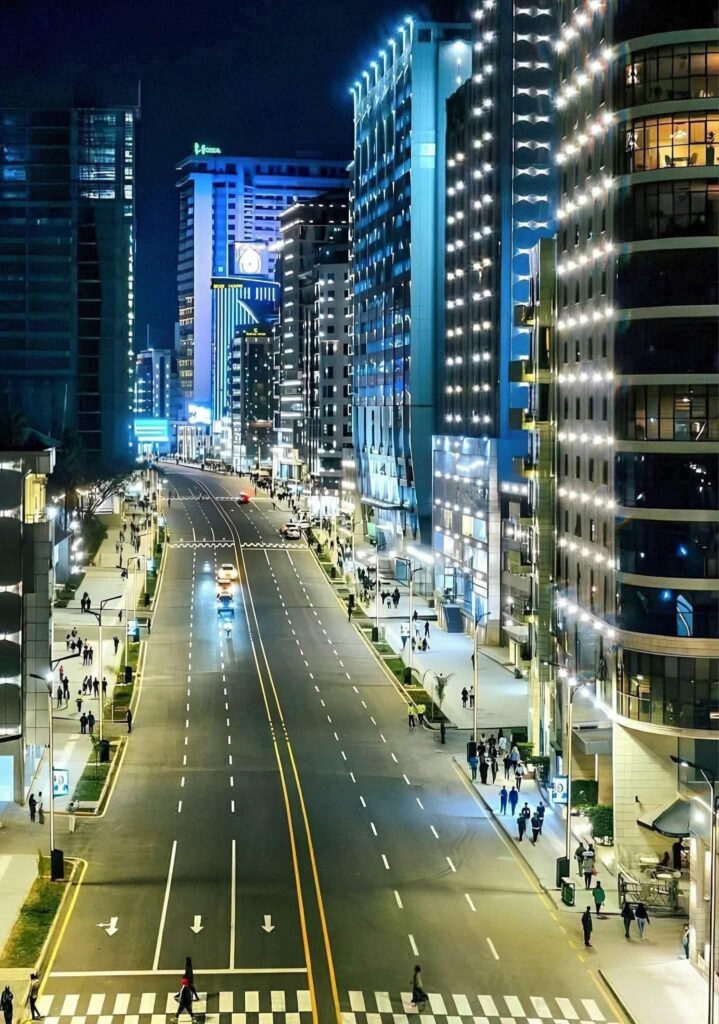
City officials frequently describe this period as a structural reset. Beyond physical construction, reforms have targeted administrative discipline, performance measurement, and long-term planning. Addis Ababa’s new strategic frameworks aim to guide compact urban growth, expand technology integration, and improve environmental management. As the diplomatic capital of Africa and Ethiopia’s primary economic hub, the city carries symbolic and strategic importance. Its transformation is therefore closely tied to national ambition.
Yet the process is not without tension. Rapid redevelopment in densely populated areas can place pressure on informal settlements and low-income residents. Questions around affordability, housing access, and equitable service delivery remain central to the debate. Sustainable transformation requires more than visible infrastructure. It demands inclusive policies that protect vulnerable communities while sustaining growth.
IShowSpeed’s reaction extended beyond architecture. He praised Ethiopian traditional dances, describing their intensity and physical energy. That cultural encounter underscores another dimension of Addis Ababa’s evolution. Even as the skyline changes, cultural expression remains deeply rooted in daily life. Public performances and traditional arts continue to anchor social identity amid structural modernization.
The phrase “I am surprised by the infrastructure in Ethiopia” resonates because it captures a shift in perception. Addis Ababa is no longer seen only through the prism of crisis. It is increasingly recognized as a city in motion, experimenting with governance reform, economic restructuring, and identity-driven urban design.
Whether this momentum translates into durable and inclusive prosperity will depend on consistent leadership, institutional capacity, and careful social policy.

What is clear is that Addis Ababa is engaged in a deliberate effort to reshape its landscape and narrative. For some visitors, that effort is unexpected. For city leaders and planners, it is the result of calculated ambition aimed at redefining the future of Ethiopia’s capital.
Online streamer IShowSpeed shared his reaction after trying Ethiopian coffee during a live broadcast, describing it as an unusually intense and energizing experience. He said the drink left him highly active throughout the stream, adding that it amplified both his movements and engagement with the crowd.
Ethiopia is widely regarded as the birthplace of coffee, where the beverage is central to daily life and traditional ceremonies. The country is also often noted in historical discussions as one of the few African nations that largely avoided long-term colonization, aside from the Italian occupation between 1936 and 1941.
Editor’s Disclaimer:
The views and opinions expressed in articles published by Horn News Hub are those of the authors and do not necessarily reflect the official position or editorial stance of Horn News Hub. Publication does not imply endorsement.