


Mekelle/Tel Aviv/Nairobi/Pretoria/London፡
Courage, Institutional Trust, and the Quiet Architecture of Ethiopia’s Development
By Chekole Alemu
In Ethiopia’s development narrative, public attention often settles on mega-projects, political figures, or headline infrastructure. Less visible, but no less decisive, are the institutions and individuals who convert national ambition into operational reality. GIZE PLC / Freight Logistics is one such institution. At its center stands Gizeshwork Tesema, a business leader whose career reflects resilience, principled leadership, and a rare alignment between private enterprise and national purpose.

Established in 2001, GIZE PLC has operated continuously for nearly twenty-five years across logistics, freight forwarding, shipping, and project cargo. Its growth has not been sudden or speculative. Instead, it has followed Ethiopia’s own development path, beginning with public-sector supply and competitive tenders, then expanding into complex industrial, infrastructure, and institutional logistics.
Building Credibility Through Institutions, Not Shortcuts
GIZE PLC earned its position through formal procurement systems, regulatory compliance, and delivery under scrutiny. In its early years, the company competed directly with established players in government tenders, including vehicle supply contracts for regional administrations. These wins were not symbolic. They required adherence to procurement law, financing structures, and delivery timelines under public oversight.

This foundation shaped the company’s institutional discipline. When GIZE later moved into heavy logistics and mega-projects, it already understood how to operate within audits, foreign-exchange controls, customs regimes, and bank supervision.
That discipline became a defining advantage in donor-funded and multilateral environments. One of the company’s most significant institutional engagements was the logistics management of cargo for the African Union Peace and Security Headquarters in Addis Ababa. Implemented by the African Union and subcontracted to GIZ as the funding partner, the project required close coordination among multiple stakeholders, including international contractors and Ethiopian authorities.
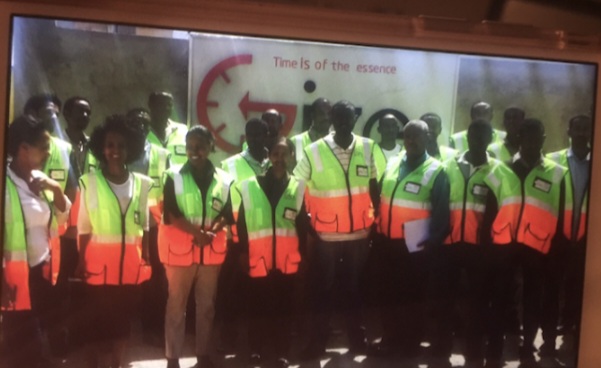
GIZE PLC managed the full cargo logistics chain and, notably, provided logistics and customs-related training to GIZ staff. This went beyond transport. It positioned the company as a capacity-building partner capable of translating Ethiopian regulatory systems for international institutions.
Solving the Problems Others Avoided
GIZE PLC’s reputation has also been shaped by its willingness to take on stalled, high-risk logistics assignments. The Tendaho Sugar Factory project illustrates this clearly. Cargo that had remained stranded at Djibouti Port for nearly three years posed technical, financial, and legal risks. GIZE conducted on-site assessments, route surveys, and recovery planning, eventually clearing and transporting the equipment inland.
Such interventions require judgment, negotiation, and accountability. They explain why GIZE has remained a trusted logistics partner for large industrial projects, including Habesha Cement Factory. From the project’s inception through commissioning, GIZE managed the importation of machinery, oversized equipment, and materials under a structured arrangement involving the Development Bank of Ethiopia. Payments made directly by the bank on behalf of the project reflected a level of institutional trust rarely extended to private logistics firms.
Sovereign Trust and Regulatory Leadership
Perhaps the strongest measure of GIZE PLC’s standing is its involvement in sovereign and central-bank logistics, where trust is absolute and error is unacceptable.
GIZE PLC was entrusted by the National Bank of Ethiopia with the logistics handling of newly produced one-birr banknotes, printed in Canada by an authorized international currency manufacturer. Due to the sensitivity of the operation, a qualified private-sector freight forwarder was required. GIZE PLC was formally selected as one of the designated representatives for the Canadian manufacturer and its logistics partner.

In this role, GIZE acted as the local freight-forwarding authority, managed all shipment documentation under strict international and national compliance, issued the original Bill of Lading in its own name, and formally endorsed it to the National Bank of Ethiopia for clearance and custody transfer.
Handling national currency logistics places GIZE among a very limited group of private firms trusted with sovereign cargo and central-bank operations. It reflects not only operational capacity, but deep institutional confidence at the highest level of the state.
Beyond security logistics, GIZE PLC has also demonstrated regulatory leadership. The company successfully operationalized an EXW (Ex-Works) logistics structure in Ethiopia, a mechanism long permitted in regulation but unused in practice for more than a decade due to its complexity.
Through direct engagement with the National Bank of Ethiopia, GIZE demonstrated that EXW arrangements were fully compliant with foreign-exchange, trade-finance, and customs frameworks. Following this engagement, NBE issued formal approval, unlocking a dormant regulatory provision.

This framework was first applied under African Union and GIZ project cargo, allowing GIZE to collect cargo directly at origin, manage international transport, clearance, and inland delivery, and complete final delivery in Addis Ababa without the physical presence of donor institutions abroad. The result was reduced friction, faster execution, and full regulatory compliance.
Together, the sovereign currency operation and the EXW execution position GIZE PLC not merely as a service provider, but as a regulatory-capable institution able to translate complex rules into workable national solutions.
Heavy Logistics and International Contractors
Handling oversized and high-value cargo has been central to GIZE’s identity. The company has delivered end-to-end logistics for major international contractors including Dragados, J&P, CCC, and ALSAMIX, covering machinery importation, inland transport, regulatory representation, and eventual export upon project completion. In several cases, GIZE also managed vessel chartering for outbound shipments.

Its portfolio extends to power-sector logistics, including transformers and large electrical equipment for Ethiopian Electric Utility projects, as well as Japanese-supported development initiatives where GIZE served as both logistics consultant and operator.
These engagements confirm the company’s capacity to manage technically complex cargo across borders, institutions, and regulatory systems.
Leadership Anchored in Principle
At the center of this record is Gizeshwork Tesema. In a sector often shaped by volatility and informal practice, her leadership is defined by consistency and rule-based decision-making. Partners describe a leadership style that prioritizes compliance even when it slows short-term gains.

As a woman leading a heavy logistics firm in a male-dominated industry, her authority has been built through performance rather than symbolism. Decisions are defended with contracts, regulations, and delivery records.

Her patriotism is practical rather than rhetorical. Many describe her as “the mother of GERD,” not as a slogan, but as recognition of the behind-the-scenes logistics and institutional work that enable national projects to function. Mega-projects do not move on speeches alone. They move on permits, ports, customs desks, and supply chains that must hold under pressure.
Why GIZE PLC Matters
GIZE PLC represents a model of Ethiopian private enterprise that is often overlooked. It shows how local firms can meet international standards, work with multilateral institutions, manage trade finance, and handle sovereign operations without outsourcing credibility.

In an era where Ethiopia seeks industrialization, infrastructure expansion, and regional integration, firms like GIZE are not peripheral. They are foundational.
Nation-building is not done only in parliaments or construction sites. It is also built quietly, day by day, in logistics chains that keep institutions functioning and national ambitions moving forward.
----------Editor’s Disclaimer:
The views and opinions expressed in articles published by Horn News Hub are those of the authors and do not necessarily reflect the official position or editorial stance of Horn News Hub. Publication does not imply endorsement.