

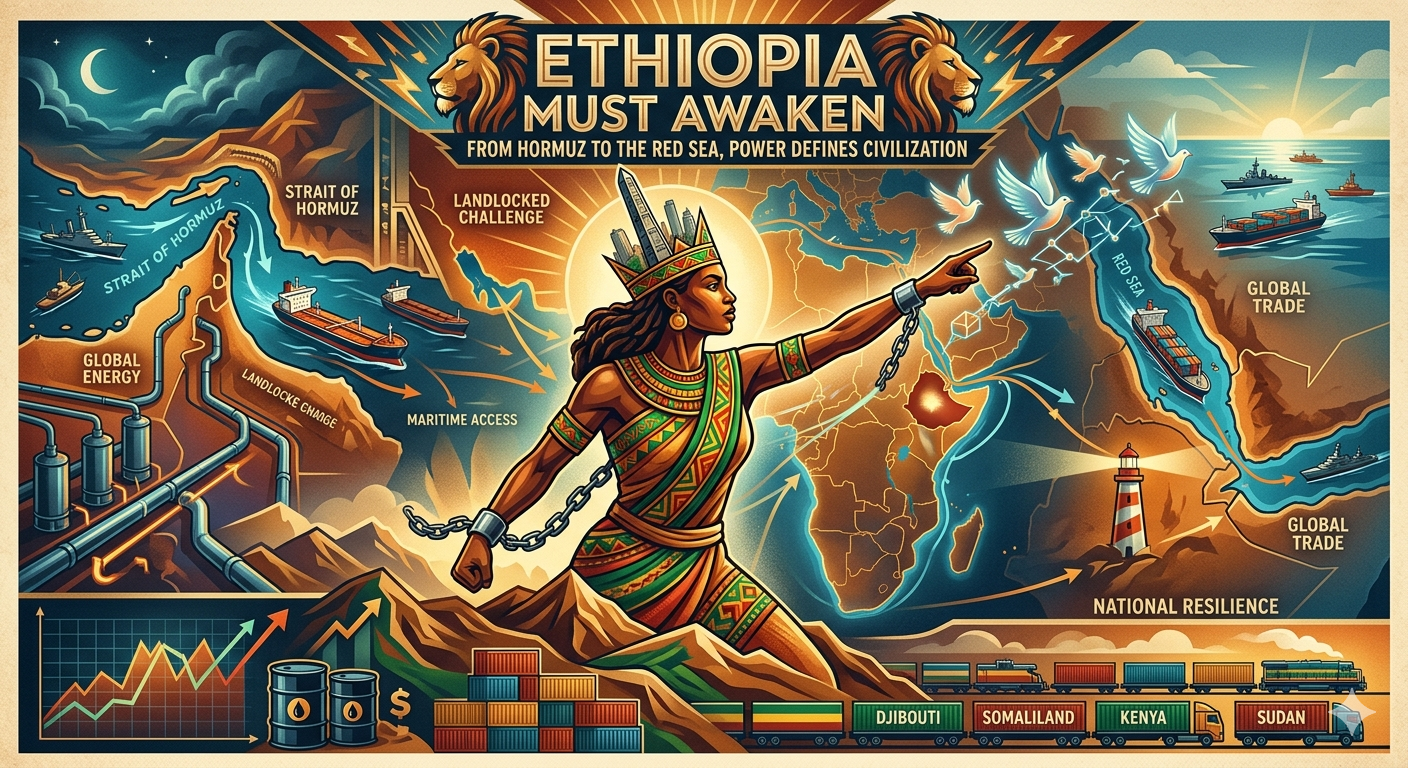
Ethiopia Must Awaken: From Hormuz to the Red Sea, Power Defines Civilization
When tensions rise in the Strait of Hormuz, the effects are felt far beyond the Middle East. Oil prices fluctuate, global shipping costs increase, and governments monitor developments closely. The narrow waterway carries nearly one fifth of the world’s oil supply, making it one of the most critical maritime chokepoints in the global economy.
At the same time, another strategic corridor holds equal importance for Africa and the Horn region. The Red Sea and the Bab el-Mandeb connect global trade between Asia, Europe, and Africa. Disruptions in this corridor have immediate consequences for countries dependent on maritime trade.
For Ethiopia, these developments carry particular significance. As a landlocked country and one of Africa’s fastest growing economies, Ethiopia relies heavily on maritime access through neighboring states.
The Strategic Importance of Global Chokepoints
International relations scholars have long emphasized the importance of geography in shaping power. Alfred Thayer Mahan argued that sea power plays a decisive role in national strength, while Halford Mackinder highlighted the enduring influence of geography on global politics.
These ideas remain visible today. Major global powers maintain military presence near strategic waterways. Countries invest in ports and logistics infrastructure to secure supply chains. Maritime security has become a central component of national strategy.
The Strait of Hormuz illustrates this reality. Tensions involving Iran, Gulf states, and global powers often lead to increased naval deployments and diplomatic engagement. The objective is to ensure uninterrupted flow of energy and trade.
A similar dynamic is emerging in the Red Sea corridor.
Rising Competition in the Red Sea
The Red Sea region has become increasingly strategic. Several international actors have expanded their presence in the area. The United States, China, Turkey, Saudi Arabia, and United Arab Emirates have all strengthened economic or security engagement along the Red Sea.
Djibouti hosts multiple foreign military facilities, reflecting the area’s strategic importance. The corridor carries more than ten percent of global trade and serves as a key route for energy shipments.
This growing competition highlights the significance of maritime access for regional states, particularly for landlocked economies.
Ethiopia’s Landlocked Challenge
Ethiopia lost direct access to the Red Sea following the independence of Eritrea in 1993. Since then, Ethiopia has relied primarily on Djibouti for port access, with the majority of imports and exports passing through Djibouti’s ports.
This reliance creates structural vulnerabilities. Fuel, fertilizer, industrial equipment, and food imports depend on uninterrupted maritime transport. Any disruption along the Red Sea corridor can directly affect domestic economic stability.
As Ethiopia’s population grows and industrialization expands, these vulnerabilities become more significant.
Scenario: Simultaneous Disruption of Hormuz and Bab el-Mandeb
Analysts note that simultaneous disruption of the Strait of Hormuz and Bab el-Mandeb would create a major global supply shock. Maritime insecurity linked to the Houthi movement in Yemen and rising regional tensions have already demonstrated how fragile these routes can be.
If both chokepoints were disrupted at the same time, global shipping routes would likely shift around the Cape of Good Hope. This would extend transit times and increase transportation costs.
For Ethiopia, the consequences could be significant:
Fuel imports would become more expensive
Transport costs would rise
Industrial production could slow
Foreign currency pressure could increase
Inflation risks would grow
Such developments would affect economic growth and development planning. Landlocked countries typically face higher transportation costs even under stable conditions. Disruptions would amplify these challenges.
Ethiopia and the Horn of Africa Strategic Balance
The Horn of Africa occupies a central location between the Middle East, Africa, and global maritime routes. Countries in the region are increasingly positioning themselves within this strategic environment.
Port investments, infrastructure development, and maritime partnerships are expanding. External actors are also increasing their presence, reflecting long term interest in the Red Sea corridor.
Ethiopia, as the largest population center in the Horn, plays an important role in regional stability and economic integration. However, analysts suggest that sustained growth may require diversified and reliable maritime access.
Ethiopia has explored cooperation with neighboring countries including Somalia, Somaliland, Kenya, and Sudan to diversify port access options.
Such efforts are viewed by observers as part of long term economic planning rather than short term policy shifts.
Maritime Access and National Resilience
Experts note that diversified maritime access can strengthen national resilience. It can reduce dependency on a single corridor, improve trade efficiency, and support economic growth.
For Ethiopia, enhanced access could support industrial expansion, export growth, and regional trade integration. It could also reduce vulnerability to external shocks.
The Red Sea corridor is expected to remain a major center of geopolitical competition in the coming decades. Population growth, infrastructure investment, and global trade patterns are increasing the importance of the region.
A Strategic Awakening
Developments in the Strait of Hormuz and Bab el-Mandeb illustrate how maritime chokepoints shape global stability. For landlocked countries, the risks associated with disruptions are particularly significant.
Analysts suggest that Ethiopia’s long term strategy may increasingly focus on secure and diversified maritime access. This approach aligns with broader economic and regional integration goals.
As the Horn of Africa evolves, Ethiopia’s position as a major economic and demographic center gives it a central role in shaping regional dynamics.
The lessons from Hormuz and the Red Sea point to a broader conclusion. Geography continues to shape global politics. Strategic access influences economic resilience. Maritime corridors remain central to development.
In this context, Ethiopia’s engagement with the Red Sea corridor is increasingly viewed as part of long term strategic planning for national stability and regional cooperation.
From the Strait of Hormuz to Bab el-Mandeb, the dynamics of power, geography, and access continue to define the modern world. For Ethiopia and the Horn of Africa, these dynamics are not distant developments but factors that may shape the region’s future.
———-
Editor’s Disclaimer:
The views and opinions expressed in articles published by Horn News Hub are those of the authors and do not necessarily reflect the official position or editorial stance of Horn News Hub. Publication does not imply endorsement.