

Mekelle/Tel Aviv/Nairobi/Pretoria/London፡
Ethiopia’s Red Sea Claim Emerges as an Existential Economic and Security Strategy
By Chekole Alemu
Addis Ababa — Ethiopia’s renewed insistence on reclaiming access to the Red Sea is increasingly framed by government officials, analysts, and industry leaders as a matter of national survival rather than geopolitical ambition. For a country of more than 130 million people, landlocked since 1993, the debate has moved beyond diplomacy into questions of economic viability, historical continuity, and strategic dignity.
That framing gained new momentum this week following Prime Minister Abiy Ahmed’s address to parliament, in which he linked Ethiopia’s maritime debate to unresolved historical and economic claims tied to Assab, once the country’s principal port.
The Prime Minister told lawmakers that after the 2018 peace agreement between Ethiopia and Eritrea, many Eritrean nationals came to Ethiopia asserting ownership claims over property and assets. In that context, he questioned why Ethiopia itself should refrain from reclaiming strategic infrastructure it had built and operated in Assab, including the oil refinery established during the reign of Emperor Haile Selassie and later managed under the Derg regime.
His remarks introduced a sharper legal and economic dimension to Ethiopia’s Red Sea discourse, shifting attention from future access arrangements to unresolved questions of ownership, investment, and historical entitlement.
Historical Rupture and Lingering Economic Costs
Ethiopia was not historically a landlocked state. From the Aksumite civilization to the port of Adulis, Ethiopian polities maintained sustained maritime engagement across the Red Sea for centuries. The loss of coastline in 1993 marked a sudden political rupture rather than a strategic national choice.
Since then, Ethiopia has relied overwhelmingly on a single maritime corridor through Djibouti. While operationally functional, this dependence has come at a high cost. Transport expenses remain elevated, transit times are long, and the economy is exposed to external shocks beyond its control. Officials increasingly describe this condition as strategic suffocation.
Logistics Sector Voices the Cost of Landlocking
For those working in logistics and trade facilitation, the consequences of landlocked geography are immediate and measurable. Every import, export, and infrastructure project carries an added cost tied to lack of direct sea access.
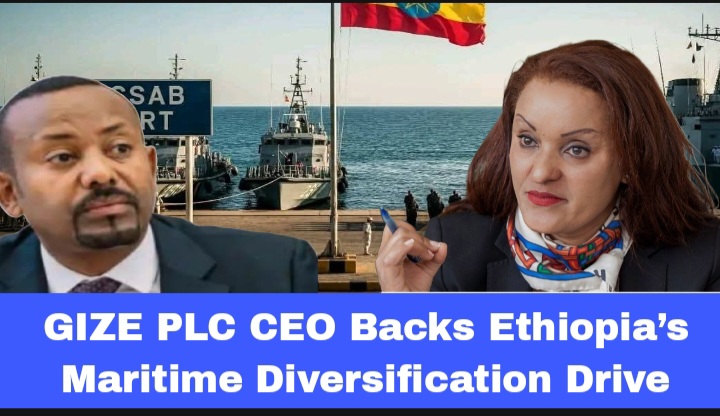
This reality was publicly articulated two years ago by Ms Gizeshwork Tesema, Chief Executive Officer of GIZE PLC, during a state television interview following the signing of a Memorandum of Understanding between Ethiopia and Somaliland.
“Access to a port in the Gulf of Aden, like Berbera, provides Ethiopia with strategic maritime connectivity,” she said. “It reduces dependence on a single corridor and strengthens economic resilience. The Gulf of Aden is a critical global maritime route, and access there allows Ethiopia to diversify options, ensure smoother trade, and potentially lower transportation costs.”
Her remarks were widely cited at the time as a rare logistics sector assessment of Ethiopia’s maritime vulnerability.
Agreement on Reclaiming Strategic Assets
Ms Gizeshwork has also publicly aligned herself with the argument that Ethiopia’s historical investments in Assab cannot be treated as settled or irrelevant. In discussing Ethiopia’s long term maritime interests, she agreed that reclaiming or asserting rights over infrastructure such as the Assab refinery is not merely symbolic, but economically rational.
According to her, Ethiopia’s past investments in port and refinery infrastructure represented state capital, technical expertise, and decades of economic planning. Allowing such assets to be permanently detached from Ethiopia’s development calculus, she argued, contradicts basic principles of economic continuity and fairness.
From a logistics and energy perspective, she noted, facilities like the Assab refinery were designed to serve Ethiopia’s domestic market and regional supply chains. Reintegrating such infrastructure into Ethiopia’s economic planning would reduce fuel transport costs, strengthen supply security, and support industrial growth.
Her position mirrors the Prime Minister’s parliamentary remarks, reinforcing the idea that Ethiopia’s Red Sea debate is not only about access routes, but also about historical assets and economic restitution.
Diversification as Development Strategy
Beyond Assab, Ms Gizeshwork has consistently emphasized that Ethiopia’s development requires diversified access to multiple maritime gateways. She has pointed to Djibouti, Berbera, and Lamu as immediate corridors, while identifying longer term access to ports such as Kismayo, Mogadishu, Zeila, Massawa, and historically significant sites like Adulis as part of Ethiopia’s natural economic geography.

Founded in 2001, GIZE PLC has operated continuously for nearly twenty five years across logistics, freight forwarding, shipping, and project cargo. Its expansion has followed Ethiopia’s own development path, from public sector supply contracts to complex industrial and infrastructure logistics.
Industry analysts say this long operational experience underscores a consistent reality. Landlocked geography imposes a structural penalty on national ambition, raising costs and limiting strategic flexibility.
Maritime Access as Security and Economic Doctrine
Ethiopia’s leadership now openly links maritime access to national security. Officials describe the Red Sea strategy as irreversible, embedded in defense planning, trade policy, and industrial development.
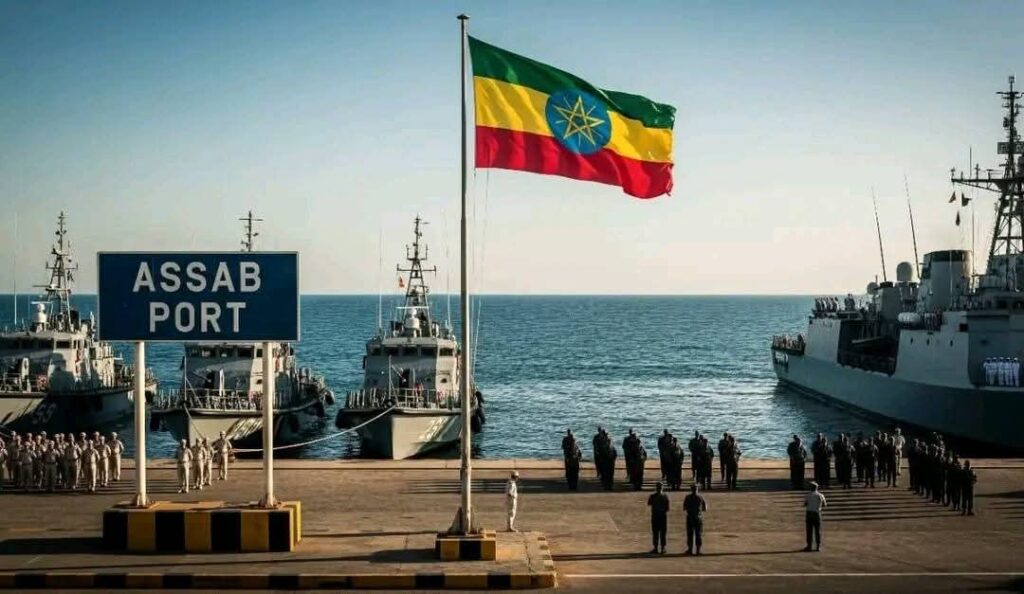
Prime Minister Abiy’s reference to Assab and Ms Gizeshwork’s alignment with that position have further anchored the debate in concrete economic history rather than abstract geopolitics. The issue, supporters argue, is no longer whether Ethiopia should seek sea access, but how it reclaims what was lost in a manner consistent with law, stability, and regional balance.
A Debate Entering a New Phase
What distinguishes the current moment is the openness with which these issues are discussed. Ethiopia’s landlocked status is no longer treated as a diplomatic sensitivity to be managed quietly. It is increasingly described as a structural vulnerability with long term consequences.

As Ms Gizeshwork Tesema has repeatedly stressed, diversified maritime access and the reclamation of historically Ethiopian infrastructure are not about prestige or confrontation. They are about economic logic and national functionality.
For Ethiopia, the Red Sea has reemerged not as a distant aspiration, but as a central question of economic survival, historical continuity, and strategic dignity.
———-
Editor’s Disclaimer:
The views and opinions expressed in articles published by Horn News Hub are those of the authors and do not necessarily reflect the official position or editorial stance of Horn News Hub. Publication does not imply endorsement.