
Mekelle/Tel Aviv/Nairobi/Pretoria/London
Eritrea’s Statement on Somaliland: Self-Contradiction, Evasion, and Selective Outrage
By Chekole Alemu
Eritrea’s decision to address Somaliland’s recognition indirectly is not a stylistic accident. It is a calculated diplomatic posture shaped by vulnerability, caution, and unresolved contradictions in its foreign policy.
Eritrea’s official position was outlined in a brief press release issued by the Ministry of Information on 28 December 2025. Titled “Purported Recognition of ‘Somaliland’”, the statement avoids direct attribution, referring instead to the decision as “the ploy,” which it claims has been “brewing for some time now to stoke dangerous regional and global crises and mayhem.”
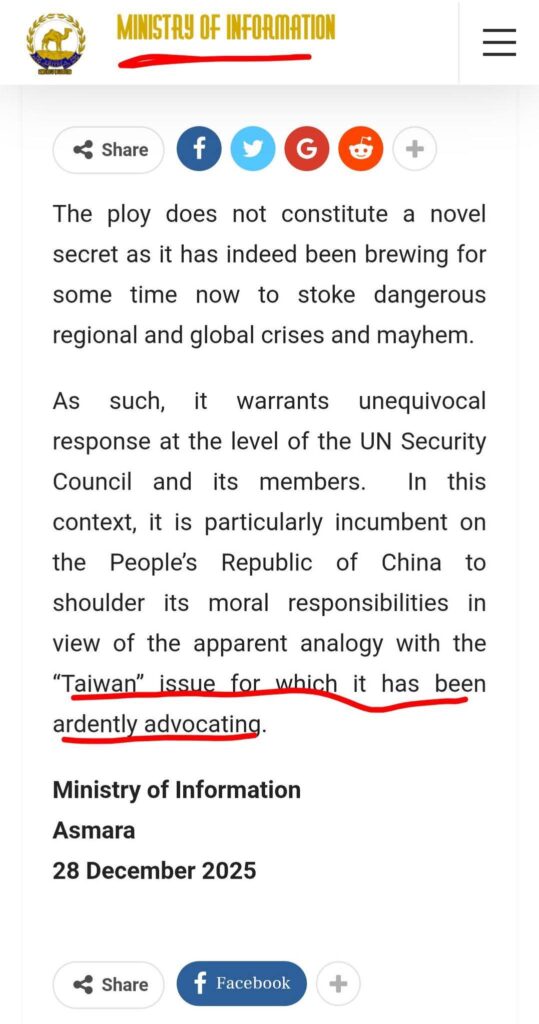
Issued by the Ministry of Information on 28 December 2025 under the title “Purported Recognition of ‘Somaliland’”, the statement avoids direct attribution. It refers to the recognition only as “the ploy,” claiming it has been “brewing for some time now to stoke dangerous regional and global crises and mayhem.” Eritrea calls for an “unequivocal response at the level of the UN Security Council and its members,” elevating the issue from a bilateral diplomatic decision to a matter of global security. It further singles out the People’s Republic of China, arguing that Beijing bears a “moral responsibility” to act, citing what it describes as an “apparent analogy with the ‘Taiwan’ issue.”
Presented as a sober warning against destabilisation and geopolitical manipulation, the statement instead exposes the uneasy tension between Eritrea’s long-cultivated revolutionary mythology and its present-day diplomacy.
For three decades, Eritrea has insisted that its legitimacy is self-derived, rooted in its liberation struggle, national sacrifice, and internal will rather than granted by external actors. In this narrative, recognition was neither sought nor required. Yet in condemning Somaliland’s recognition, Eritrea suddenly treats recognition as a profoundly consequential act capable of igniting regional disorder. This is not a minor rhetorical slip. It is an intellectual contradiction. Recognition cannot simultaneously be something Eritrea claims not to need and something so politically potent that it warrants urgent escalation to the UN Security Council when applied elsewhere.
More importantly, Eritrea’s position carries logical consequences it appears unwilling to confront. By calling for the recognition to be revisited and internationally scrutinised, Asmara implicitly endorses the principle that unilaterally granted state legitimacy is subject to review and potential reversal. If that logic holds, then Ethiopia or any other actor could, in theory, call for a reassessment of Eritrea’s own secession and recognition process. Ethiopia has long argued that the 1993 referendum and subsequent international recognition occurred under conditions shaped by EPLF dominance rather than a genuinely free political environment. Eritrea, however, insists that its statehood is beyond review. It demands immunity from the very reasoning it now applies to others.
The appeal to China deepens this inconsistency. Invoking Beijing and drawing parallels with Taiwan is intended to wrap Eritrea’s stance in the language of sovereignty and territorial integrity. Yet Eritrea has never accepted comparable legal or moral inquiries into its own breakaway from Ethiopia. Such challenges have always been dismissed as illegitimate affronts to historical truth. The reference to China, therefore, is not a neutral legal analogy but a selective geopolitical alignment, reinforcing Eritrea’s anti-Western posture while borrowing China’s sovereignty discourse for regional utility.
Equally revealing is what the statement avoids. Israel is never named. Responsibility is obscured behind the vague label “the ploy.” If the act truly represents a grave destabilising intervention, intellectual confidence would require clear attribution. The evasive phrasing suggests diplomatic caution disguised as moral alarm, a reluctance to confront Israel directly while still seeking the authority that comes with condemnation.
Perhaps most striking is the complete erasure of Somaliland as a political subject. Eritrea, more than most states, understands the weight of prolonged struggle without international recognition. Yet Somaliland’s internal legitimacy, political endurance, and popular will are entirely ignored. It is treated not as an actor with agency, but as a passive object in a geopolitical scheme designed by others. This omission undercuts any claim that Eritrea’s stance is grounded in consistent principle or solidarity with self-determination. It is driven by expediency.
Finally, Eritrea stops short of openly affirming solidarity with Somalia’s federal leadership or explicitly backing President Hassan Sheikh Mohamud. Instead, it retreats into sterile procedural language. This ambiguity reflects unresolved political tensions between Asmara and Mogadishu, fractures so persistent that even regional power brokers aligned with Eritrea have struggled to bridge them. The statement functions less as a defense of Somali sovereignty than as an instrument within broader regional rivalries.
Strategic Implications for Ethiopia and the Emerging Regional Alignment
Beyond exposing Eritrea’s contradictions, the episode creates strategic space for Ethiopia to reposition itself as a central security actor in the Horn of Africa and the Red Sea corridor. While Eritrea retreats into abstraction and rhetorical protest, Ethiopia stands to benefit from clarity, alignment, and action.
Ethiopia’s long-standing role as a regional security anchor has rested on geography, manpower, and institutional experience, particularly through peacekeeping missions and counterterrorism operations. The current moment reinforces that role. As regional instability increasingly intersects with Red Sea security, maritime trade routes, and transnational militant threats, Ethiopia is well placed to present itself as a stabilising force rather than a reactive one.
An emerging alignment linking Ethiopia with Israel, the United States, Somaliland, and the United Arab Emirates reflects this shift. These actors share converging security priorities, notably countering Al Shabaab’s persistent threat in the Horn and containing the regional spillover effects of the Houthi conflict along the Red Sea. For Ethiopia, participation in such a framework is less about ideology and more about strategic necessity. The security of Red Sea corridors directly affects Ethiopia’s trade access, economic recovery, and regional leverage.
Somaliland occupies a particularly important position in this equation. Its coastline, relative internal stability, and resistance to Al Shabaab make it a valuable security partner. Engagement with Somaliland allows Ethiopia to extend its strategic depth toward the Red Sea while reducing dependence on fragile federal structures in Mogadishu. This does not formally negate Somalia’s sovereignty, but it reflects the security realities shaping cooperation on the ground.
Israel and the United States bring intelligence capabilities, maritime security experience, and counterterrorism reach. The UAE contributes logistical infrastructure, investment leverage, and operational access along the Red Sea. Ethiopia, in turn, offers scale, legitimacy within African multilateral frameworks, and decades of peacekeeping experience. Together, these elements form a security architecture that Eritrea’s current posture neither shapes nor influences.
Crucially, this alignment allows Ethiopia to reclaim a leadership role that is proactive rather than defensive. While Eritrea appeals to distant analogies and procedural escalation, Ethiopia can frame itself as an actor willing to shoulder responsibility for regional stability. In a region where security outcomes matter more than rhetorical positioning, capacity and consistency carry weight.
In this context, Ethiopia’s advantage lies not only in alliance formation but in narrative control. It can position itself as a guardian of stability in the Horn of Africa and the Red Sea through sustained engagement against shared threats, from Al Shabaab’s insurgency to the destabilising activities of non-state actors such as the Houthis.
Taken together, Eritrea’s intervention does not project the authority of a principled defender of international order. It reveals a state constrained by its past, reliant on indirection and grievance. Ethiopia’s positioning, by contrast, reflects a forward-looking strategy rooted in security provision, regional responsibility, and strategic relevance. In a rapidly evolving regional landscape, that distinction is decisive.
It is also important to note that, as of now, the Ethiopian government has not issued any official statement regarding Israel’s recognition of Somaliland. Addis Ababa has maintained public silence, a posture that contrasts sharply with Eritrea’s rapid, if indirect, response.
This restraint is notable given that Ethiopia and Somaliland signed a memorandum of understanding earlier this year, signalling a willingness on both sides to deepen political, economic, and security cooperation. While the details and legal standing of that MOU remain contested, its existence underscores that Ethiopia is not approaching Somaliland as an abstract geopolitical problem, but as a practical partner within a shifting regional environment.
Ethiopia’s silence should therefore not be read as indecision. Rather, it reflects a deliberate preference for strategic patience over rhetorical escalation. By withholding immediate comment, Addis Ababa preserves diplomatic flexibility, avoids premature alignment, and allows regional dynamics to unfold before committing to a public position.
In contrast to Eritrea’s appeal to international forums and distant analogies, Ethiopia’s approach suggests confidence in leverage rather than anxiety about recognition. Whether or not Addis Ababa eventually articulates a formal stance, its actions, past agreements, and security calculations already place it at the centre of emerging regional realignments shaping the Horn of Africa and the Red Sea.