

Mekelle/Tel Aviv/Nairobi/Pretoria/London
A Fragile Breakthrough: Inside the AU-Brokered Peace Deal as New Accusations Shake Ethiopia’s Political Landscape
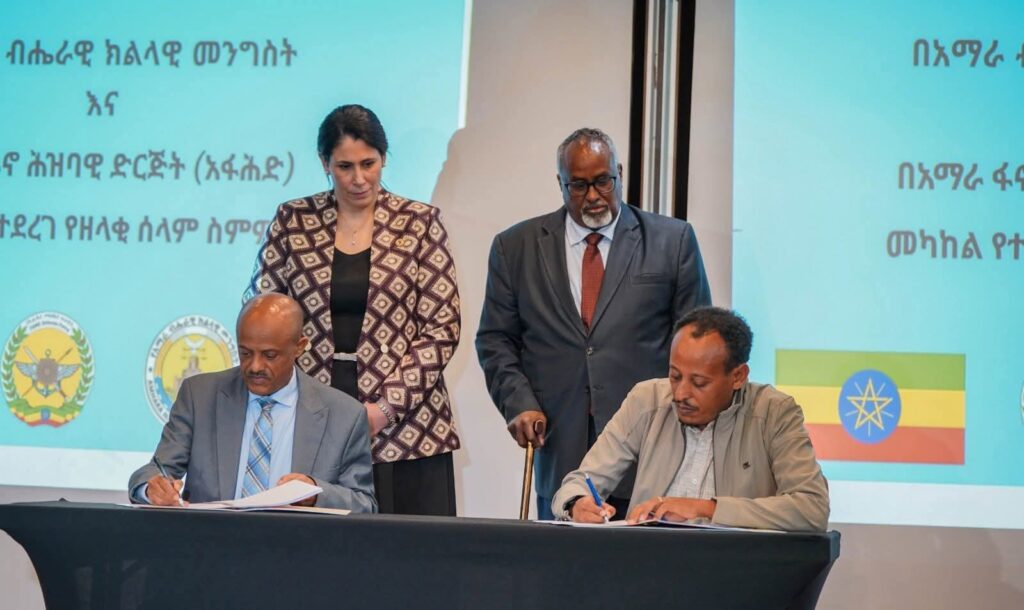
The African Union’s endorsement of a sustainable peace agreement between the Amhara National Regional State and the Amhara FANO Popular Organisation (FANO-AFPO) has been widely hailed as a diplomatic breakthrough. The signing, witnessed in Addis Ababa by AU Deputy Chairperson Selma Malika Haddadi and IGAD Deputy Executive Secretary Mohamed Abdi Ware, is being framed as a rare moment of consensus in an increasingly fractured Ethiopian political environment. Yet behind the ceremony and the carefully worded statements lies a complex and rapidly shifting landscape that threatens to overshadow the significance of the accord.

According to officials present at the event, the AU views the agreement not merely as a regional settlement but as a symbolic step in its broader agenda of “Silencing the Guns in Africa.” The Deputy Chairperson’s remarks reflected a continent-wide aspiration, praising both parties for choosing negotiation over escalation. With multiple armed actors and political factions vying for influence across Ethiopia, the AU sees the Amhara deal as a precedent it hopes can be replicated elsewhere.
But almost immediately after the ink dried, internal frictions within the Amhara armed movement surfaced, exposing deep cracks that could weaken the agreement’s implementation. FANO figure Masresha Were announced that he intends to release a recorded audio of a secret meeting involving another influential FANO leader, Zemene Kase. While the contents of the audio remain undisclosed, early indications from sources familiar with the dispute suggest it could reveal competing agendas within the movement one faction aligned with political negotiation and another more resistant to compromise. Such divisions risk undermining the very cohesion FANO-AFPO needs to uphold its commitments under the new accord.
Complicating matters further, Prime Minister Abiy Ahmed has formally notified UN Secretary-General António Guterres that the Tigray People’s Liberation Front (TPLF) is allegedly violating the Pretoria Peace Agreement. According to the Prime Minister’s letter, the TPLF is forging new ties with internal armed militias, including elements of FANO, and is receiving political backing from the Eritrean government. These allegations if substantiated would represent one of the most serious breaches of the Pretoria deal since its signing in November 2022, reopening questions about its durability and enforcement.
Diplomatic observers say the claims carry significant geopolitical implications. Any perceived alignment Between TPLF and Eritrea, historically bitter rivals, would mark a dramatic reconfiguration of northern Ethiopia’s political map. At the same time, the allegation that parts of FANO are simultaneously negotiating peace with the Amhara Region while allegedly coordinating with the TPLF underscores the fragmented and unpredictable nature of Ethiopia’s armed landscape.
This confluence of competing alliances, political realignments, and internal fractures presents a difficult road ahead for the African Union. The continental body, which has invested heavily in promoting African-led conflict resolution, now faces the challenge of ensuring that the peace accord does not become another symbolic achievement without durable implementation. AU officials quietly acknowledge that any agreement involving FANO will be tested by the movement’s decentralised structure and the diffuse loyalties of its commanders.
Ethiopian political analysts warn that the coming months will be crucial. While the agreement between the Amhara Region and FANO-AFPO offers a moment of diplomatic optimism, the broader national situation remains volatile. The government’s accusations against the TPLF, the emerging rift within FANO’s leadership, and the historical mistrust between regional actors all create a fluid environment where alliances shift quickly and clarity is scarce.
For now, the peace deal stands as a tentative victory for diplomacy in a country where political grievances, security rivalries, and unresolved wartime tensions continue to reshape the landscape. Whether it becomes a turning point or another fleeting pause in Ethiopia’s cycle of political upheaval will depend on how these competing forces resolve or entrench themselves in the months ahead.
Editor’s Disclaimer:
The views and opinions expressed in articles published by Horn News Hub are those of the authors and do not necessarily reflect the official position or editorial stance of Horn News Hub. Publication does not imply endorsement.