

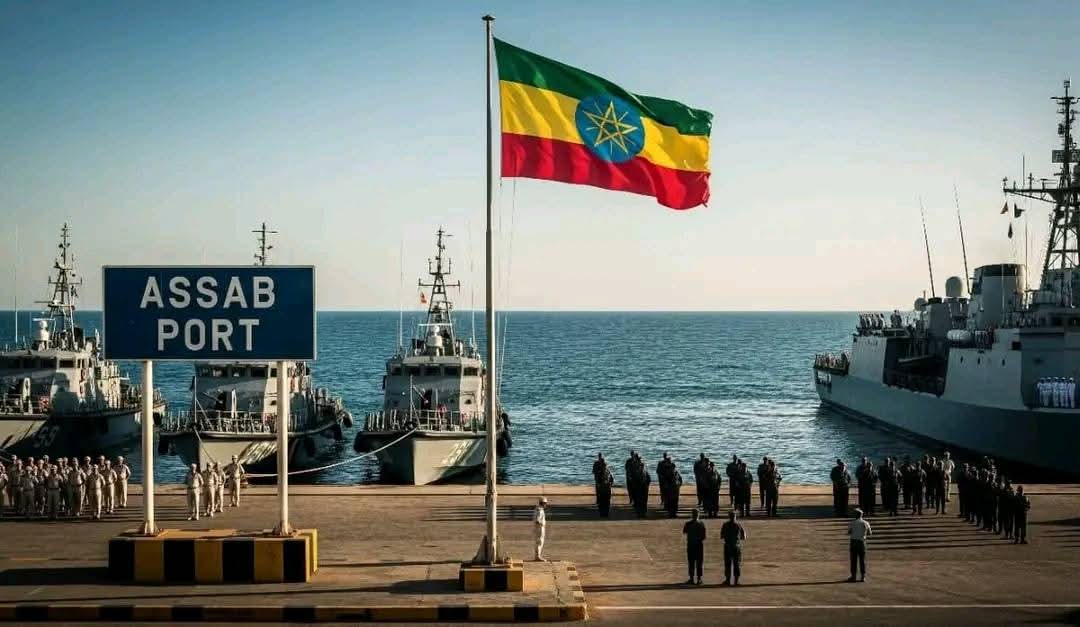
Mekelle/Tel Aviv/Nairobi/Pretoria/London፡
Why Access to the Red Sea Is Framed as an Existential Necessity for Ethiopia
By Contributor
Ethiopia’s push for access to the Red Sea has emerged as one of the most consequential strategic debates in the Horn of Africa. While often interpreted as political rhetoric, Ethiopian officials and regional analysts increasingly frame maritime access as an existential necessity rooted in economics, national security, diplomacy, digital sovereignty, and regional stability. The argument is also beginning to extend beyond the Horn, with implications for Europe and the wider international community.
Ethiopia, with a population exceeding 120 million, became landlocked in 1993 following Eritrea’s independence. Since then, the country has relied almost entirely on external ports, particularly Djibouti, for international trade. This structural dependency has shaped Ethiopia’s economic and strategic posture for more than three decades.
Economic Pressure and Structural Vulnerability
Economically, landlocked status has imposed persistent constraints. More than 90 percent of Ethiopia’s imports and exports transit through a single corridor, exposing the economy to congestion, rising transit fees, and external political or security shocks. Transport and logistics costs remain significantly higher than those of coastal economies, limiting export competitiveness and slowing industrial growth.
Economists note that for a country pursuing export-led industrialization, maritime access is not optional infrastructure but a core enabler of growth. Ethiopian officials argue that sovereign or guaranteed access to a port would allow long-term planning of trade corridors, reduce dependency-driven costs, and strengthen manufacturing, agriculture, and energy exports.
Beyond cost, the issue is framed as economic sovereignty. Reliance on third-party ports limits Ethiopia’s ability to manage its trade lifelines during periods of crisis or geopolitical tension.
Security, Resilience, and Strategic Autonomy
From a national security perspective, dependence on foreign ports is viewed as a structural risk. Disruptions caused by regional instability, diplomatic disputes, or internal crises in transit states could rapidly affect access to fuel, food, and essential imports.
Ethiopia’s leadership has increasingly linked sea access to national resilience. Control or guaranteed use of a maritime outlet would reduce exposure to external leverage and allow the country to better withstand regional or global shocks. It would also enable Ethiopia to participate more actively in Red Sea maritime security efforts, including anti-piracy operations and the protection of trade routes passing through the Bab el Mandeb corridor.
Despite being one of Africa’s largest states, Ethiopia currently has limited influence over security arrangements governing one of the world’s most strategic sea lanes.
Diplomacy and Regional Influence
Diplomatically, maritime access is tied to Ethiopia’s regional standing. As a landlocked state, Ethiopia negotiates access largely as a dependent user rather than as a stakeholder in Red Sea governance. Analysts argue this weakens its leverage in regional diplomacy and limits its role in shaping security and economic frameworks.
Recent diplomatic initiatives aimed at securing access have generated regional tension, underscoring how central the issue has become to the balance of power in the Horn of Africa. For Ethiopian policymakers, access to the Red Sea is increasingly viewed as a prerequisite for functioning as a regional stabilizer rather than a constrained hinterland.
Digital and Cyber Security Dimensions
Beyond physical trade, modern ports are critical digital nodes. They manage vast flows of customs data, financial transactions, logistics platforms, and undersea cable connectivity. Ethiopia’s dependence on foreign ports also means reliance on externally controlled digital infrastructure.
Cyber security experts warn that this creates vulnerabilities ranging from data exposure to economic disruption during political or security crises. Sovereign or long-term controlled access would allow Ethiopia to integrate port operations into national cyber security systems, protect trade data, and secure digital supply chains that are now central to modern economies.
Migration Pressure and European Stakes
Another dimension increasingly raised by analysts is the migration risk associated with prolonged economic constraint. Ethiopia’s rapidly growing population and youthful demographic face mounting pressure from unemployment, climate stress, and regional instability. If development ambitions are structurally limited by trade bottlenecks and dependency, outward migration could intensify.
Migration specialists warn that instability in a country of Ethiopia’s size would not remain a regional challenge. The Horn of Africa is already a major source of irregular migration routes toward the Middle East and Europe. Large-scale economic distress in Ethiopia could significantly increase refugee and migrant flows, placing additional pressure on European states already grappling with migration management.
From this perspective, Ethiopia’s access to the sea is framed not only as a national concern but as an issue of broader international stability. European policymakers, analysts argue, have a strategic interest in Ethiopia’s economic resilience, as sustained instability in a population exceeding 120 million would have far-reaching consequences.
The Anchor State Argument
Underlying these debates is Ethiopia’s ambition to function as an anchor state in the Horn of Africa. Proponents argue that regional stability depends on Ethiopia’s ability to sustain growth, provide economic gravity, and contribute to security beyond its borders.
The Red Sea sits at the center of this vision. It is a corridor through which global trade, energy flows, and geopolitical competition intersect. Without a direct or guaranteed stake in this corridor, Ethiopia’s capacity to shape regional outcomes remains limited.
Supporters of maritime access frame the issue as a structural correction rather than territorial expansion. They argue that sustainable solutions must be negotiated, lawful, and anchored in mutual economic benefit, whether through shared port arrangements, long-term leasing, or regional integration mechanisms.
What is increasingly clear is that for Ethiopia, access to the Red Sea is no longer discussed as a policy option. It is framed as a defining factor in economic survival, security resilience, diplomatic relevance, and regional stability in a rapidly changing global order.
———-
Editor’s Disclaimer:
The views and opinions expressed in articles published by Horn News Hub are those of the authors and do not necessarily reflect the official position or editorial stance of Horn News Hub. Publication does not imply endorsement.