
By HAGR
Academic, Cold):
Analog Generals, Digital Graves: From the Pretoria Agreement to “Total War” A Strategic Autopsy of TPLF Hardliner Self-Destruction
(News Analysis Style):
They Could Have Exited with Honor The Military Madness and Political Bankruptcy of Tigray’s 2026 Renewed War
Comparative Metaphor):
Yorktown’s Glory and the Dueling Ground’s Shame: TPLF’s Slide from “Honorable Defeat” to a “Hamilton Defeat”
Abstract
When the Tigray People’s Liberation Front signed the Pretoria Peace Agreement in November 2022, it still held one card: the ability to trade an honorable defeat for political survival. Four years later, hardliners chose to burn that card themselves. In September 2026, TPLF forces seized the airports of Mekelle, Aksum, and Shire, launching offensives into Afar and Amhara and declaring “total war” against the federal government. This is a war that cannot be won—not for lack of courage, but because those commanding it are still fighting a twenty-first-century battlefield with twentieth-century military thinking.
I. Hamilton at Yorktown: The Glorious Charge and the Fatal Duel
Alexander Hamilton led the assault on Redoubt 10 at Yorktown in 1781 the pinnacle of his military career, a glorious, collective, strategically meaningful victory. Nineteen years later, he was mortally wounded in a duel with Aaron Burr. That was not war. That was a lethal mixture of personal grievance, pride, and political calculation.
The metaphor of a “Hamilton defeat” is brutally precise: the transformation from a respected adversary on the battlefield into a tragic figure cut down on a political dueling ground by his own ego. In 2022, the TPLF at least formally accepted an honorable defeat—handing over heavy weapons, acknowledging the federal government’s constitutional authority, and trading submission for the political survival of Tigray. That was not surrender. It was a strategic retreat that preserved the possibility of recovery under conditions of extreme disadvantage.
In 2026, TPLF hardliners chose the dueling ground.
II. “Analog Generals”: Donkeys, Caves, and the War of Drones
Former Tigray interim leader Gebru Asrat offered a precise diagnosis in a July 2026 interview: TPLF hardliners “rejected the agreement from the start,” and “retained heavy weapons and strengthened their military structure instead of completing the agreed disarmament.”
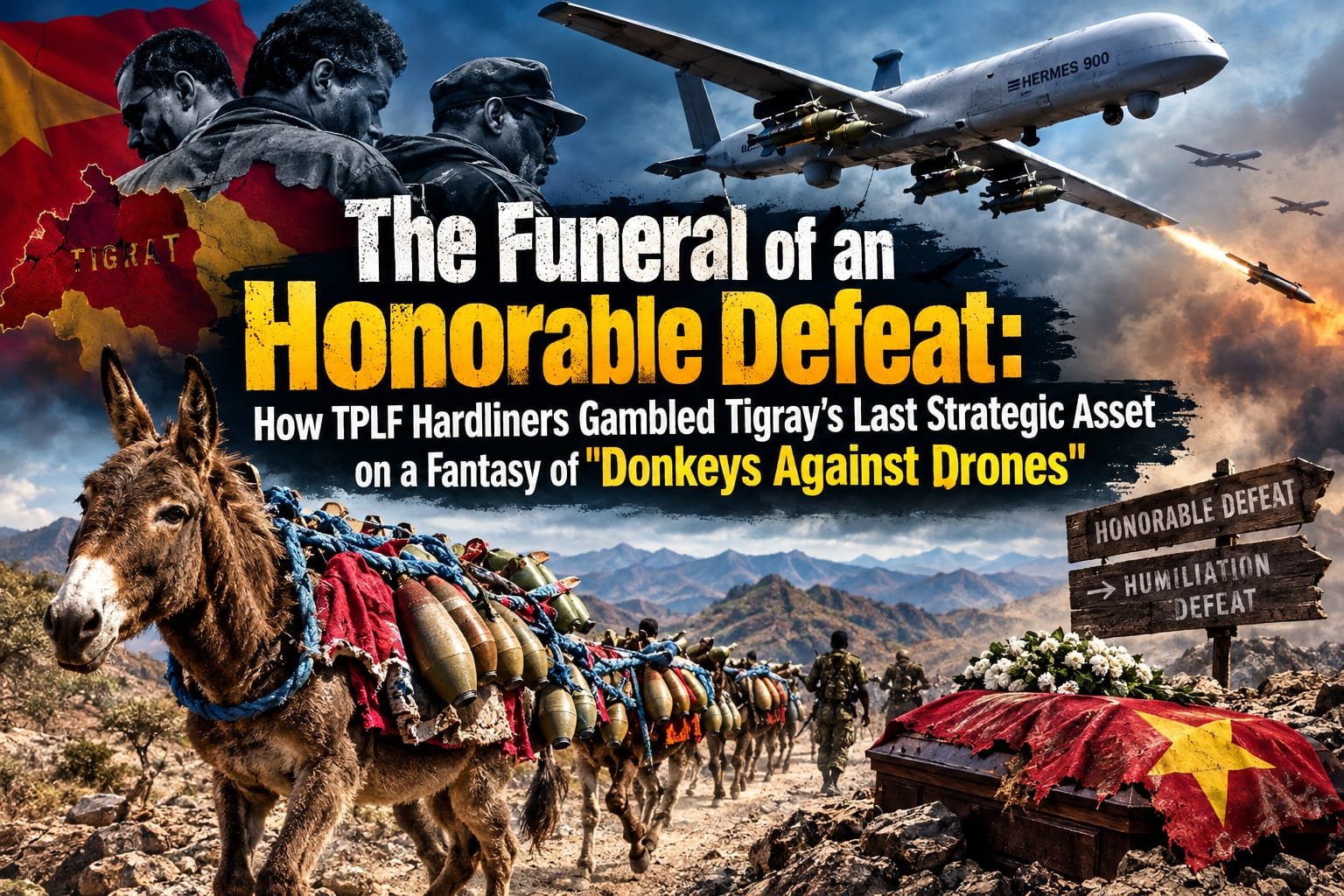
What does this mean? It means that over four years, while the federal government accelerated its procurement of Turkish Bayraktar TB2s, Chinese Wing Loong IIs, and Iranian Mohajer-6 systems, TPLF military thinking remained frozen in the logic of the previous war. Retreating into Tigray’s deep gorges, moving ammunition by donkey, exploiting cloud cover and terrain to evade reconnaissance—these analog-era tactics may have worked in the 2020–2022 war, when federal drone capabilities were still in their infancy.
By 2026, the federal military was a different force entirely. Tigray’s forces “have no air force and no sophisticated air defense systems.” While they move supplies by donkey, federal drones are locking onto targets from thousands of feet with thermal imaging. On a single day September 23, 2026 the federal air force conducted more than fifteen to twenty-one drone strikes across Tigray. This is not war. This is the hunt.
TPLF Deputy Chairman Amanuel Assefa told AFP that “we are in a state of total war.” But what is “total war”? Seizing three airports and then what? Pushing into Afar and Amhara and then what? Analysts suggest TPLF tactical objectives may include cutting the Djibouti supply corridor and, ultimately, threatening Addis Ababa. But that “ultimately” requires what? Sustained logistics, air superiority, international support. The TPLF has none of these.
III. From Honorable Defeat to Strategic Suicide: The Hardliners’ Political Arithmetic
The key to understanding this war does not lie on the military plane the military conclusion was written long ago. The key lies in why hardliners chose to fight a war they cannot win.
Gebru Asrat’s assessment is that hardliners “may see prolonged instability as a political advantage.” Aregawi Berhe a founding member and former chairman of the TPLF put it more bluntly: the TPLF leadership “viewed the Pretoria Agreement as an opportunity to regroup and advance its long-term objectives,” and they “wanted to use the peace process to buy time and reorganize.”
This is political arithmetic, not military logic. For hardliners who lost de facto control over Tigray’s governance after 2022, peace represents a slow political death. Political dialogue under the Pretoria framework “has not yet begun,” and the root causes of the war “remain unaddressed.” In this stagnation, hardliner legitimacy erodes, their military assets age, and international attention fades.
War even a losing war puts them back at the center.
This is an extraordinarily dangerous gamble. It bets that the federal government will halt under international pressure; that Tigray’s population will re-unite behind a “genocide” narrative; that external actors (allegedly including Eritrea) will provide substantive support. The reality of September 2026: the U.S. ambassador publicly expressed “disappointment,” calling the TPLF’s offensive an “unwinnable battle”; the African Union called for “maximum restraint,” but no party showed any sign of backing down; Tigray’s youth “are not interested in war” and “believe differences can be resolved through political dialogue.”
IV. The Donkey-Drone Divide: Myth and Reality of Asymmetric Warfare
“Donkeys against drones” is a powerful metaphor, but it also obscures a crueler truth.
The donkey represents more than low technology it represents an obsolete paradigm of warfare. In the 2020–2022 war, the TPLF could resist federal forces effectively partly because federal drone capabilities were limited at the time, partly because of terrain advantages, and partly because of broad popular mobilization in Tigray. Four years later, the first two advantages have significantly eroded: the federal drone fleet is larger and its operators more experienced. And Tigray’s population, after 600,000 deaths and millions displaced, has exhausted its appetite for another liberation war.
Gebru Asrat also revealed a critical detail: the TPLF “is recruiting children as young as 13 or 14,” while Tigrayan families “are actively opposing this forced conscription, sending their children outside Tigray.” When an army must fill its ranks with children, it is no longer a case of analog generals it is desperate warlordism.
On the federal side, the strategy is clear: use drones to attrit TPLF military assets, apply economic pressure and diplomatic isolation to squeeze its political space, and avoid the casualties and political costs of a large-scale ground invasion. This is the war logic of the digital age using technological advantage to drag an opponent into unsustainable attrition rather than seeking a decisive battle.
V. Regional Chain Reactions: When Everyone Becomes a Variable
The most dangerous feature of this war is not whether the TPLF can win it cannot. The danger is that the regional landscape is now completely different from 2020–2022.
In 2020, Eritrea stood with the federal government against the TPLF, as did Amhara’s Fano militia. In 2026, Fano has become the TPLF’s ally, and Eritrea is allegedly supporting the TPLF. The TPLF has formed the “Ethiopian Peoples’ Forces Alliance for Survival” with six other armed groups, aimed squarely at toppling the Abiy government.
The swapping of allies and enemies means the stakes of this war have already exceeded Tigray. If the TPLF succeeds in prolonging the war, the federal government will be forced to fight on multiple fronts simultaneously: Tigray, Amhara, Oromia. This is precisely the scenario the federal government worked desperately to avoid in 2020–2022.
But it also means the TPLF’s “total war” strategy is holding the entire nation hostage. It bets that the Abiy government cannot withstand the pressure of multi-front warfare and will eventually return to the negotiating table and this time, the starting point will be different from 2022.
This is a profoundly cold-blooded gamble. It uses the lives of Tigrayan civilians, the stability of Ethiopia, and the peace of the entire Horn of Africa as chips to buy hardliners a seat at the political table.
Conclusion: The General at the Funeral
In 2022, the TPLF had a choice: accept an honorable defeat and preserve the possibility of political survival. The leadership at the time chose to sign. They handed over tanks, rockets, mortars.
In 2026, hardliners chose another path. They have no tanks left, no air force, no air defense systems. They have donkeys, caves, a cohort of forcibly conscripted teenagers, a collapsing well of international sympathy, and a war that the U.S. ambassador has called “unwinnable.”
From Hamilton at Yorktown to Hamilton at the dueling ground, the distance is not nineteen years. The distance is a single decision: to accept an imperfect peace, or to embrace a perfect destruction.
TPLF hardliners chose the latter. History will record that this was not a continuation of honorable defeat, but a second war—driven by political arrogance and strategic delusion—waged against the people of Tigray themselves.
The “Analog Generals in a Digital Age” Problem
One of the most important strategic metaphors emerging from contemporary warfare is that of the analog general in the digital age.
An analog general is not necessarily technologically ignorant.
The concept refers more broadly to a leadership culture formed around the assumptions of an earlier era of warfare: mass mobilization, territorial occupation, large infantry formations, artillery, conventional armor, mountain warfare, human intelligence, physical supply networks, and prolonged wars of attrition.
Modern conflict increasingly operates through a different architecture. The battlefield now includes drones, satellite imagery, electronic warfare, digital communications, precision targeting, cyber capabilities, artificial intelligence, real-time intelligence, and information operations.
The strategic problem arises when commanders trained to think primarily in terms of territory and manpower confront an environment in which information can move faster than armies.
The contemporary battlefield does not eliminate infantry. It changes the conditions under which infantry can survive and operate. That is the real lesson of the drone age.
The “Tanks, Banks and Aircraft” Contradiction
There is an especially powerful historical irony in Tigray’s military trajectory.
During the 2022 peace process, the issue was not merely whether armed forces would continue fighting. The agreement created a formal framework for disarmament and the transition away from an independent armed structure.
Today, renewed confrontation raises a different question: What happens when a political movement gives up or loses much of the institutional framework associated with conventional warfare, only to return to armed confrontation in an environment that has become even more technologically demanding?
The old battlefield was dominated by tanks, artillery, and massed formations. The new battlefield is increasingly dominated by information, mobility, surveillance, and precision.
This produces a striking strategic paradox: Yesterday’s heavy weapons cannot automatically solve today’s technological problems. The answer to a drone is not simply another tank. The answer to a modern intelligence system is not simply another battalion. And the answer to a political crisis cannot ultimately be another offensive.
Donkeys Against Drones: The Wrong Strategic Comparison
The image of “donkeys against drones” is powerful as political commentary, but it should not be treated literally as a complete military analysis.
Pack animals have historically remained useful in difficult terrain because they can transport supplies where vehicles struggle to operate. But that does not mean that animal transport makes forces invisible to modern surveillance.
The deeper metaphor is more important. It represents the collision between industrial-era warfare and information-age warfare.
A military organization may possess extraordinary knowledge of mountainous terrain, local networks, and irregular warfare while simultaneously facing an opponent with greater access to modern surveillance and air capabilities.
Neither side should assume that technology alone determines victory. But neither should pretend that the technological transformation of warfare has not occurred.
The Real Strategic Asymmetry
The renewed conflict should therefore not be reduced to a simple contest between high technology and low technology. There are several layers of asymmetry.
Military asymmetry: Federal forces possess national military institutions and access to state resources, while Tigrayan forces operate within a regional political and military environment.
Technological asymmetry: Modern ISR and UAV capabilities can significantly alter the battlefield environment, particularly by increasing the speed at which information is collected and acted upon.
Geographic asymmetry: Tigray’s terrain historically provides opportunities for concealment, mobility, and decentralized operations.
Political asymmetry: The federal government represents the internationally recognized Ethiopian state, while Tigrayan political forces must translate regional political legitimacy into national political influence.
Diplomatic asymmetry: Once fighting resumes, international actors are likely to focus increasingly on civilian protection, humanitarian access, and restoration of the peace process rather than treating military escalation as a legitimate substitute for political negotiations.
The Alliance Problem
The emergence of an alliance involving seven Ethiopian armed groups adds another layer of complexity.
Reuters reported on September 21 that seven armed groups, including the TPLF and Amhara Fano National Movement, announced an alliance seeking to remove Prime Minister Abiy Ahmed’s government. Reuters also noted that the groups have significant political and territorial differences despite their common opposition to the federal government.
This creates a fundamental strategic dilemma. An alliance can increase pressure on a government. But a coalition of armed movements does not automatically constitute a coherent political alternative.
Different groups may have different territorial objectives, ethnic constituencies, political programs, security priorities, historical grievances, and visions of Ethiopia’s future. The greater the coalition, the greater the potential coordination problem.
The question is therefore not simply: Can these groups fight together? It is: Can they agree on what political order should follow if they succeed in weakening the federal government?
Without a credible political answer, military coordination can become temporary rather than transformative.
The Most Dangerous Miscalculation
The most dangerous strategic assumption would be that military pressure automatically produces political concessions.
History repeatedly demonstrates otherwise. Wars often create outcomes that neither side initially intended. A limited offensive can become a wider war. A local confrontation can activate regional alliances. A security crisis can trigger humanitarian displacement. A military victory in one locality can produce a political defeat elsewhere. And a conflict that begins as an attempt to strengthen bargaining power can eventually destroy the bargaining position itself.
That is why the current escalation deserves attention beyond the immediate battlefield.
Tigray’s Population Must Not Become the Currency of Political Strategy
The most important strategic consideration is ultimately not the survival of a political organization. It is the survival and security of the population.
Tigray has already experienced extraordinary human suffering. Another major war would impose costs on civilians, farmers, displaced families, children, health systems, universities, businesses, humanitarian organizations, and a generation whose future has already been disrupted by conflict.
Reports on September 24 indicated residents were stocking up on food, cash, and essential goods amid fears that renewed fighting could develop into a wider war.
That is perhaps the clearest measure of the strategic cost. When ordinary citizens begin preparing for another war, political calculations have already become human consequences.
The Pretoria Lesson
The most important lesson from Pretoria is not that one side defeated another. It is that eventually the battlefield returned both sides to the negotiating table.
The agreement created mechanisms for cessation of hostilities, disarmament, restoration of services, and humanitarian access.
If the political system again abandons negotiation in favor of military escalation, the central question becomes: What has changed since 2022 that makes war capable of producing a fundamentally different political result?
If the answer is unclear, renewed war risks becoming repetition rather than strategy.
Strategic Conclusion
The tragedy of renewed conflict in Tigray is that the region has already paid the price of learning the lessons that war teaches. The question now is whether those lessons will be remembered.
The concept of the analog general in the digital age captures one dimension of the problem. Military institutions cannot remain psychologically anchored in the wars of yesterday while confronting the technological realities of tomorrow.
But there is an even deeper lesson. The greatest strategic failure is not losing a battle. It is entering a war without a credible political end-state.
A military organization can lose equipment and recover. A political movement can lose an election and reorganize. A government can suffer a battlefield setback and negotiate. But a society devastated by another prolonged war may take a generation to recover.
For Tigray, therefore, the central strategic issue is not whether its forces can demonstrate battlefield resilience. It is whether political leadership can prevent battlefield logic from consuming political possibilities.
Pretoria provided an exit from war. The present crisis risks closing that exit.
The distinction between an honorable defeat and a strategically humiliating defeat ultimately lies not in how many weapons remain on the battlefield, but in whether political leadership can recognize when continued military confrontation is destroying the very political future it claims to defend.
In the twenty-first century, the decisive battlefield is no longer only the mountain, the road, the airport, or the city. It is also the political imagination of those who command.
The question is no longer simply who can fight. The question is who can end the cycle before another generation pays the price.
HAGR Strategic Bottom Line
The renewed Tigray crisis should be understood as a failure of conflict transformation, not merely as another military confrontation.
The Pretoria agreement demonstrated that military exhaustion could create political space. The present escalation demonstrates how quickly that space can disappear.
The strategic challenge for every Ethiopian actor is therefore to prevent a renewed conflict from becoming a wider national and regional war.
For Tigray’s political and military leadership, the fundamental test is whether it can reconcile its security concerns and political objectives with the imperative of protecting the population from another catastrophic war.
For the federal government, the corresponding challenge is to respond to armed escalation while maintaining civilian protection, humanitarian access, and a viable political pathway.
The Horn of Africa cannot afford another conflict in which military calculations outrun political strategy.
Disclaimer:
Horn News Hub strives to provide accurate, balanced, and responsible reporting. Views expressed by contributors or quoted sources are their own and do not necessarily reflect those of Horn News Hub. Information may be updated or corrected as new facts emerge.
HAGR | Horn of Africa Geopolitical Review
Independent Regional & International Geostrategy, Security • Political • Legal • Institutional Affairs Analysis